Electronics
The best fish finder for catfish
You are not looking for fish. You are looking for the hole, the timber and the channel edge they are sitting in.
By Sawyer V. · Last updated · How we pick
The short answer
Catfish lie on the bottom, where sonar separates them from it poorly. So stop looking for fish and read structure instead: holes, timber, channel edges and hard-to-soft bottom changes. Bottom detail and mapping matter; fish arches barely do.
Reel & Rig earns a commission from qualifying purchases made through links on this page, at no extra cost to you. It does not change which gear we pick or what we say about it. Full disclosure.
Quick picks
| # | Product | Best for | Price |
|---|---|---|---|
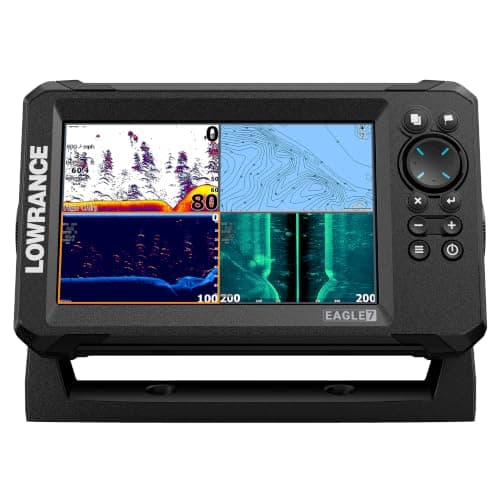
| 1 | Best for catfish Lowrance Eagle 7 with TripleShot HD 7 in with TripleShot HD and preloaded charts for 17,000+ US lakes. | River and reservoir catfishing, finding holes and channels | $599.99 · Check price on Amazon #ad how this is funded · price as of October 12, 2026 |
| 2 | 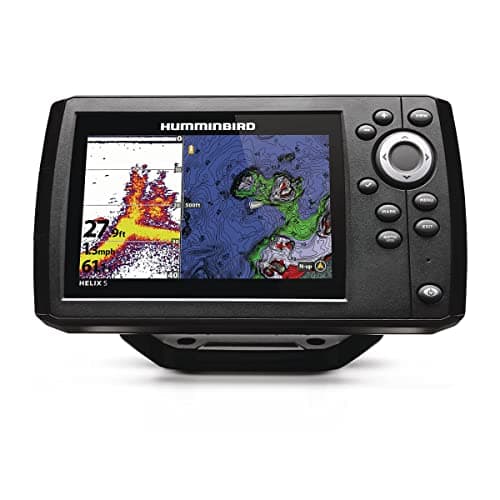 Best value for bottom reading Humminbird HELIX 5 CHIRP GPS G3 5 in CHIRP with GPS — enough to read bottom composition and mark a hole. | Reading bottom hardness and depth on a budget | $349.99 · Check price on Amazon #ad how this is funded · price as of October 12, 2026 |
Why you should stop looking for fish
A catfish lying on the bottom is a return sitting on top of the bottom return. Sonar separates targets by distance, and a fish with no gap beneath it has almost nothing to separate.
Which means the arches our reading page describes are largely unavailable to you. You will see the occasional fish off the bottom, and you will miss most of them.
The productive approach inverts the task: find the place, not the fish. Catfish location is highly predictable from structure, and structure is what sonar reads best.
The four features to look for
1. Holes. A sudden depth increase, especially below a riffle or on a bend. Catfish sit in the deepest part and feed at the edges.
2. Channel edges. In reservoirs, the old river channel still runs along the bottom. Its edge is a highway, and it shows clearly as a depth break on any unit.
3. Submerged timber. Flatheads especially live in wood. Timber shows as hard vertical returns off the bottom, and side coverage finds it faster than down sonar.
4. Hard-to-soft transitions. Where gravel becomes mud. Channel cats patrol these, and bottom-line thickness is how you spot them.
What matters, and what does not
| Spec | Priority | Why |
|---|---|---|
| Mapping and contours | Highest | Holes and channel edges are map features |
| Bottom hardness reading | High | Finds gravel-to-mud transitions |
| GPS waypoints | High | A good hole produces for years |
| Side coverage | Medium | Finds submerged timber quickly |
| Target separation | Low | Bottom-hugging fish barely separate anyway |
| Screen size | Medium-high | Contour maps need legible detail |
The river problem
A great deal of catfishing happens on rivers, and rivers are where mapping coverage is worst. Reservoirs are surveyed; small and medium rivers frequently are not.
On unmapped water the method changes: idle the stretch first with the screen on, watching depth, and mark the holes and breaks yourself before you fish. An hour of that on a new stretch is worth more than a day of guessing.
Current also complicates the install. Everything on our installation page about aerated water applies harder in moving water, and a transducer that reads fine on a lake can scramble in a river.
Anchored fishing, and the transducer that is pointing the wrong way
Catfishing is often static: anchor, cast baits out, wait. Our catfish combos page builds the tackle for exactly that.
Two consequences for sonar. A stationary boat draws flat lines rather than arches, which is normal. And a transom transducer reads the water behind the boat, while your baits are usually out in front or to the side.
So use sonar before you anchor, not after. Read the hole, position the boat against it, then fish. Once the anchor is down the screen has told you everything it is going to.
A portable transducer float is a cheap way to check depth around an anchored boat if you want to keep reading.
So what do I actually buy?
Buy mapping and a screen big enough to read contours. Imaging features and target separation are the two things catfishing needs least.
Lowrance Eagle 7 with TripleShot HD
$599.997 in, TripleShot HD, charts for 17,000+ US lakes. Mapping is the catfish priority.
#ad how this is funded · price as of October 12, 2026
Humminbird HELIX 5 CHIRP GPS G3
$349.995 in CHIRP with GPS — reads bottom hardness and marks a hole for much less.
#ad how this is funded · price as of October 12, 2026
Ugly Stik Catfish Spinning Rod (7' Med-Heavy)
$64.95The rod side of the setup: 7 ft medium-heavy for channel cats.
#ad how this is funded · price as of October 12, 2026
The picks, in full
Every card below lists the specs we could read off a published page, the URL they came from, and one honest reason you might not want it.
1. Best for catfish
Lowrance Eagle 7 with TripleShot HD
Lowrance
7 in with TripleShot HD and preloaded charts for 17,000+ US lakes.
Mapping is the priority for catfish and it is what this unit leads with. Catfish hold in depth changes — the outside of a river bend, a hole below a riffle, the edge of an old channel — and a charted contour map finds those before you have put a transducer over them.
TripleShot HD gives down and side coverage from one transom transducer, which is a useful combination here: side coverage finds submerged timber alongside the boat, and timber is where flathead catfish live.
Seven inches makes contour lines legible, which is the difference between reading a map and squinting at one.
The drawback
Chart coverage is patchy on small rivers and private water, which is precisely where a lot of catfishing happens — check your water is surveyed before buying for the mapping. A transom transducer is also poorly placed for anchored still-fishing, because you end up reading the water behind the boat rather than where the baits are.
Published specs
- Display
- 7 in, 800 x 480, 1000 nits
- Viewing angle
- 80 deg top/bottom, 80 deg left/right
- Transducer
- TripleShot HD
- Sonar
- CHIRP, DownScan Imaging, SideScan
- SideScan range
- Up to 600 ft per side
- Mapping
- C-MAP inland, 17,000+ US lakes
- Dimensions
- 8.89 x 5.5 x 3.48 in
- Power draw
- 550 mA @ 12 V, full backlight
- Operating temp
- 5 to 131 deg F
Specs read from L&M Fleet Supply — Lowrance Eagle 7 with TripleShot HD Transducer.
#ad how this is funded · price as of October 12, 2026
2. Best value for bottom reading
Humminbird HELIX 5 CHIRP GPS G3
Humminbird
5 in CHIRP with GPS — enough to read bottom composition and mark a hole.
For catfish you can drop a long way down the feature list and lose very little. Bottom hardness and depth are the two readings that matter, and plain CHIRP sonar delivers both well.
Hard bottom returns thick and bright; mud returns thin and dim. That single distinction, covered on our screen-reading page, finds the gravel bars and rock transitions channel cats patrol.
GPS lets you mark a hole. A productive catfish hole is productive for years, and marking it is worth more than any imaging feature.
The drawback
No preloaded mapping, so you are building contours by driving them rather than reading a survey — slow on a big reservoir. Five inches also makes depth-change reading harder to see at a glance than a 7 in screen.
Published specs
- Display
- 5 in, 800H x 480V color TFT
- Transducer
- XNT 9 HW T
- Sonar
- Dual Spectrum CHIRP: narrow 180-240, wide 140-200, full 150-220 kHz
- Coverage
- 20, 42 and 60 deg @ -10 dB
- Max depth
- 1,200 ft standard (3,000 ft with optional 50 kHz)
- Power output
- 4,000 W peak-to-peak / 500 W RMS
- Mapping
- Humminbird Basemap, AutoChart Live (8 h)
- Waypoints
- 2,750 waypoints / 45 routes / 50 tracks
- Dimensions
- 7.55 W x 4.64 H x 3.3 D in (gimbal)
- Power draw
- 615 mA
Specs read from Rogers Sporting Goods — Humminbird HELIX 5 CHIRP GPS G3.
#ad how this is funded · price as of October 12, 2026
Questions people actually ask
What should you look for on sonar when catfishing?
Structure, not fish. Holes, channel edges, submerged timber and hard-to-soft bottom transitions. A catfish lying on the bottom barely separates from the bottom return, so the place is findable and the fish often is not.
Do you need mapping for catfish?
It is the highest-value feature, because holes and channel edges are map features. The caveat is that small and medium rivers — where a lot of catfishing happens — are frequently unsurveyed, so check your water before paying for charts.
Why does my fish finder show flat lines when catfishing?
Because the boat is anchored. Sonar builds a picture over time as the transducer moves, so a stationary boat produces flat horizontal lines rather than arches. It is not a fault — use sonar before you anchor.
Is side imaging useful for catfish?
Moderately. It finds submerged timber alongside the boat faster than down sonar, and timber is where flatheads live. For channel cats on gravel and channel edges, mapping and bottom hardness matter more.
Prices on this page come from the retailer at request time and change without notice. If we cannot get a live one we say “check price” rather than show you a number that has gone stale. How we pick.