Picks
The best spinning reels for a first real setup
Four spinning reels ranked on published line capacity and retrieve rate — the two numbers that actually differ between them.
Best overall
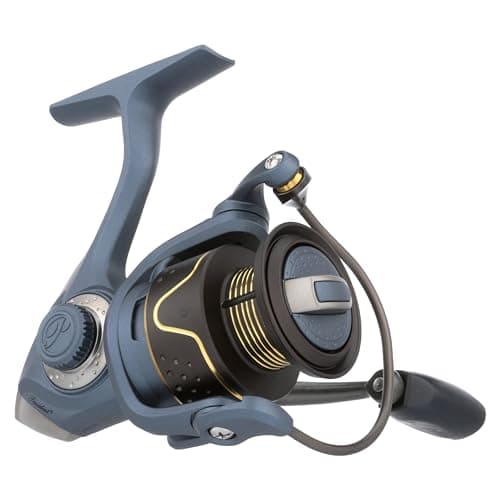
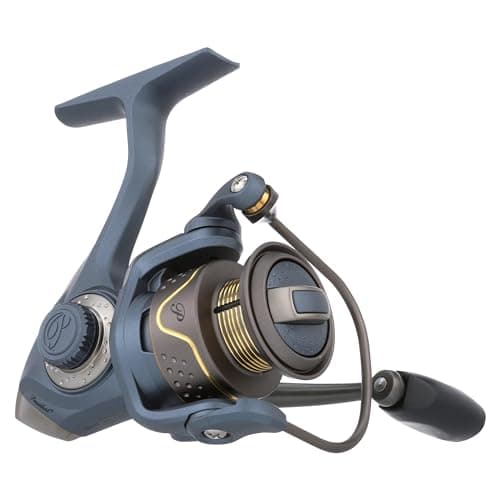
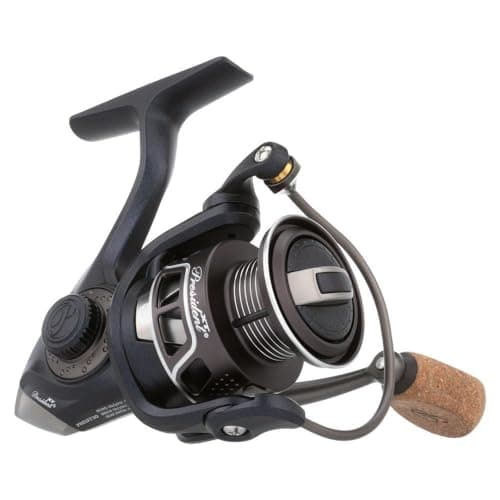
Check pricePflueger President Spinning Reel (30X)

Reel & Rig
A 2500 and a 3000 are not two sizes of the same thing. Here is what actually changes, in yards and inches per turn.
The reel is where your money does the most work. A rod either fits your fishing or it does not; a reel is a machine with a drag, and a rough drag is a thing you feel on every single fish. If you are splitting a budget between the two, put more into the reel.
Start with the size number, because it is the most confusing thing in the category. There is no standard. Pflueger sells a 25, 30, 35 and 40. Shimano and Daiwa use 1000, 2500, 3000, 4000. Abu Garcia uses both conventions across different lines. The numbers are not interchangeable and the makers are not trying to help you.
The fix is to ignore the number and read the published line capacity. A Pflueger President 30X holds 145 yards of 6 lb and 130 yards of 8 lb. A Daiwa BG2500 holds 210 yards of 6 lb and 170 yards of 8 lb. Those are both “mid-size” reels and one holds roughly 40% more line than the other. That number is the comparison; the badge is not.
Second number worth knowing: inches per turn. It tells you how much line one full crank recovers, and it lets you compare reels across gear ratios honestly. A 5.2:1 President 30X recovers 25.3 inches. A 5.6:1 Daiwa BG2500 recovers 33.2 inches, because the spool is bigger. The BG has the lower-sounding advantage on paper and the much faster retrieve in practice.
Each of these carries live prices, a published-spec table for every pick, and at least one thing we would skip.
Reel & Rig earns a commission from qualifying purchases made through links on this page, at no extra cost to you. It does not change which gear we pick or what we say about it. Full disclosure.

Picks
Four spinning reels ranked on published line capacity and retrieve rate — the two numbers that actually differ between them.
Best overall
Check pricePflueger President Spinning Reel (30X)

Guide
Why reel size numbers are not comparable across brands, and the one published spec that is.
Read the guide →
Head to head
The honest comparison: what each reel type is genuinely better at, and why spinning is still the right first purchase.
Read the guide →
Picks
What to look for in a first baitcaster — magnetic braking and a published drag figure — and the one we would start with.
Best first baitcaster
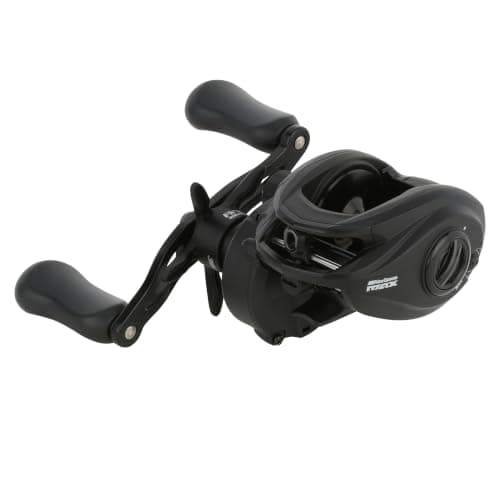
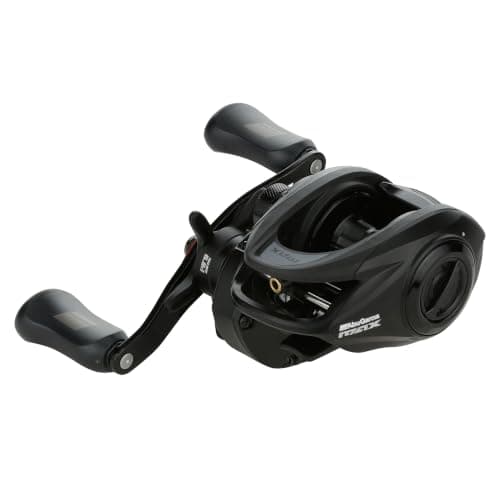
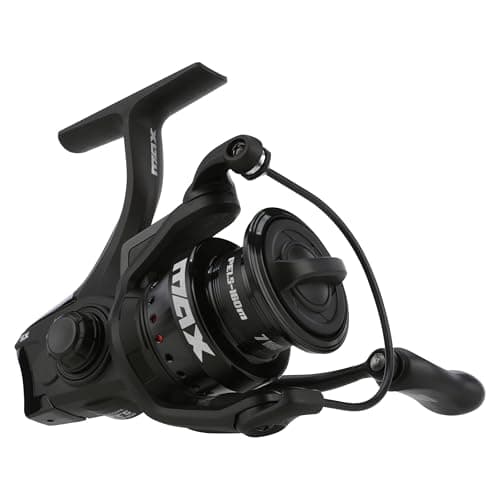
Check priceAbu Garcia Max5 X Casting Reel

Picks
Three spinning reels that sit under $100, compared on the specs that differ rather than on price alone.
Best overall under $100
Check pricePflueger President Spinning Reel (30X)

Head to head
The push-button reel against open-face spinning: what each does well, and why one of them is a dead end.
Read the guide →
Guide
The 25% rule, how to check it by hand without a scale, and why erring loose beats erring tight.
Read the guide →
Guide
What gear ratio means, why it is a trade rather than a score, and the published figure that beats it.
Read the guide →For a general freshwater setup, you want roughly 130–200 yards of your chosen line on the spool. In practice that means a 2500/30 for 6–10 lb line and light to medium lures, and a 3000/35 for 8–12 lb and slightly heavier work. Go to a 1000 or a 25 only for genuinely light panfish and trout fishing with 4 lb line. Go above a 4000 only for catfish and pike.
A higher gear ratio recovers line faster and gives up cranking power. Nothing about a higher number is inherently better. A 5.2:1 spinning reel is well suited to a beginner precisely because it is harder to fish a moving bait too fast with it, which is the single most common mistake with a new crankbait.
Baitcasters run faster as a rule — an Abu Garcia Max5 X is 6.8:1 and picks up 28 inches a turn. That is genuinely useful when you are burning a squarebill back to the boat, and it is one of the honest reasons to own one.
Bearing counts are marketing. A ten-bearing reel is not twice as good as a five-bearing one; it depends entirely on where the bearings are and what quality they are. The Pflueger President runs ten stainless bearings plus a roller. The Abu Garcia Max SX runs six plus a roller. Both are perfectly good reels, and the gap between them is not five bearings wide.
The bearing that genuinely matters is the one in the line roller, because that is where line twist is born. If a maker lists a roller bearing separately — the “+1 RB” in specs like “6BB + 1RB” — that is the one doing real work.
Drag is the reel’s job. Many makers do not publish a maximum drag figure at all, which is worth noticing — Tackle Warehouse’s spec tables for both the Pflueger President and the Abu Garcia Max SX omit it entirely. Where it is published, freshwater rarely needs more than about 10 lb, and you will fish well below the maximum anyway.
Body material is a weight-versus-rigidity trade. Graphite bodies are lighter and cheaper and flex slightly under heavy load. Aluminum bodies are stiffer and heavier. Daiwa’s BG uses what it calls a Hard Bodyz body and side cover specifically to keep the internals in alignment under load, and it weighs 9.3 oz at the 2500 size against the President’s 8.8 oz at a comparable size. That is the trade, in ounces.
If you can handle a reel before buying, do one thing: pull line off against a mid-set drag. It should pay out smoothly, not in jerks. That single test tells you more than any spec on this page.
Mostly spool capacity and a small amount of body size and weight. A 3000 typically holds around 30 to 50 more yards of the same line and recovers a couple more inches per crank because the spool is wider. For most freshwater fishing either works; pick a 2500 for 6 to 10 lb line and a 3000 for 8 to 12 lb.
Far fewer than the box implies. Placement and quality matter more than count, and the single most important one is the line roller bearing, usually listed separately as '+1RB'. A well-made six-bearing reel routinely outperforms a poorly made ten-bearing one.
Spinning. A baitcaster backlashes when the spool outruns the line leaving it, which happens on mistimed casts and in wind, and that is genuinely discouraging early on. Baitcasters are better for heavy line, heavy lures and casting accuracy — add one once your casting is confident.
A 2500 to 3000 size (or a 30 to 35 on the Pflueger scale) covers nearly all freshwater bass fishing. That gives you room for roughly 130 to 200 yards of 8 to 12 lb line, which is the working range for soft plastics, squarebills and spinnerbaits.
Five complete builds. Each one is a rod, reel, line and starter lure selection chosen to work together for one species or one budget.
Beginner, bass, spinning, baitcasting and under-$100 combos, compared on the specs the makers publish rather than on the box copy.
Beginner rod picks plus the guides that make the spec sheet readable — power and action, graphite against fiberglass, and what a rod does that a pole does not.