Picks
The best fish finders for freshwater
Five fish finders ranked on published sonar coverage, depth, mapping and power draw — with the source for every figure.

Reel & Rig
The screen size argument is a distraction. On a small boat, where the transducer goes decides more than anything on the spec sheet.
Fish finder pages almost always rank units by price and screen size. That ordering is nearly useless, because the constraint on a small freshwater boat is rarely the display — it is where you can physically mount a transducer, how much 12-volt power you can carry, and whether the unit’s beam angles suit water that is fifteen feet deep rather than a hundred and fifty.
So this section is organized by what you fish from. A kayak, a jon boat, a 14-foot aluminum boat and a bank all impose different constraints, and the right unit changes accordingly.
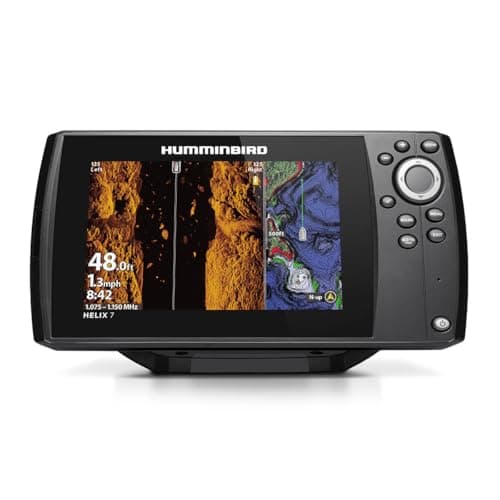
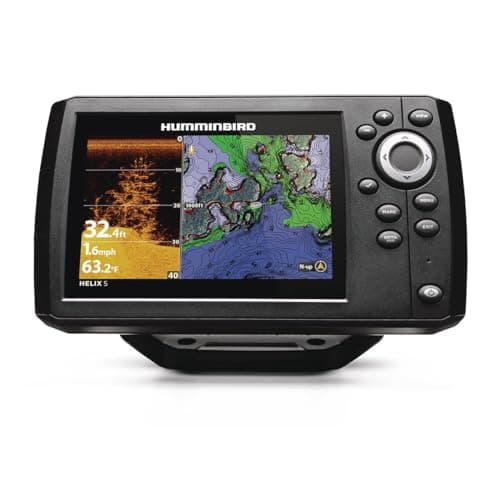
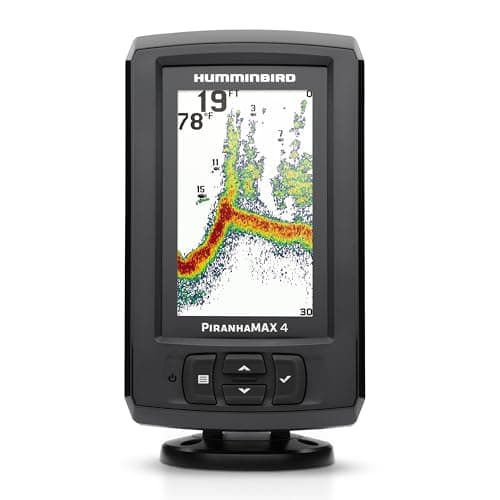
Two numbers do most of the work. Frequency sets the trade between depth and detail: lower frequencies (around 50–83 kHz) reach deeper and show a wider, blurrier cone; higher frequencies (200 kHz and up) show sharper detail over a narrower area. Coverage angle is how wide that cone is. A Humminbird HELIX 5 lists 20, 42 and 60 degrees at −10 dB; a PiranhaMAX 4 lists 28 and 16 degrees. In twelve feet of water, a 60-degree cone sees a circle roughly fourteen feet across, and a 16-degree cone sees about three. That difference is the whole game in shallow water, and it is not on the front of the box.
Depth ratings, meanwhile, are the most-quoted and least-relevant spec in freshwater. A unit rated to 1,900 feet and one rated to 600 feet perform identically on a lake that is thirty feet deep. Do not pay for depth you will never use.
Each of these carries live prices, a published-spec table for every pick, and at least one thing we would skip.
Reel & Rig earns a commission from qualifying purchases made through links on this page, at no extra cost to you. It does not change which gear we pick or what we say about it. Full disclosure.

Picks
Five fish finders ranked on published sonar coverage, depth, mapping and power draw — with the source for every figure.

Picks
Three first fish finders compared on the four things a beginner actually needs a screen to do.
Best first unit
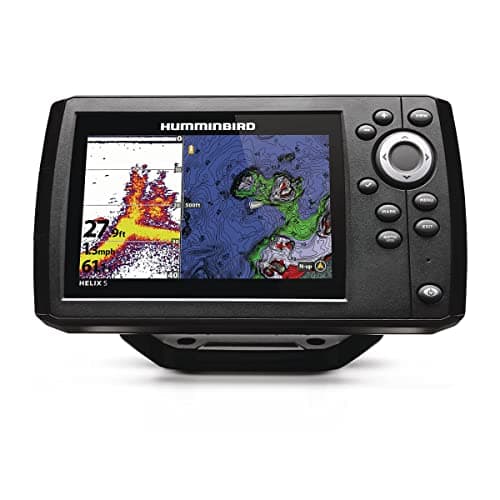
Check priceHumminbird HELIX 5 CHIRP GPS G3

Guide
A routing guide: what changes between a kayak, a jon boat, an aluminum boat and the bank, and which page to read next.
Read the guide →
Picks
Fish finders for a kayak, chosen on published power draw and physical footprint rather than screen size.
Best overall for a kayak
Check priceHumminbird HELIX 5 CHIRP GPS G3

Picks
Fish finders for a jon boat, with the transducer placement rule that flat-bottom hulls make trickier than they look.

Picks
Fish finders for a 14-16 ft aluminum boat — the size where screen and mapping matter more than power draw.
Best overall
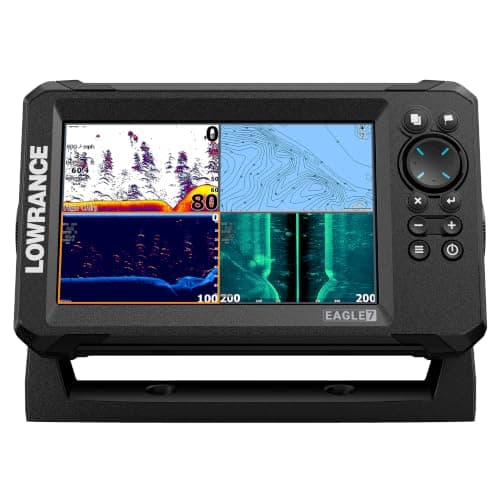
Check priceLowrance Eagle 7 with TripleShot HD

Guide
Why boat fish finders do not work from the bank, what castable sonar actually does, and why we are not recommending one yet.
Read the guide →
Guide
What 2D CHIRP, down imaging and side imaging each do, with the published frequencies and the beam-width arithmetic.
Read the guide →
Guide
Pre-loaded charts against draw-your-own mapping, with the published lake counts and which suits which angler.
Read the guide →
Head to head
The STRIKER and ECHOMAP lines are built around different jobs. Which one you need, and why it is usually the cheaper one.
Read the guide →
Head to head
The three big fish finder brands compared on published mapping, imaging reach and spec transparency.
Read the guide →
Picks
Three fish finders in the sub-$300 band, and the honest account of what that budget does and does not buy.
Best overall under $300
Check priceHumminbird HELIX 5 CHIRP GPS G3

Guide
Why sonar matters more on ice than anywhere else, what a flasher does that a graph does not, and what crosses over.
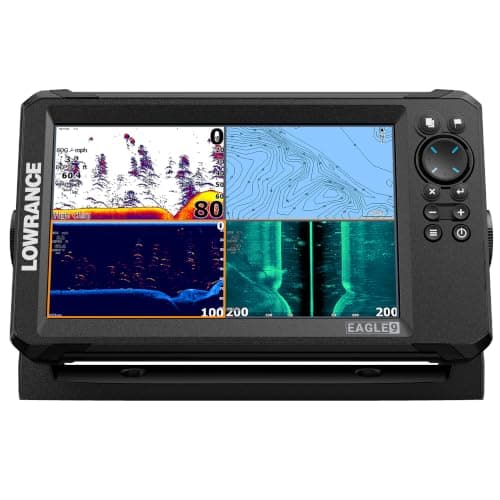
Read the guide →On a boat with a cranking battery this never comes up. On a kayak or a small jon boat running a sealed lead-acid or lithium pack, it decides everything. A Humminbird HELIX 5 draws 615 mA. A Lowrance Eagle 7 draws 550 mA at full backlight, and an Eagle 9 draws 640 mA.
Those are small numbers, and that is the point: a 7 amp-hour battery runs any of them for a full day with margin. The specification to actually check is the input voltage range — most of these want 10.8–20 VDC, so a 12-volt pack is fine and a 9-volt improvisation is not.
Traditional 2D sonar shows you a cone beneath the boat and is what you read for depth, bottom hardness and fish arches. Down imaging runs at a much higher frequency — 455 kHz on a HELIX 5 DI, in a 420–520 kHz band — and trades depth for a near-photographic picture of what is directly below. That HELIX 5 DI reads to 1,200 feet on traditional sonar and 350 feet on down imaging, which is exactly the trade described above.
Side imaging is a different proposition again. It looks sideways, and on a HELIX 7 MEGA SI it reaches 250 feet per side; a Lowrance TripleShot HD claims up to 600 feet per side. It is a searching tool for covering water, and it is genuinely transformative on a big flat — and largely wasted in a 40-foot-wide creek arm.
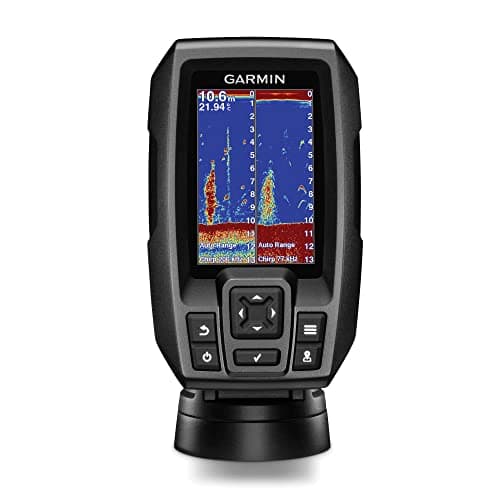
A unit with built-in charts is worth real money if you fish varied water and nothing at all if you fish one pond. Lowrance’s Eagle line ships with C-MAP inland charts covering more than 17,000 US lakes. Humminbird ships its own Basemap, and the HELIX 7 G4’s version covers more than 10,000 lakes. Garmin’s STRIKER Vivid instead gives you Quickdraw Contours, which draws your own one-foot contour map as you drive.
Those are genuinely different philosophies: buy a map, or make one. If your home lake is already charted, the pre-loaded map wins. If it is a small local water nobody has surveyed, Quickdraw is the better answer and it is free with the unit.
We have not mounted or run any of these units. Every figure on these pages was read off a published manufacturer or retailer specification page, and the URL is on the page. Several things that matter a great deal — how a screen reads in direct sun, how well the menus are organized, how the unit behaves at speed — are not in any spec table and we do not pretend to know them.
A 4 to 5 inch unit with a single transom-mount transducer and built-in GPS. That gives you depth, bottom detail, water temperature and the ability to mark a spot and come back to it, which is the entire useful feature set until you have spent a season reading a screen.
Not on a first unit. Traditional 2D sonar tells you depth, bottom hardness and whether fish are there. Down imaging adds a sharper picture directly beneath you; side imaging is a water-covering tool that pays off on big flats and does almost nothing in a narrow creek arm.
Far less than the box advertises. A typical inland lake is under 60 feet, and a unit rated to 600 feet handles that with enormous margin. Depth rating is one of the least useful specs to shop on in freshwater.
A conventional transom-mount unit will not, because the transducer has to be in the water and moving with the boat. Castable sonar units exist for exactly this, and they are a genuinely different product category with different trade-offs — we cover the shore case on its own page rather than pretending a boat unit fits it.
Five complete builds. Each one is a rod, reel, line and starter lure selection chosen to work together for one species or one budget.
Beginner, bass, spinning, baitcasting and under-$100 combos, compared on the specs the makers publish rather than on the box copy.
Beginner rod picks plus the guides that make the spec sheet readable — power and action, graphite against fiberglass, and what a rod does that a pole does not.