Electronics
The best fish finder for a pontoon boat
Two aluminum tubes and a flat deck. The sonar problem is entirely about where the bubbles are.
By Sawyer V. · Last updated · How we pick
The short answer
A pontoon does not have a conventional transom, and the two tubes throw turbulence down both sides. Mount the transducer on the inside face of a tube, well forward of the motor, or use a clamp-on arm off the deck. Pontoons fish calm, shallow-to-moderate water, so a 5 to 7 in unit with good down sonar is plenty.
Reel & Rig earns a commission from qualifying purchases made through links on this page, at no extra cost to you. It does not change which gear we pick or what we say about it. Full disclosure.
Quick picks
| # | Product | Best for | Price |
|---|---|---|---|
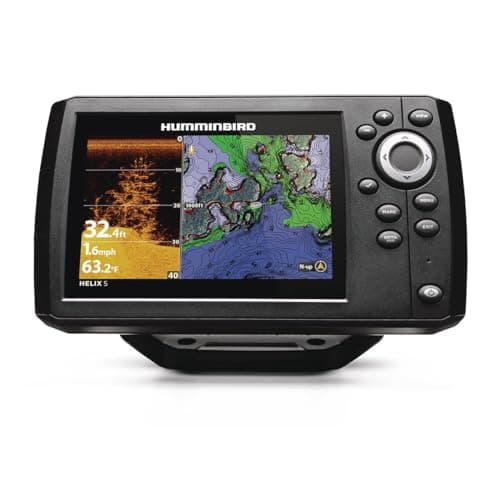
| 1 | Best for a pontoon Humminbird HELIX 5 CHIRP DI GPS G3 A 5 in CHIRP unit with down imaging and GPS, on a single transom-style transducer. | Calm-water pontoon fishing with a simple install | $375.66 · Check price on Amazon #ad how this is funded · price as of October 12, 2026 |
| 2 | 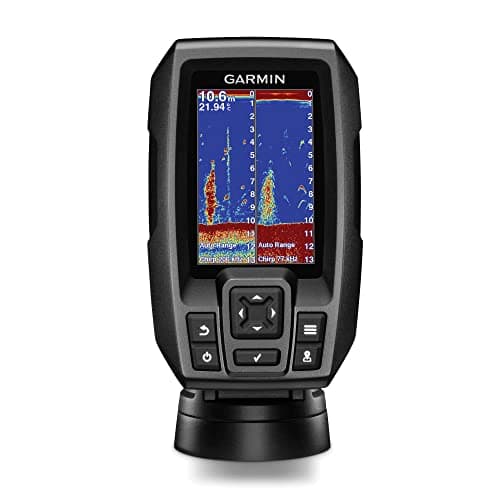 Simplest pontoon install Garmin STRIKER 4 A compact CHIRP unit with basic GPS, small enough to move between boats. | A rented or shared pontoon, or a first unit | $139.99 · Check price on Amazon #ad how this is funded · price as of October 12, 2026 |
The pontoon problem: no transom, two tubes
A conventional transducer mount assumes a flat transom sitting in undisturbed water. A pontoon has neither.
The two tubes each push water outward and generate a turbulent wake down their inner and outer faces. The motor sits between or behind them, adding prop wash. Almost any obvious mounting point is in disturbed water.
As our installation page explains, a transducer in aerated water scatters sound and returns nothing usable. On a pontoon that is the entire difficulty — the unit is easy, the placement is not.
Three placements that work
1. Inside face of a tube, well forward. The most common permanent solution. Mount on the inner face of one tube, as far forward of the motor as the mount allows, with the face parallel to the water. Forward of the motor means forward of the prop wash.
2. A clamp-on arm off the deck rail. An adjustable arm that drops the transducer into clean water outboard of the tube. No drilling, removable, and easy to reposition until the screen stays solid. The right answer on a boat you do not own.
3. A portable suction or over-the-side mount. Least permanent, most fiddly, and fine for occasional use.
Whichever you choose, test before you drill: clamp it, run the boat at the speeds you actually use, and check the bottom line stays solid.
What pontoon fishing actually needs
| Spec | Priority | Why |
|---|---|---|
| Down sonar or down imaging | High | You fish slowly over structure, not at speed |
| Screen size | Medium | A flat deck lets you mount at a comfortable distance |
| Deep-water rating | Low | Pontoons fish calm, moderate-depth water |
| Removability | High if shared | Pontoons are often family or rental boats |
| Side imaging | Low | Hard to place well on a pontoon, and rarely needed |
The advantage nobody mentions
A pontoon has an enormous flat deck and no console constraint, which means you can mount the screen exactly where you want it and at the height you want it. That is a real ergonomic advantage over both a bass boat and a jon boat.
Pontoons are also stable enough to read a screen and fish at the same time in conditions that would have you holding on in a smaller hull.
Power
Most pontoons have a starting battery, and running a fish finder from it directly with the inline fuse is fine. Follow the same rule as anywhere else: to the battery, not to a shared accessory panel, or trolling motor noise bands the screen.
On a boat where you cannot get to the battery easily, a small sealed 12 V pack in a box is the simpler answer, and our battery guide sizes it.
A clamp-on transducer arm is the accessory that makes a pontoon install straightforward.
So what do I actually buy?
Pick the unit for the water and the mount for the boat. On a pontoon the mount is the decision that determines whether it works at all.
Humminbird HELIX 5 CHIRP DI GPS G3
$375.665 in CHIRP with down imaging and GPS — the right sonar for slow structure fishing.
#ad how this is funded · price as of October 12, 2026
Garmin STRIKER 4
$139.99Compact and quick to remove, for a shared or rented pontoon.
#ad how this is funded · price as of October 12, 2026
Lowrance Eagle 7 with TripleShot HD
$599.99A larger screen with preloaded charts if the pontoon is yours and stays rigged.
#ad how this is funded · price as of October 12, 2026
The picks, in full
Every card below lists the specs we could read off a published page, the URL they came from, and one honest reason you might not want it.
1. Best for a pontoon
Humminbird HELIX 5 CHIRP DI GPS G3
Humminbird
A 5 in CHIRP unit with down imaging and GPS, on a single transom-style transducer.
Down imaging is the right sonar priority on a pontoon. You are typically anchored or drifting slowly over structure rather than covering water at speed, and down imaging gives a clearer picture of what is directly beneath than plain sonar does.
Five inches is enough here because a pontoon lets you mount the unit wherever you like on a flat deck — you can put it at comfortable reading distance instead of wherever a console allows.
CHIRP and GPS are published, so you get depth, structure and waypoints from one box with one transducer to place.
The drawback
Down imaging is narrow, which is the trade for the detail — it tells you very little about what is out to the sides, and on a big flat that means covering water slowly. Humminbird also does not publish current draw, so a pontoon without a fitted battery needs one sized with margin rather than calculated.
Published specs
- Display
- 5 in widescreen, 800H x 480V, 16-bit color
- Transducer
- XNT 9 HW DI T
- Sonar
- Dual Spectrum CHIRP 83/200 kHz (75-155 / 130-250 kHz)
- Down Imaging
- 455 kHz (420-520 kHz)
- Coverage
- 20, 42 and 60 deg @ -10 dB
- Max depth
- 1,200 ft sonar / 350 ft Down Imaging
- Power output
- 4,000 W peak-to-peak / 500 W RMS
- Mapping
- Built-in GPS, AutoChart Live (8 h), LakeMaster/Navionics ready
- Dimensions
- 7.55 W x 4.64 H x 3.3 D in (gimbal)
Specs read from L&M Fleet Supply — Humminbird HELIX 5 CHIRP DI GPS G3.
#ad how this is funded · price as of October 12, 2026
2. Simplest pontoon install
Garmin STRIKER 4
Garmin
A compact CHIRP unit with basic GPS, small enough to move between boats.
On a pontoon you often do not own the boat, or you share it. A small unit that mounts and unmounts quickly, running off a portable battery, is a genuinely better answer than a permanent installation.
The published sonar is enough for what pontoons do: depth, bottom hardness and fish arches in the shallow-to-moderate water pontoons fish comfortably.
It is also the unit to pair with a clamp-on transducer arm, because the whole assembly can come off the boat in two minutes.
The drawback
The screen is small and the mapping is basic — no preloaded charts, so you are marking waypoints rather than reading a surveyed lake. Garmin does not publish current draw on this unit either, which our battery guide notes forces buying with margin.
Published specs
- Display
- 3.5 in color
- Transducer
- Dual-beam CHIRP, 77/200 kHz, transom + trolling motor mounts
- Transmit power
- 200 W RMS / 1,600 W peak-to-peak
- GPS
- Built-in high-sensitivity, waypoint map
- Extras
- Built-in flasher, sonar history rewind, speed
Specs read from Fish307 — Garmin STRIKER 4 FishFinder with 77/200 kHz transducer.
#ad how this is funded · price as of October 12, 2026
Questions people actually ask
Where do you mount a transducer on a pontoon boat?
On the inside face of one tube, as far forward of the motor as possible, or on a clamp-on arm off the deck rail that drops it into clean water. The tubes and prop both throw turbulence, so most obvious spots are in aerated water.
Do you need side imaging on a pontoon?
Rarely. Side imaging is hard to place well on a pontoon and pontoons fish slowly over structure rather than scanning banks. Down sonar or down imaging is the better priority.
Can you use a portable fish finder on a pontoon?
Yes, and it is often the best answer — pontoons are frequently family or rental boats. A compact unit on a clamp-on arm with a small sealed battery comes off in two minutes and needs no drilling.
What size screen for a pontoon fish finder?
5 to 7 inches is plenty. A pontoon's flat deck lets you mount the screen at a comfortable reading distance rather than wherever a console allows, so you need less screen than on a bass boat bow.
Read next
Prices on this page come from the retailer at request time and change without notice. If we cannot get a live one we say “check price” rather than show you a number that has gone stale. How we pick.