Electronics
The best fish finder for a jon boat
A jon boat gives you a proper transom and takes away a place to put a battery. Both change the answer.
By Sawyer V. · Last updated · How we pick
The short answer
A jon boat has a real transom, so a standard transom-mount transducer is straightforward — with one catch. A flat-bottom hull pushes water in a way that sheds bubbles under the transom, so the transducer must sit slightly below the hull bottom and away from rivets. Otherwise the screen scrambles the moment you get on plane.
Reel & Rig earns a commission from qualifying purchases made through links on this page, at no extra cost to you. It does not change which gear we pick or what we say about it. Full disclosure.
Quick picks
| # | Product | Best for | Price |
|---|---|---|---|
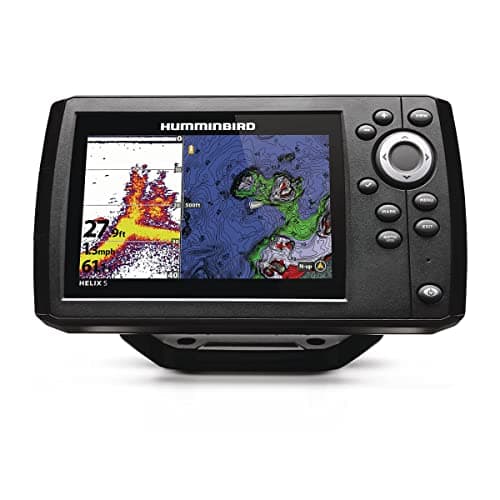
| 1 | Best overall Humminbird HELIX 5 CHIRP GPS G3 A 60-degree wide cone and 500 W RMS on a 5-inch screen — sized for exactly the water this hull can reach. | The shallow water jon boats live in | $341.56 · Check price on Amazon #ad how this is funded · price as of October 19, 2026 |
| 2 | 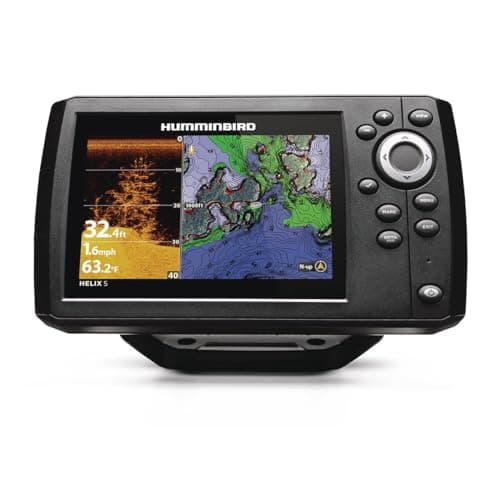 Best for timber and brush Humminbird HELIX 5 CHIRP DI GPS G3 Adds 455 kHz down imaging, which turns a fuzzy mound on the screen into recognizable branches. | Reading the stumps you are fishing around | $375.66 · Check price on Amazon #ad how this is funded · price as of October 19, 2026 |
| 3 | 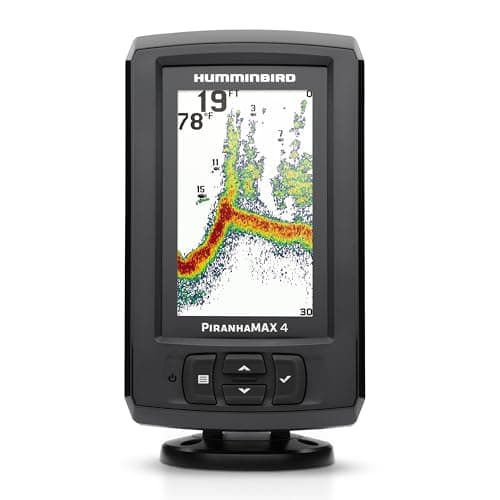 Cheapest that still works Humminbird PiranhaMAX 4 Depth, bottom and fish for a fraction of the price, on a footprint that fits a small console. | A jon boat used a few times a year | $135.02 · Check price on Amazon #ad how this is funded · price as of October 19, 2026 |
Transducer placement on a flat-bottom hull
The good news is you have a transom, so the standard bracket works. The complication is that a flat-bottom aluminum hull is unusually good at generating bubbles and pushing them straight back under the transom.
Bubbles under the transducer face reflect sound. The screen fills with noise or goes blank entirely the moment you get on plane, and almost everyone blames the unit.
Three rules that fix it:
- Mount the transducer face slightly below the hull bottom — roughly an eighth of an inch proud. Level with the hull is not enough.
- Stay away from rivets, strakes and welds. Every one of them sheds a stream of turbulence directly astern. On a riveted jon boat, find a smooth run of hull.
- Mount on the opposite side from the prop. Prop wash is the largest bubble source on the boat.
Getting this right is worth more than the difference between any two units on this page.
Power on a boat that may not have a battery
Plenty of jon boats run a tiller outboard with a pull start and no electrical system at all. If that is yours, you are powering the unit the same way a kayak does: a small sealed 12 V battery.
At a published 615 mA, a HELIX 5 runs about eleven hours on a 7 Ah pack. All these units want 10.8–20 VDC, so a 12 V battery is comfortably in range.
If the boat does have a starting battery, run the fish finder off it with an inline fuse — Humminbird specifies a fuse on the power lead and it is not optional. A screen that shorts and takes out your starting battery is a long paddle home.
Screen size against a wet, bright environment
A jon boat has no windshield, no shade and usually no console. The screen sits in direct sun and gets rained on and splashed.
Brightness is the spec that decides sun readability, and it is published far less often than it should be — of the units in this hub, only the Lowrance Eagle line publishes a figure (1,000 nits). For the Humminbirds we simply do not know, and we are not going to guess.
What we can say is that the tilt-and-swivel mount on the PiranhaMAX 4 is a genuine practical advantage in this environment: being able to angle the screen away from the sun solves the problem mechanically rather than optically.
What we would skip
Side imaging, for the same reason as on a kayak but less absolutely. A jon boat can hold a straight track at a steady speed, so side imaging does work. But the water jon boats reach — narrow creeks, flooded timber, backwater sloughs — is exactly where a 600-foot-per-side sweep is mostly imaging the bank.
The picks, in full
Every card below lists the specs we could read off a published page, the URL they came from, and one honest reason you might not want it.
1. Best overall
Humminbird HELIX 5 CHIRP GPS G3
Humminbird
A 60-degree wide cone and 500 W RMS on a 5-inch screen — sized for exactly the water this hull can reach.
Jon boats go where bigger boats cannot: shallow backwaters, flooded timber, small creeks. That water is often under ten feet deep, and a wide cone is what makes shallow sonar useful. The published 60-degree wide mode covers roughly an 11.5-foot circle in ten feet of water.
Dual Spectrum CHIRP with published narrow, wide and full bands lets you tighten the cone when you want detail and widen it when you want coverage, which is a real control rather than a marketing feature.
4,000 W peak-to-peak, 500 W RMS, 1,200 ft, 615 mA draw, 2,750 waypoints, and Basemap with AutoChart Live.
The drawback
No down imaging, so flooded timber stays an interpretation rather than a picture. On a jon boat working brush and stumps, that is exactly the situation where down imaging would help most.
Published specs
- Display
- 5 in, 800H x 480V color TFT
- Transducer
- XNT 9 HW T
- Sonar
- Dual Spectrum CHIRP: narrow 180-240, wide 140-200, full 150-220 kHz
- Coverage
- 20, 42 and 60 deg @ -10 dB
- Max depth
- 1,200 ft standard (3,000 ft with optional 50 kHz)
- Power output
- 4,000 W peak-to-peak / 500 W RMS
- Mapping
- Humminbird Basemap, AutoChart Live (8 h)
- Waypoints
- 2,750 waypoints / 45 routes / 50 tracks
- Dimensions
- 7.55 W x 4.64 H x 3.3 D in (gimbal)
- Power draw
- 615 mA
Specs read from Rogers Sporting Goods — Humminbird HELIX 5 CHIRP GPS G3.
#ad how this is funded · price as of October 19, 2026
2. Best for timber and brush
Humminbird HELIX 5 CHIRP DI GPS G3
Humminbird
Adds 455 kHz down imaging, which turns a fuzzy mound on the screen into recognizable branches.
Jon boats spend their lives around wood — laydowns, stumps, standing timber — and telling a stump from a brush pile from a fish holding tight to one is genuinely hard on 2D sonar.
Down imaging at a published 455 kHz (420–520 kHz band) resolves that. The trade is depth: 350 ft on down imaging against 1,200 ft on 2D, which in freshwater is irrelevant.
Same 5-inch 800 × 480 16-bit color display, same Dual Spectrum CHIRP at 83/200 kHz, same 20/42/60-degree coverage, same 4,000 W and 500 W RMS. The transducer is an XNT 9 HW DI T.
The drawback
You are now looking at two sonar views and learning to read both, which is more menu time and more interpretation on your first few trips. The simpler unit above genuinely gets you fishing faster.
Published specs
- Display
- 5 in widescreen, 800H x 480V, 16-bit color
- Transducer
- XNT 9 HW DI T
- Sonar
- Dual Spectrum CHIRP 83/200 kHz (75-155 / 130-250 kHz)
- Down Imaging
- 455 kHz (420-520 kHz)
- Coverage
- 20, 42 and 60 deg @ -10 dB
- Max depth
- 1,200 ft sonar / 350 ft Down Imaging
- Power output
- 4,000 W peak-to-peak / 500 W RMS
- Mapping
- Built-in GPS, AutoChart Live (8 h), LakeMaster/Navionics ready
- Dimensions
- 7.55 W x 4.64 H x 3.3 D in (gimbal)
Specs read from L&M Fleet Supply — Humminbird HELIX 5 CHIRP DI GPS G3.
#ad how this is funded · price as of October 19, 2026
3. Cheapest that still works
Humminbird PiranhaMAX 4
Humminbird
Depth, bottom and fish for a fraction of the price, on a footprint that fits a small console.
If the boat comes out a handful of times a season, this covers the useful basics. Dual beam at 200/455 kHz with 28 and 16-degree cones, reading to 600 ft and 320 ft, 2,400 W peak-to-peak and 300 W RMS.
The 4.3-inch 272 × 480 display and 3.91 × 7.34 × 3.62 in gimbal fit on the small flat surfaces a jon boat actually has, and the tilt-and-swivel mount handles the fact that you are usually sitting rather than standing.
The drawback
The 28-degree cone sees about a 5-foot circle in 10 feet of water, and in the shallow water a jon boat fishes that is genuinely limiting. No GPS either, so no waypoints — and a jon boat is exactly the platform where re-finding a stump matters.
Published specs
- Display
- 4.3 in, 272H x 480V, 256-color TFT
- Transducer
- XNT 9 28 T, transom mount
- Sonar
- Dual Beam, 200/455 kHz
- Coverage
- 28 deg and 16 deg @ -10 dB
- Max depth
- 600 ft @ 200 kHz / 320 ft @ 455 kHz
- Power output
- 2,400 W peak-to-peak / 300 W RMS
- Dimensions
- 3.91 W x 7.34 H x 3.62 D in (gimbal)
- Input
- 10.8-20 VDC
Specs read from L&M Fleet Supply — Humminbird PiranhaMAX 4.
#ad how this is funded · price as of October 19, 2026
Questions people actually ask
What is the best fish finder for a jon boat?
A 5-inch unit with a wide beam option and built-in GPS. Jon boats fish shallow water where cone width matters more than anything else — a 60-degree cone covers roughly 11.5 feet in ten feet of water against about 5 feet for a 28-degree beam.
Where do you mount a transducer on a jon boat?
On the transom, slightly below the hull bottom, away from rivets and strakes, and on the opposite side from the prop. A flat-bottom hull sheds bubbles straight back under the transom, and bubbles under the transducer scramble the screen at speed.
Why does my fish finder stop working when I speed up?
Turbulent water and bubbles passing under the transducer, almost always. Mount the transducer face about an eighth of an inch below the hull bottom and away from any rivet or weld that sheds turbulence astern.
Can I run a fish finder on a jon boat with no electrical system?
Yes. A small sealed 12 V battery is all these units need — they want 10.8 to 20 VDC, and at around 615 mA a 7 Ah pack runs one for roughly eleven hours. Fit an inline fuse on the power lead.
Read next
Sources
Prices on this page come from the retailer at request time and change without notice. If we cannot get a live one we say “check price” rather than show you a number that has gone stale. How we pick.