Electronics
The best fish finder for a kayak
On a kayak the limiting factors are amp-hours and where the transducer can physically go. Screen size barely enters into it.
By Sawyer V. · Last updated · How we pick
The short answer
On a kayak, pick on power draw and footprint, not screen size. A 7 Ah battery running a 615 mA unit lasts roughly eleven hours, which covers any realistic day. The harder problem is the transducer: a kayak has no transom, so it goes inside the hull, through a scupper, or on an arm over the side.
Reel & Rig earns a commission from qualifying purchases made through links on this page, at no extra cost to you. It does not change which gear we pick or what we say about it. Full disclosure.
Quick picks
| # | Product | Best for | Price |
|---|---|---|---|
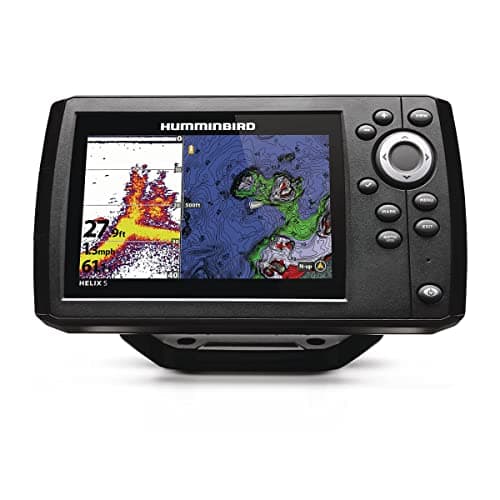
| 1 | Best overall for a kayak Humminbird HELIX 5 CHIRP GPS G3 615 mA draw, a 7.55 x 4.64 in gimbal footprint, and a 60-degree wide cone for the shallow water kayaks fish. | A full day on a small battery | $341.56 · Check price on Amazon #ad how this is funded · price as of October 19, 2026 |
| 2 | 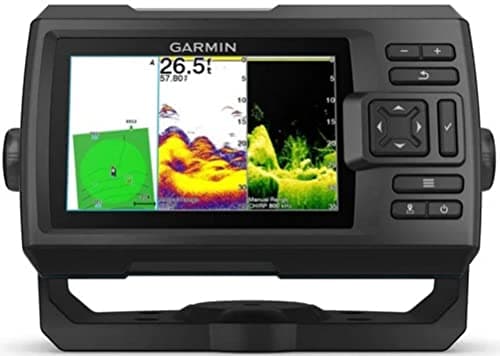 Best transducer options Garmin STRIKER Vivid 5cv Ships with both transom and trolling motor mounting hardware and a 20 ft cable, which is what a kayak install actually needs. | Awkward kayak mounting | $334.99 · Check price on Amazon #ad how this is funded · price as of October 19, 2026 |
| 3 | 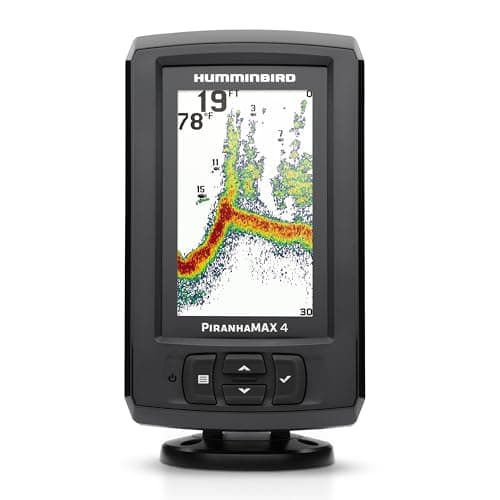 Smallest footprint Humminbird PiranhaMAX 4 3.91 in wide on the gimbal, and 2.5 in deep in-dash. The physically smallest option here. | A kayak with very little deck space | $135.02 · Check price on Amazon #ad how this is funded · price as of October 19, 2026 |
The battery arithmetic, done once
A sealed 12 V 7 Ah battery is the common kayak choice, and the sums are simple: capacity in amp-hours divided by draw in amps gives you hours.
| Unit | Published draw | Approx. runtime |
|---|---|---|
| Lowrance Eagle 7 | 550 mA | ~12.7 h |
| Humminbird HELIX 5 | 615 mA | ~11.4 h |
| Lowrance Eagle 9 | 640 mA | ~10.9 h |
All three comfortably cover a full day. Which means the honest conclusion is that battery anxiety on a kayak is mostly misplaced — a 7 Ah pack runs any of these longer than you will fish.
Two caveats. Lead-acid batteries deliver less than their rated capacity in cold, and running one flat repeatedly shortens its life considerably. Sizing for roughly double your expected day is a sensible habit rather than a strict requirement.
The real problem: mounting the transducer
A kayak has no transom. Three approaches, each with a genuine trade.
Inside the hull, shooting through
The transducer sits inside the kayak in a bed of marine epoxy or a water-filled well, and the sonar shoots through the plastic. Nothing hangs below the boat, so nothing snags weeds and nothing gets destroyed on a rocky launch.
The cost is signal. You lose some through the hull, and any air bubble in the bond destroys the return entirely. It also does not work through every hull — foam-cored or air-gapped sections block it completely.
Through a scupper hole
Many fishing kayaks have a scupper hole positioned for exactly this, and purpose-made transducer mounts drop through it. Full signal, no epoxy, and reversible. The transducer sits slightly below the hull, so it is exposed on a shallow launch.
On an arm over the side
The most flexible option and the most exposed. Full signal, easy to adjust, easy to remove — and it is a paddle obstruction and the first thing to hit a submerged log.
For most people the scupper mount is the right first choice: it gets full signal without permanent modification.
What we would skip on a kayak
Side imaging. A kayak moves at two or three miles an hour and turns constantly. Side imaging wants a steady straight track at consistent speed, which is exactly what a kayak is bad at. The image quality suffers enough that you are paying for a feature the platform undermines.
A nine-inch screen. It will not fit anywhere sensible, it is a sail in wind, and it moves your center of gravity in a boat that is already tippy.
The picks, in full
Every card below lists the specs we could read off a published page, the URL they came from, and one honest reason you might not want it.
1. Best overall for a kayak
Humminbird HELIX 5 CHIRP GPS G3
Humminbird
615 mA draw, a 7.55 x 4.64 in gimbal footprint, and a 60-degree wide cone for the shallow water kayaks fish.
Kayaks fish shallow — weed edges, backwaters, flats. The published 60-degree wide cone sees roughly a 23-foot circle in 20 feet of water, against about 7 feet for a 20-degree narrow beam. On shallow water that is the difference between a useful screen and a novelty.
615 mA at 10.8–20 VDC means a 7 Ah sealed lead-acid or lithium pack runs it for roughly eleven hours. That is a comfortable margin over any realistic day on the water.
The gimbal footprint is 7.55 × 4.64 × 3.3 in, and the in-dash version is 4.28 in tall at 1.13 in deep, which matters if you are flush-mounting it into a console pod.
The drawback
Humminbird does not publish a weight for this unit, and weight matters on a kayak more than anywhere else. You are also mounting an 800x480 5-inch screen where sun angle is uncontrollable, and no brightness figure is published either.
Published specs
- Display
- 5 in, 800H x 480V color TFT
- Transducer
- XNT 9 HW T
- Sonar
- Dual Spectrum CHIRP: narrow 180-240, wide 140-200, full 150-220 kHz
- Coverage
- 20, 42 and 60 deg @ -10 dB
- Max depth
- 1,200 ft standard (3,000 ft with optional 50 kHz)
- Power output
- 4,000 W peak-to-peak / 500 W RMS
- Mapping
- Humminbird Basemap, AutoChart Live (8 h)
- Waypoints
- 2,750 waypoints / 45 routes / 50 tracks
- Dimensions
- 7.55 W x 4.64 H x 3.3 D in (gimbal)
- Power draw
- 615 mA
Specs read from Rogers Sporting Goods — Humminbird HELIX 5 CHIRP GPS G3.
#ad how this is funded · price as of October 19, 2026
2. Best transducer options
Garmin STRIKER Vivid 5cv
Garmin
Ships with both transom and trolling motor mounting hardware and a 20 ft cable, which is what a kayak install actually needs.
The mounting hardware is the reason this is here. Garmin publishes that the GT20-TM ships with both transom and trolling-motor mounts and a 20-foot cable with a built-in temperature sensor.
Twenty feet is generous for a kayak, where the run from a scupper or in-hull mount to the console is short but rarely direct. The trolling-motor bracket is also frequently the easiest way to attach a transducer to a kayak arm.
77/200 kHz traditional and CHIRP ClearVu at 455/800 kHz, both at 500 W, reading to 1,900 ft and 750 ft. Quickdraw Contours maps the small water kayaks tend to fish and that charts tend to ignore.
The drawback
The retailer page we cite does not publish power draw, weight or physical dimensions, which are the three specs a kayak buyer most needs. That is a real gap and we would rather flag it than guess.
Published specs
- Display
- 5 in color
- Transducer
- GT20-TM, 20 ft cable with temperature sensor
- Traditional sonar
- 77/200 kHz, 500 W
- ClearVu sonar
- CHIRP 455/800 kHz, 500 W
- Max depth
- 1,900 ft traditional / 750 ft ClearVu
- Mapping
- Quickdraw Contours, 1-ft contours
- Mounts
- Transom and trolling motor
Specs read from Fish307 — Garmin STRIKER Vivid 5cv with GT20-TM Transducer.
#ad how this is funded · price as of October 19, 2026
3. Smallest footprint
Humminbird PiranhaMAX 4
Humminbird
3.91 in wide on the gimbal, and 2.5 in deep in-dash. The physically smallest option here.
Deck space on a kayak is genuinely scarce, and this is the smallest unit here at 3.91 × 7.34 × 3.62 in on the gimbal mount, or 3.91 × 5.875 × 2.5 in in-dash.
4.3-inch 272 × 480 screen, dual beam 200/455 kHz, 600 ft and 320 ft, 300 W RMS with a tilt-and-swivel mount that helps a lot when you cannot control where the sun is.
The drawback
The 28-degree cone sees about a 5-foot circle in 10 feet of water — genuinely small for the shallow water kayaks fish. And no GPS means no waypoints, which is a bigger loss on a kayak where you cannot cover water quickly to re-find a spot.
Published specs
- Display
- 4.3 in, 272H x 480V, 256-color TFT
- Transducer
- XNT 9 28 T, transom mount
- Sonar
- Dual Beam, 200/455 kHz
- Coverage
- 28 deg and 16 deg @ -10 dB
- Max depth
- 600 ft @ 200 kHz / 320 ft @ 455 kHz
- Power output
- 2,400 W peak-to-peak / 300 W RMS
- Dimensions
- 3.91 W x 7.34 H x 3.62 D in (gimbal)
- Input
- 10.8-20 VDC
Specs read from L&M Fleet Supply — Humminbird PiranhaMAX 4.
#ad how this is funded · price as of October 19, 2026
Questions people actually ask
What is the best fish finder for a kayak?
A 4 to 5 inch unit with a wide beam option and a published power draw under about 700 mA. The HELIX 5 draws 615 mA, which runs about eleven hours on a 7 Ah battery, and its 60-degree wide cone suits the shallow water kayaks fish.
What size battery do I need for a kayak fish finder?
A 12 V 7 Ah pack runs any unit in this class for a full day — roughly eleven hours at 615 mA. Sizing for about double your expected day is sensible, because lead-acid batteries deliver less in cold and repeated deep discharge shortens their life.
How do you mount a transducer on a kayak?
Three ways: inside the hull shooting through the plastic, through a purpose-made scupper mount, or on an arm over the side. The scupper mount is usually the best first choice because it gets full signal without permanent modification.
Do I need side imaging on a kayak?
No. Side imaging needs a steady, straight track at consistent speed to produce a clean image, and a kayak moving at two or three miles an hour and turning constantly is exactly the wrong platform for it.
Can you shoot sonar through a kayak hull?
Usually yes, through solid polyethylene, with the transducer bedded in epoxy or sitting in a water-filled well. You lose some signal, and any trapped air bubble destroys the return. It does not work through foam-cored or air-gapped hull sections.
Read next
Sources
Prices on this page come from the retailer at request time and change without notice. If we cannot get a live one we say “check price” rather than show you a number that has gone stale. How we pick.