Ice
Rod holders for an ice shelter: how it mounts is the whole decision
Every rod holder on the market does the same thing. What separates them is what they bolt to, and whether that part is in the box.
By Sawyer V. · Last updated · How we pick
The short answer
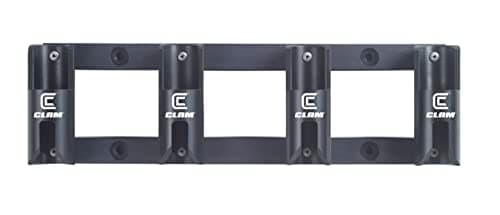
Buy the Clam Four Position Rod Holder. It hard-mounts straight to a shelter tub, it holds four rods, and unlike the ClamLock version it needs nothing else in the box to work. Buy the ClamLock Four Position instead only if you already run ClamLock accessories - it is the better system and the worse first purchase, because it mounts to a baseplate sold separately. The decision here is not how many rods a holder takes. It is whether the thing it attaches to is included, and on roughly half the market it is not. This page is about the hardware; for the rig that goes in it, our ice rigs page covers the deadstick in full.
Reel & Rig earns a commission from qualifying purchases made through links on this page, at no extra cost to you. It does not change which gear we pick or what we say about it. Full disclosure.
Quick picks
| # | Product | Best for | Price |
|---|---|---|---|
| 1 | Best shelter rod holder Clam Four Position Rod Holder Four positions, hard-mounted to the shelter tub, with nothing else to buy. Published MSRP $29.99. | A flip-over tub or a permanent house, and anyone buying their first holder | $39.99 · Check price on Amazon #ad how this is funded · price as of October 22, 2026 |
| 2 | 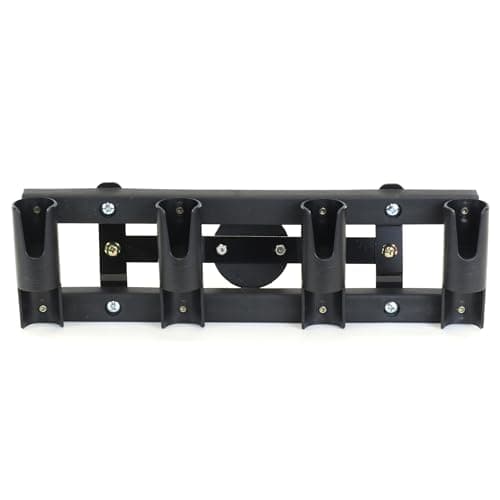 Best if you already run ClamLock Clam ClamLock Four Position Rod Holder The same four positions on the ClamLock system: tool-free to move, and dependent on a baseplate sold separately. | Anyone with a ClamLock baseplate already mounted | $44.99 · Check price on Amazon #ad how this is funded · price as of October 22, 2026 |
| 3 | 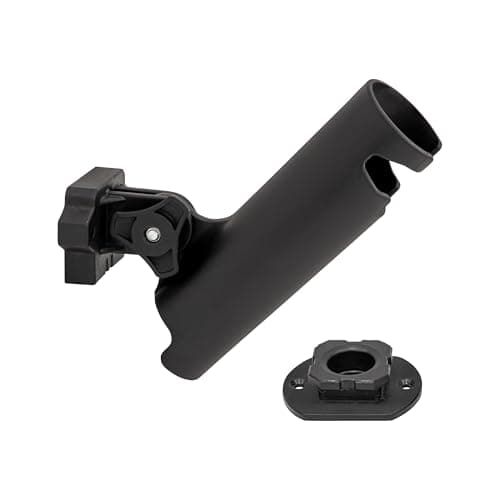 Best for a rod you are actually fishing Eskimo E-Hub Deadstick Holder A holder built to hold a rod that is fishing rather than parked - and the one where nothing is published. | Eskimo hub owners running a deadstick beside the jigging hole | $30.37 · Check price on Amazon #ad how this is funded · price as of October 22, 2026 |
The three mounting types, and what each one really costs
Criteria first, because the holders themselves are nearly identical. A rod holder is a plastic cradle. What you are choosing is the attachment.
| Type | What it attaches to | Second purchase? | Moves later? | Entry MSRP |
|---|---|---|---|---|
| Hard-mount | Screwed to the shelter tub | No | Only by drilling again | $14.99 single / $29.99 four |
| Baseplate system | A ClamLock plate you mount once | Yes - the plate | Yes, tool-free | $14.99 holder + $14.99 plate |
| Clip-on | A bucket lip, a sled rail | No | Yes, instantly | Clam publishes the single at $14.99 |
Those are Clam’s published MSRPs, read off its own product pages. What each item costs on Amazon today is live on the cards above and stamped with the date it was checked - and on this category the street price and the MSRP diverge in both directions, so check the number on the card rather than the one in this table.
Hard-mount or system: the honest split
Hard-mount if this is your first holder, if you fish one shelter and expect to keep fishing it, or if you are holding rods in a flip-over tub where there is one obvious place for them to go. It is half the price and it works out of the box.
A baseplate system if you already own a plate, if you are kitting out a permanent house where you will add a rattle reel and a light and a cup holder over several seasons, or if you genuinely move things around. Drilling a tub once and never again is worth real money to some people and nothing at all to others.
Clip-on if you fish out of a bucket on open ice rather than inside anything. Clam publishes its single hard-mount holder as doing double duty here - fixed or clipped to a bucket lip - which makes it the cheapest honest answer.
Why we are not recommending a cheap universal clip
Search this category and most of what comes back is an $8 to $15 adjustable clip that claims to fit a bucket, a shelter and a sled. Several are in stock right now. We looked at them and did not feature one.
The reason is the same one that kept the unbranded soft bags off our ice rod case page: none of them publishes a specification. No materials, no dimensions, no rod-diameter range, and in most cases no reachable manufacturer site at all. For a part whose entire job is gripping a specific thickness of rod handle on a specific thickness of bucket rim, those are the only numbers that matter, and they are absent across the category.
That is not a claim they are bad. It is a statement that we cannot check them, and this site does not recommend gear it cannot check - the standard our how we pick page applies everywhere else.
How many rods you actually need to hold
Fewer than the four-position holders suggest, and the reason to buy four anyway is not the rod count.
Most states allow one or two lines through the ice and a few allow more, so the number you are legally fishing is usually one or two. The other two slots are for the rod you just put down to unhook a fish, and the spare rigged differently that you brought because you did not know what depth the fish would be at. Our panfish against walleye page covers why two rigged rods is a sensible load even when you only fish one at a time.
Line limits are a state rule, not a national one, and they change by county and season in several places. Check your current regulations before you plan a multi-rod setup - that is the one piece of research on this page we cannot do for you.
Parking a rod and fishing a rod are different jobs
This is the distinction the category mostly ignores, and it decides whether you want one holder or two kinds.
A parking holder keeps a rod off a wet floor, keeps the tip out of the way and keeps the reel out of slush. Any of the Clam holders does this. Tip protection is the real value: an ice rod blank is thin, and the usual way one breaks is being stood on or having a heater set down on it. Our rod case page covers the same problem in transit.
A fishing holder holds a rod that is working. It needs the tip visible and clear of the hole, enough grip that a live minnow cannot shift the rod, and a fast release. That is what the Eskimo deadstick holder is built for, and what a flat storage cradle does badly.
If you only buy one, buy a parking holder - it is the job you do twenty times a day. Add the fishing holder when you start running a second rod seriously.
Where to mount it
Above and behind where you sit. Rods come up and out, not across your face. A holder mounted in front of you is one you lean into every time you stand.
Not above a hole. Water runs off a rod and a reel, and a rod parked over an open hole drips into it and freezes the edges. It also puts the reel where slush can splash it.
Clear of the heater. Blanks and reel seats are plastic and graphite composites. Our Buddy heater comparison covers the clearances those units publish; a rod holder is one of the things worth keeping out of that zone.
On a hub, over the center assembly. Clam publishes its ClamLock baseplate as designed originally for exactly that spot, because it is the one part of a hub shelter rigid enough to carry a load. On a fabric wall there is nothing to screw into.
What nobody in this category publishes
Worth stating plainly, because it is the whole category rather than one brand.
Clam publishes a description, a SKU and an MSRP for every holder in both of its lines, and no dimensions, no weight and no rod-diameter range for any of them - which on a part designed to grip a rod handle is the specification. Eskimo publishes nothing; its site is a lander with no product pages. The clip-on brands mostly have no site at all.
We have left every one of those as a gap rather than filling it from a listing bullet. In practice it means one thing for you: if you fish an unusually fat-handled combo or a palm-sized inline reel, you are buying on a guess, and buying the cheaper hard-mount first is the lower-risk way to find out.
So what do I actually buy?
One hard-mount four-position holder if you are starting. The ClamLock version plus a baseplate only if you are kitting out a house over several seasons. A deadstick holder when you start fishing a second rod rather than parking it.
Clam Four Position Rod Holder
$39.99Four positions, hard-mounts to the tub, nothing else to buy. $29.99 MSRP.
#ad how this is funded · price as of October 22, 2026
Clam ClamLock Four Position Rod Holder
$44.99The system version. Better long term, needs a baseplate to work at all.
#ad how this is funded · price as of October 22, 2026
Clam ClamLock Accessory Base Plate
$12.99The plate the ClamLock holder mounts to. Buy it with the holder, not after.
#ad how this is funded · price as of October 22, 2026
Eskimo E-Hub Deadstick Holder
$30.37Built to hold a rod that is fishing. Eskimo publishes no specifications for it.
#ad how this is funded · price as of October 22, 2026
The picks, in full
Every card below lists the specs we could read off a published page, the URL they came from, and one honest reason you might not want it.
1. Best shelter rod holder
Clam Four Position Rod Holder
Clam Outdoors
Four positions, hard-mounted to the shelter tub, with nothing else to buy. Published MSRP $29.99.
This is the one to start with for a reason that has nothing to do with the holder itself: Clam publishes it as hard-mounting to your shelter tub, which means the mount is the screws and the tub you already own. There is no second purchase, no system to buy into, and no compatibility question.
Four positions is also the right number for a shelter rather than a nicety. The rods you want off the floor are not just the ones you are fishing - it is the jigging rod while you unhook, the deadstick rod while you re-bait it, and the spare you brought because the bite might be shallower than you planned.
Clam sells the same hard-mount design as a Single Position holder (SKU 109555, published at $14.99), and publishes one genuinely useful extra about it: the single can be fixed in place or clipped to the lip of a bucket. If you fish out of a bucket rather than a shelter, that is the one to buy, and our bucket seat page covers the rest of that setup.
The drawback
Hard-mounting means drilling your shelter, which is permanent and which some people will not do to a tub they paid several hundred dollars for - and once it is placed you cannot move it without a second set of holes. Clam publishes no dimensions, no weight and no rod-diameter range for it either, so whether a fat-handled combo or a palm-reel ice rod sits properly is something you find out on arrival. Amazon also titles this one Multi-Position 4 Rod Holder rather than Four Position, which makes it harder to match to Clam's own page than it should be.
Published specs
- SKU
- 115490
- Positions
- Four
- Mounting
- Hard-mounts to a shelter tub - no baseplate needed
- Line
- Sold alongside a Single Position holder (109555, $14.99)
- MSRP
- $29.99
- Listing name
- Amazon titles it "Multi-Position 4 Rod Holder"
- Dimensions, rod diameter range, weight
- Clam does not publish figures
Specs read from Clam Outdoors - Four Position Rod Holder.
#ad how this is funded · price as of October 22, 2026
2. Best if you already run ClamLock
Clam ClamLock Four Position Rod Holder
Clam Outdoors
The same four positions on the ClamLock system: tool-free to move, and dependent on a baseplate sold separately.
The ClamLock version is the better piece of equipment and the worse thing to buy first, and both halves of that are worth understanding before you choose.
Better, because a baseplate is a standard. Clam publishes the plate as mounting to hub center assemblies, flip-over tubs and the walls of permanent ice houses, and as accepting rod holders, rattle reels, tackle trays, cup holders and more. Drill once, then change what hangs there without drilling again - a rod holder in January and a rattle reel next season, covered on our rattle reel page.
Worse as a first purchase, because the plate is not in the box. A $49.99 published holder plus a $14.99 published baseplate is a $65 entry to hold four rods, against $29.99 for the hard-mount version that does the same job.
Clam makes the ClamLock holders in four arrangements - single (115814), two-position vertical (115953), two-position horizontal (115401) and this four-position (115498). The horizontal two-position is published at $14.99 and is the cheapest way into the system if you want to test it before committing.
The drawback
It does not work out of the box. A ClamLock baseplate is a separate purchase, so the real cost is the holder plus the plate, and if you only ever mount one accessory you have paid for a standard you are not using. Like the hard-mount line, Clam publishes no dimensions, weight or rod-diameter range. And it ties you to one manufacturer's mounting pattern: nothing from Eskimo, Frabill or Otter bolts to a ClamLock plate.
Published specs
- SKU
- 115498
- Positions
- Four, rods held upright
- Mounting
- Any ClamLock baseplate - sold separately
- Baseplate mounts to
- Hub center assemblies, flip-over tubs, or permanent house walls
- Line
- Also made as a single (115814), 2-position vertical (115953) and 2-position horizontal (115401)
- MSRP
- $49.99
- Dimensions, rod diameter range, weight
- Clam does not publish figures
Specs read from Clam Outdoors - ClamLock 4 Position Rod Holder.
#ad how this is funded · price as of October 22, 2026
3. Best for a rod you are actually fishing
Eskimo E-Hub Deadstick Holder
Eskimo
A holder built to hold a rod that is fishing rather than parked - and the one where nothing is published.
Most rod holders are storage: somewhere to put a rod you are not using. A deadstick holder is a different job, because the rod in it is fishing. It has to sit at an angle that keeps the tip visible, hold the rod firmly enough that a minnow cannot move it, and release it fast enough that you can pick it up when the tip goes.
Eskimo builds this one specifically for that, and the listing describes a locking connection into the E-Hub system. If you fish an Eskimo hub and run a second rod rather than a rattle reel, it is the purpose-built answer.
What we cannot tell you is anything measurable about it. Eskimo’s own site resolves to a single lander with no product pages at all - no mounting detail, no materials, no dimensions. We hit exactly the same wall on this site with Eskimo’s Rod Locker bags and its rattle reel, and the conclusion has not changed: it is a real product from a real brand that publishes nothing.
The drawback
Nothing is published about it - no mounting specification, no materials, no dimensions - so you are buying on the brand and the listing text. It is also built around the E-Hub system, so whether it mounts cleanly in a Clam, a Frabill or a home-built house is something you find out on arrival. And it holds one rod: if what you want is somewhere to park three, this is the wrong product and one of the Clam holders is the right one.
Published specs
- Built for
- Eskimo E-Hub shelters
- Connection
- Locking, per the listing
- Published specifications
- None - eskimofishing.com resolves to a lander with no product pages
- Mounting detail, materials, dimensions
- Not published anywhere we could cite
Specs read from Eskimo Fishing - no product page exists for this item.
#ad how this is funded · price as of October 22, 2026
Questions people actually ask
What is the best ice fishing rod holder?
The Clam Four Position Rod Holder for most people, because it hard-mounts straight to a shelter tub and needs nothing else to work. The ClamLock four-position is the better system but mounts to a baseplate sold separately, which makes it a poor first purchase.
Do ice fishing rod holders need a baseplate?
Only the system ones. Clam's hard-mount line screws directly to a shelter tub, while its ClamLock line mounts to a baseplate sold separately - so a $49.99 ClamLock holder is really a $65 purchase once you add a $14.99 plate.
Can you mount a rod holder on a hub shelter?
Over the center hub assembly, yes - Clam publishes its baseplate as designed originally for that spot, because it is the one part of a hub rigid enough to carry a load. A fabric wall has nothing to screw into, so a hub without a usable assembly needs a bucket or sled holder instead.
How many rod holders do you need in an ice shelter?
One four-position holder covers almost everyone. Most states allow one or two lines through the ice, so the extra slots are not for extra lines - they are for the rod you just put down to unhook a fish and the spare you rigged at a different depth.
What is a deadstick rod holder?
A holder built for a rod that is fishing rather than parked: it sits at an angle that keeps the tip visible, grips firmly enough that a live minnow cannot move the rod, and releases fast when the tip goes. A flat storage cradle does all three badly.
Where should you mount a rod holder in an ice shelter?
Above and behind where you sit, so rods come up and out rather than across your face; never directly over a hole, because water running off a reel freezes the edges; and clear of the heater, because blanks and reel seats are plastic and graphite composites.
Will a rod holder fit any ice rod?
Nobody publishes a figure that would let you answer that. Clam lists a SKU and an MSRP for every holder it makes and no rod-diameter range for any of them, and Eskimo publishes nothing at all. If you fish a fat-handled combo or a palm-sized inline reel, buy the cheaper hard-mount holder first.
Read next
Sources
Prices on this page come from the retailer at request time and change without notice. If we cannot get a live one we say “check price” rather than show you a number that has gone stale. How we pick.