Ice
The best ice fishing rods, sized by what you are actually chasing
On ice, length and power move together — and the printed ladder tells you exactly which fish each rod was built for.
By Sawyer V. · Last updated · How we pick
The short answer
Buy a 28 inch medium rated around 4–8 lb as a first ice rod. On ice, length and power rise together rather than trading off — a maker’s 26 inch model is its light one and its 36 inch is medium-heavy. Choose by the fish, and the length follows.
Reel & Rig earns a commission from qualifying purchases made through links on this page, at no extra cost to you. It does not change which gear we pick or what we say about it. Full disclosure.
Quick picks
| # | Product | Best for | Price |
|---|---|---|---|
| 1 | Best all-round Ugly Stik GX2 Ice Spinning Rod (28 in Medium) The 28 in medium sits in the middle of a published ladder that runs 26 in light to 36 in medium-heavy. | Panfish through walleye on one rod | $33.29 · Check price on Amazon #ad how this is funded · price as of October 19, 2026 |
| 2 | Best for panfish Ugly Stik GX2 Ice Spinning Rod (28 in Medium) The 26 in light at 2-6 lb is the panfish end of the same published ladder. | Crappie, perch and 1/32 oz jigs | $33.29 · Check price on Amazon #ad how this is funded · price as of October 19, 2026 |
Why length and power move together on ice
In open water, length is a distance-versus-control trade and power is a separate axis. You can buy a long light rod or a short heavy one, and both are sensible tools.
On ice, that decoupling disappears, because nobody is casting. Length is instead about two practical things: how much room you have (a shelter is small, and you are sitting), and how much leverage you want on a fish that is directly below you.
Both of those track the size of the fish. So makers build the ladder as a single axis, and the published Ugly Stik range shows it cleanly:
| Length | Power | Line rating | Suits |
|---|---|---|---|
| 26 in | Light | 2–6 lb | Crappie, perch, bluegill on 1/32–1/16 oz |
| 28 in | Medium | 4–8 lb | The all-rounder: panfish through walleye |
| 30 in | Medium heavy | 6–10 lb | Walleye, lake trout, bigger jigging spoons |
| 32 in | Medium | 4–8 lb | Same as the 28, with more reach outside a shelter |
| 36 in | Medium heavy | 6–10 lb | Pike, lake trout, fishing standing up outside |
Note the 28 and the 32 share a rating. That pair is the clearest evidence that length here is about working room rather than power — identical tool, two amounts of reach.
The spec that matters most is the one nobody publishes
Tip action. Not one maker in this tier publishes an action rating for an ice rod, and it is the property that decides whether the rod does its main job.
That job is visual. A winter fish often rises with the jig rather than pulling against it, so the line goes slack and the rod tip straightens. If the tip is stiff, nothing visible happens and you never know a fish was there.
Since you cannot buy this from a spec sheet, the practical substitutes are: buy the lightest power that suits your target species, and consider a spring bobber — a fine wire coil at the tip that exaggerates tiny movements. A spring bobber on a medium rod recovers much of what a genuinely soft tip would have given you.
What we would skip
Combo kits with a rod, reel, line and a tray of jigs for very little money. The rod in these is usually a solid fiberglass blank with no meaningful tip action, which means it fails at the one thing an ice rod exists to do. The jigs are the reason the kit exists and they are the cheapest part of the sport to buy properly.
Anything sold as an all-species ice rod at 36 inches. Long and strong is the pike end of the ladder. Sold as a do-everything rod, it is the one that will not show you a panfish bite.
A note on how short this list is
Two picks from one published range, because that is what we can put a full specification table behind with a source link. Ice rods are unusually poorly documented online — most product pages give a length and a power word and nothing else.
When we can document more of them properly, this page will get more picks. A longer list where most entries have no citable specs would be a worse page, not a better one.
The picks, in full
Every card below lists the specs we could read off a published page, the URL they came from, and one honest reason you might not want it.
1. Best all-round
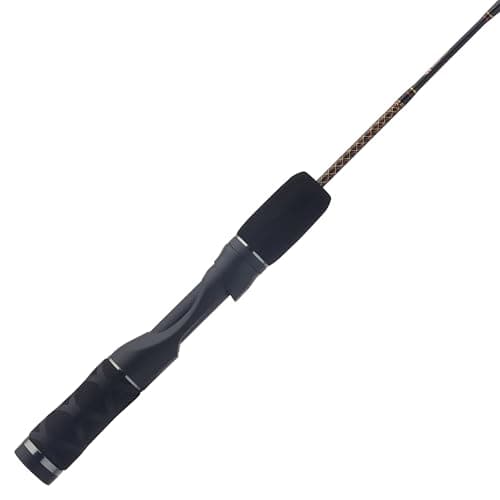
Ugly Stik GX2 Ice Spinning Rod (28 in Medium)
Ugly Stik
The 28 in medium sits in the middle of a published ladder that runs 26 in light to 36 in medium-heavy.
The reason to start here is that Ugly Stik publishes the whole range with its ratings, so you can see the sizing logic rather than guess at it: 26 inch light at 2–6 lb, 28 and 32 inch medium at 4–8 lb, 30 and 36 inch medium-heavy at 6–10 lb.
Read the pairing. Length is not buying casting distance — there is no casting. It tracks the power you need and the space you have, so the longer models are the stronger ones rather than the further-casting ones.
The 28 inch medium at 4–8 lb is the widest-coverage single choice. It will show a crappie bite and still handle a walleye, and it fits inside a shelter without fouling the walls.
The blank is the standard Ugly Stik with the Clear Tip design, PVD-coated one-piece stainless guides, and an EVA handle. One-piece guides matter more on ice than anywhere: there is no ceramic insert to crack, and a cracked insert plus frozen line is how a good fish gets lost.
The drawback
No action rating is published for any model in this range — only length and power. Action is the spec that decides how well an ice rod shows a soft bite, so its absence is the one thing we would most like to see and cannot report.
Published specs
- Model
- USGXSPICE28M
- Length
- 28 in (26, 28, 30, 32, 36 in offered)
- Power
- Medium
- Line rating
- 4-8 lb
- Light model
- 26 in, 2-6 lb
- Med-heavy model
- 30 in and 36 in, 6-10 lb
- Blank
- Ugly Stik blank with Clear Tip design
- Guides
- PVD-coated Ugly Tuff one-piece stainless
- Handle
- EVA, ergonomic reel seat
Specs read from Ugly Stik — GX2 Ice Spinning Rod.
#ad how this is funded · price as of October 19, 2026
2. Best for panfish
Ugly Stik GX2 Ice Spinning Rod (28 in Medium)
Ugly Stik
The 26 in light at 2-6 lb is the panfish end of the same published ladder.
If you already know you are chasing panfish, the light model is the better buy and the reason is the same one that governs rod choice in open water: the lure has to load the blank.
A 1/32 oz jig weighs about nine tenths of a gram. On a medium-heavy rod rated 6–10 lb you will not see what it is doing, and you certainly will not see a crappie lift it. On a light rod rated 2–6 lb you will.
Twenty-six inches is also the easiest length to fish sitting down inside a shelter, which is where most panfish get caught.
The drawback
It is genuinely under-gunned for walleye and hopeless for pike. If your water holds both and you only want one rod, take the 28 in medium and accept slightly less sensitivity on the smallest jigs.
Published specs
- Model
- USGXSPICE28M
- Length
- 28 in (26, 28, 30, 32, 36 in offered)
- Power
- Medium
- Line rating
- 4-8 lb
- Light model
- 26 in, 2-6 lb
- Med-heavy model
- 30 in and 36 in, 6-10 lb
- Blank
- Ugly Stik blank with Clear Tip design
- Guides
- PVD-coated Ugly Tuff one-piece stainless
- Handle
- EVA, ergonomic reel seat
Specs read from Ugly Stik — GX2 Ice Spinning Rod.
#ad how this is funded · price as of October 19, 2026
Questions people actually ask
What length ice fishing rod is best?
Twenty-eight inches for a first rod. On ice, length tracks power rather than casting distance, so the 28 inch medium sits in the middle of the range and covers panfish through walleye.
What is the difference between a light and medium ice rod?
The line rating, and what the tip will show you. A light rod rated 2 to 6 lb will register a crappie lifting a 1/32 oz jig; a medium-heavy rated 6 to 10 lb will not, but it will handle a walleye or a pike.
Do ice rods have an action rating?
Usually not, and it is the spec that matters most. Makers publish length and power and leave action out, so you cannot buy tip softness from a spec sheet — buy the lightest power that suits your species, or add a spring bobber.
What is a spring bobber?
A fine wire coil fitted at the rod tip that exaggerates very small movements. It matters because winter fish often rise with the jig, making the line go slack rather than tight, and a spring bobber makes that visible on a rod that is otherwise too stiff.
Read next
Sources
Prices on this page come from the retailer at request time and change without notice. If we cannot get a live one we say “check price” rather than show you a number that has gone stale. How we pick.