Electronics
The best fish finder for someone buying their first one
A first fish finder has four jobs. Everything past those four is a feature you will grow into, or never use.
By Sawyer V. · Last updated · How we pick
The short answer
A first fish finder needs to do four things: tell you the depth, show you what the bottom is like, show you fish, and let you mark a spot and come back to it. That last one is GPS, and it is the feature that turns a screen into a fishing tool. Everything else — side imaging, networking, live sonar — is a feature you will grow into.
Reel & Rig earns a commission from qualifying purchases made through links on this page, at no extra cost to you. It does not change which gear we pick or what we say about it. Full disclosure.
Quick picks
| # | Product | Best for | Price |
|---|---|---|---|
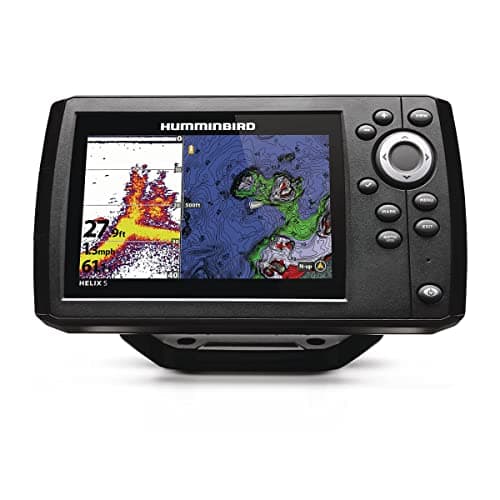
| 1 | Best first unit Humminbird HELIX 5 CHIRP GPS G3 Depth, bottom, fish and GPS with 2,750 waypoints, on a 60-degree wide cone that actually sees shallow water. | Doing all four jobs properly | $341.56 · Check price on Amazon #ad how this is funded · price as of October 19, 2026 |
| 2 | 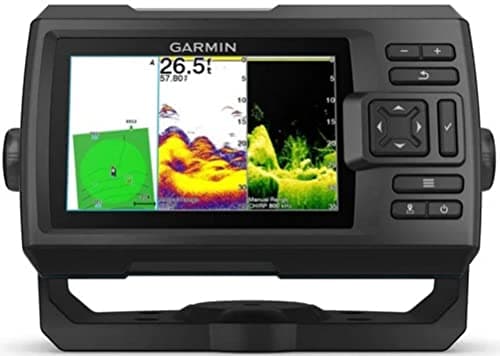 Best if your lake is not on any map Garmin STRIKER Vivid 5cv Quickdraw Contours builds a 1-ft contour map of wherever you drive, which is the right answer for uncharted water. | Small local water nobody has charted | $334.99 · Check price on Amazon #ad how this is funded · price as of October 19, 2026 |
| 3 | 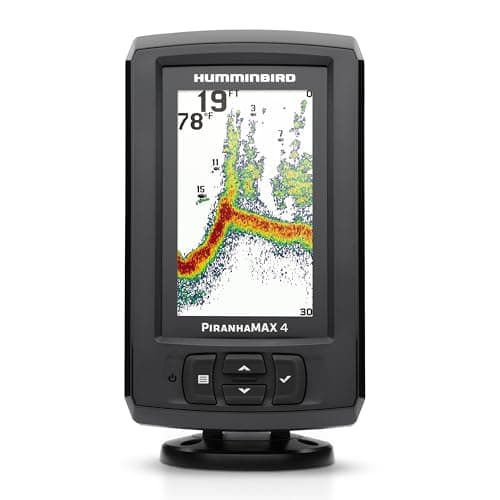 Cheapest honest option Humminbird PiranhaMAX 4 Depth, bottom and fish on a 4.3-inch screen. No GPS, and the 28-degree cone is genuinely narrow. | Finding out whether you want a screen at all | $135.02 · Check price on Amazon #ad how this is funded · price as of October 19, 2026 |
Which fish finder is easiest to use?
Honestly: none of them, at first, and the marketing on all three implies otherwise. Every unit in this class has a menu system that takes a few trips to learn, and no published specification tells you how good it is.
What genuinely reduces the learning curve is fewer features. A unit with 2D sonar and GPS has two things to understand. A unit that also has down imaging, side imaging, networking and chart overlays has six, and you will spend your first three trips in menus rather than fishing.
That is the honest argument for starting with the simpler unit, and it is a better argument than price.
What the four jobs actually mean
Depth
The single most useful number, and every unit here does it perfectly. Knowing you are in eight feet rather than twenty-eight changes which lure you tie on.
Bottom composition
A hard bottom returns a strong, thin echo; soft bottom returns a weak, thick one. Learning to read that takes a season and it is the skill that separates people who own fish finders from people who use them — bass, walleye and crappie all relate to bottom transitions.
Fish
The famous arches. Worth knowing: an arch forms because the fish passes through your cone, entering at the edge, passing beneath, and exiting the far edge. A fish that sits still under a stationary boat draws a straight line, not an arch.
Which is also why cone width matters so much. A narrow cone produces fewer, shorter arches simply because fish spend less time in it.
Marking a spot
This is where GPS earns its cost. Fish hold on specific structure — a rock pile, a brush pile, a creek channel bend. Without GPS you find one, catch fish, and then spend twenty minutes next week trying to find it again. With GPS you save a waypoint and drive straight back.
The HELIX 5 stores 2,750 waypoints. You will not use a fraction of that, and the feature existing at all is what matters.
Transducer mounting is the part that goes wrong
More first fish finders underperform because of mounting than because of specifications.
The transducer face must sit in clean, undisturbed water and stay in the water at whatever speed you run. On a transom mount that means below the hull bottom, ideally away from strakes and rivets that shed turbulent water and bubbles. Bubbles under the transducer look like a scrambled screen, and people blame the unit.
On a small aluminum boat with a riveted hull, mounting on the opposite side from the prop and slightly below the hull line is the usual answer. Getting this right is worth more than the gap between any two units on this page.
What to skip on a first unit
Side imaging. It is a water-covering tool that shines on big flats and does very little in a narrow creek arm. It is also a genuinely harder image to interpret than 2D sonar. Buy it when you know you need it.
Networking and chart cards. Features for people with more than one screen or a specific charting need. Neither is you yet.
Live sonar. Extraordinary technology, several times the price of any unit here, and completely wasted before you can read a normal sonar return.
The picks, in full
Every card below lists the specs we could read off a published page, the URL they came from, and one honest reason you might not want it.
1. Best first unit
Humminbird HELIX 5 CHIRP GPS G3
Humminbird
Depth, bottom, fish and GPS with 2,750 waypoints, on a 60-degree wide cone that actually sees shallow water.
This does all four jobs without asking you to learn anything complicated. Dual Spectrum CHIRP gives you a readable 2D picture; the published 60-degree wide mode means you see a useful amount of water rather than a keyhole; and built-in GPS with Basemap stores 2,750 waypoints.
The AutoChart Live feature with eight hours of built-in recording is worth knowing about early: it maps your own water as you drive, which is genuinely useful on a lake the included Basemap does not detail.
5-inch 800 × 480 display, 500 W RMS, reading to 1,200 ft, drawing 615 mA.
The drawback
There is no down imaging, so structure stays an interpretation rather than a picture. And the menu system on any of these units takes a few trips to learn — no spec sheet warns you about that and every one of them is guilty.
Published specs
- Display
- 5 in, 800H x 480V color TFT
- Transducer
- XNT 9 HW T
- Sonar
- Dual Spectrum CHIRP: narrow 180-240, wide 140-200, full 150-220 kHz
- Coverage
- 20, 42 and 60 deg @ -10 dB
- Max depth
- 1,200 ft standard (3,000 ft with optional 50 kHz)
- Power output
- 4,000 W peak-to-peak / 500 W RMS
- Mapping
- Humminbird Basemap, AutoChart Live (8 h)
- Waypoints
- 2,750 waypoints / 45 routes / 50 tracks
- Dimensions
- 7.55 W x 4.64 H x 3.3 D in (gimbal)
- Power draw
- 615 mA
Specs read from Rogers Sporting Goods — Humminbird HELIX 5 CHIRP GPS G3.
#ad how this is funded · price as of October 19, 2026
2. Best if your lake is not on any map
Garmin STRIKER Vivid 5cv
Garmin
Quickdraw Contours builds a 1-ft contour map of wherever you drive, which is the right answer for uncharted water.
A pre-loaded chart set is worth nothing if your lake is not in it. Quickdraw Contours solves that differently: it records depth as you drive and builds your own one-foot contour map.
For a beginner on one small home lake, that is arguably a better learning tool than a professionally surveyed chart, because you build it yourself and you understand what you are looking at.
The GT20-TM transducer publishes 77/200 kHz traditional and CHIRP ClearVu at 455/800 kHz, both at 500 W, reading to 1,900 ft and 750 ft respectively. Twenty-foot cable with a temperature sensor, transom and trolling-motor mounts included.
The drawback
Your first trip anywhere new gives you no map at all, because Quickdraw only records water you have driven over. If you fish many different lakes, pre-loaded charts are the better philosophy.
Published specs
- Display
- 5 in color
- Transducer
- GT20-TM, 20 ft cable with temperature sensor
- Traditional sonar
- 77/200 kHz, 500 W
- ClearVu sonar
- CHIRP 455/800 kHz, 500 W
- Max depth
- 1,900 ft traditional / 750 ft ClearVu
- Mapping
- Quickdraw Contours, 1-ft contours
- Mounts
- Transom and trolling motor
Specs read from Fish307 — Garmin STRIKER Vivid 5cv with GT20-TM Transducer.
#ad how this is funded · price as of October 19, 2026
3. Cheapest honest option
Humminbird PiranhaMAX 4
Humminbird
Depth, bottom and fish on a 4.3-inch screen. No GPS, and the 28-degree cone is genuinely narrow.
Three of the four jobs, and it says so. 4.3-inch 272 × 480 display in 256 colors, dual beam at 200/455 kHz reading to 600 ft and 320 ft respectively, 300 W RMS.
If you are not sure a fish finder will change how you fish, this answers that question for a fraction of the price of finding out with a better unit. The tilt-and-swivel mount and 3.91 × 7.34 × 3.62 in footprint fit almost anywhere.
The drawback
No GPS is the real cost, and it is larger than the price gap suggests — you cannot mark a spot and return to it, which is the thing that actually changes how you fish. The 28-degree cone sees about a 10-foot circle in 20 feet of water against roughly 23 feet for a 60-degree unit.
Published specs
- Display
- 4.3 in, 272H x 480V, 256-color TFT
- Transducer
- XNT 9 28 T, transom mount
- Sonar
- Dual Beam, 200/455 kHz
- Coverage
- 28 deg and 16 deg @ -10 dB
- Max depth
- 600 ft @ 200 kHz / 320 ft @ 455 kHz
- Power output
- 2,400 W peak-to-peak / 300 W RMS
- Dimensions
- 3.91 W x 7.34 H x 3.62 D in (gimbal)
- Input
- 10.8-20 VDC
Specs read from L&M Fleet Supply — Humminbird PiranhaMAX 4.
#ad how this is funded · price as of October 19, 2026
Questions people actually ask
What is the best fish finder for beginners?
A 5-inch unit with 2D CHIRP sonar and built-in GPS. Those two features cover the four jobs a first fish finder needs to do — depth, bottom, fish, and marking a spot to return to — without a menu system full of things you will not use.
Which fish finder is easiest to use?
The one with the fewest features. Every unit in this class takes a few trips to learn, and a unit with 2D sonar and GPS has two things to understand while one with side imaging, networking and chart overlays has six.
Do I need GPS on my first fish finder?
Yes, more than any other optional feature. Fish hold on specific structure, and without GPS you find a productive spot, catch fish, and then cannot reliably find it again next week.
Why does my fish finder screen look scrambled at speed?
Almost always turbulent water or bubbles passing under the transducer, not a fault in the unit. The transducer must sit in clean water below the hull line, away from rivets and strakes that shed bubbles.
Do I need side imaging on a beginner fish finder?
No. Side imaging is a water-covering tool that pays off on large flats and does little in a narrow creek arm, and it produces a harder image to interpret than 2D sonar. Add it when you know you want it.
Read next
Sources
Prices on this page come from the retailer at request time and change without notice. If we cannot get a live one we say “check price” rather than show you a number that has gone stale. How we pick.