Electronics
The best fish finder for a 14 to 16 foot aluminum boat
This is the size of boat where the constraints finally relax, and the question stops being what fits and starts being what you want.
By Sawyer V. · Last updated · How we pick
The short answer
On a 14–16 ft aluminum boat, power draw stops being a constraint and screen size and mapping start to matter. You have a starting battery, a real transom, and a console or gunwale to mount to. That means you can buy a 7 or 9-inch unit, and the honest question becomes whether the mapping suits the water you fish.
Reel & Rig earns a commission from qualifying purchases made through links on this page, at no extra cost to you. It does not change which gear we pick or what we say about it. Full disclosure.
Quick picks
| # | Product | Best for | Price |
|---|---|---|---|
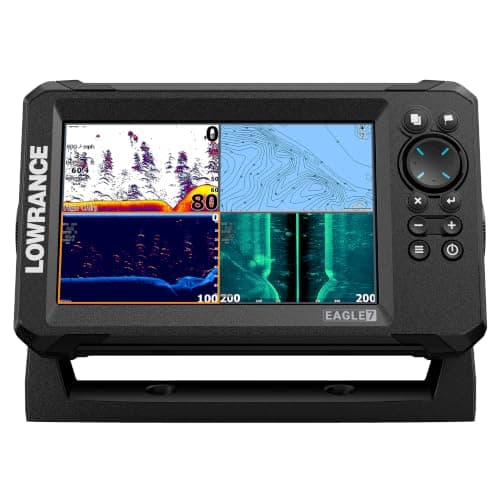
| 1 | Best overall Lowrance Eagle 7 with TripleShot HD 7 inches at 1,000 nits with C-MAP charts for 17,000+ US lakes, drawing only 550 mA. | Fishing many different lakes | $599.99 · Check price on Amazon #ad how this is funded · price as of October 19, 2026 |
| 2 | 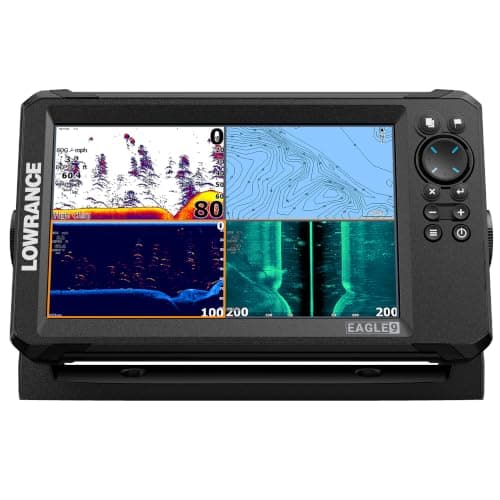 Biggest useful screen Lowrance Eagle 9 with TripleShot HD 9 inches at 1024x600 IPS, 1,000 nits, 3,000 waypoints, 1.98 lb, and still only 640 mA. | Running split views without squinting | $764.99 · Check price on Amazon #ad how this is funded · price as of October 19, 2026 |
| 3 | 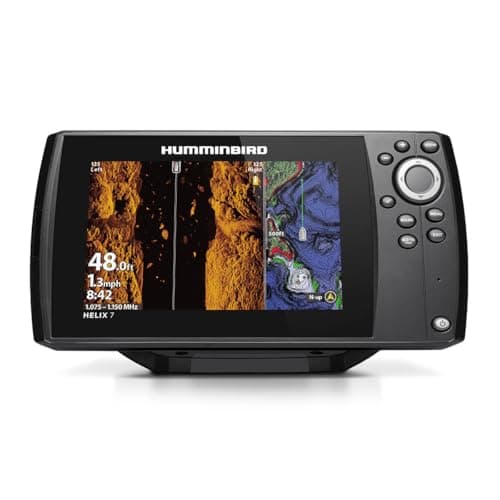 Best imaging detail Humminbird HELIX 7 CHIRP MEGA SI GPS G4 MEGA imaging at up to 1.2 MHz, 250 ft per side, on a 1024x600 7-inch screen. | Reading structure at high resolution | $748.66 · Check price on Amazon #ad how this is funded · price as of October 19, 2026 |
What changes at this boat size
Three constraints disappear at once, and it is worth being explicit about it because it changes what you should buy.
Power stops mattering. With a starting battery, a 640 mA draw is irrelevant. On a kayak it decides the purchase; here it does not enter into it.
Space stops mattering, mostly. You have a console or a gunwale. The remaining question is whether an 11-inch-wide unit is sensible on a 14-foot boat, and that is a judgment about your specific layout.
Mounting gets easy. A real transom, a smooth run of hull, and enough beam to get away from the prop.
What replaces them is a genuine choice about mapping philosophy and imaging philosophy, which is a much better problem to have.
Two imaging philosophies, both defensible
| Spec | Lowrance TripleShot HD | Humminbird MEGA SI |
|---|---|---|
| Side reach | Up to 600 ft per side | 250 ft per side |
| Down imaging depth | Not published | Up to 75 ft (MEGA) |
| Top frequency | Not published | 1.2 MHz |
| Philosophy | Cover more water | See it in more detail |
Neither is better in the abstract. If your water is big and open and you are searching, the 600-foot sweep finds structure faster. If your water is smaller and you already know roughly where things are, the higher-resolution image tells you more about what you found.
Two mapping philosophies
Pre-loaded charts — Lowrance ships C-MAP inland covering 17,000+ US lakes; Humminbird ships Basemap covering 10,000+. If you trailer to varied water, this is worth real money on day one.
Draw your own — Humminbird’s AutoChart Live (eight hours of built-in recording) and Garmin’s Quickdraw Contours both build a map as you drive. If your home lake is small and unmapped, this is better than any chart set.
Both Humminbird units here do both, which is the practical reason they are on this page.
Aluminum hulls and transducer placement
The same rule as a jon boat, for the same reason: aluminum hulls are riveted or welded, and every rivet, strake and weld sheds a stream of bubbles straight astern.
Mount the transducer face about an eighth of an inch below the hull bottom, on a smooth run of hull, on the opposite side from the prop. Then run the boat at speed and watch the screen before you drill anything permanent — most brackets let you test with the transducer clamped rather than fixed.
What we would skip
Networking two units together. It is a genuinely useful feature on a bass boat with a bow and console unit, and on a 14-foot aluminum boat there is one place to stand and one place to put a screen.
The picks, in full
Every card below lists the specs we could read off a published page, the URL they came from, and one honest reason you might not want it.
1. Best overall
Lowrance Eagle 7 with TripleShot HD
Lowrance
7 inches at 1,000 nits with C-MAP charts for 17,000+ US lakes, drawing only 550 mA.
A 14–16 ft boat is a trailer boat, and a trailer boat visits lots of water. That makes pre-loaded charts genuinely valuable, and the published C-MAP embedded inland set here covers more than 17,000 American lakes with an upgrade path to C-MAP Discover.
The screen is 7 inches at 800 × 480 with a published 1,000 nits and 80-degree viewing angles in every direction. Brightness is the specification that decides sun readability, and Lowrance is one of the few makers here that publishes it.
The TripleShot HD transducer gives you CHIRP, DownScan and SideScan reaching up to 600 ft per side. Draw is 550 mA at 12 VDC on full backlight, which is the lowest of any unit in this hub despite the larger screen. Dimensions 8.89 × 5.5 × 3.48 in.
The drawback
Lowrance does not publish frequency ranges, per-sonar depth limits, or waypoint capacity for this configuration. For a unit at this price those are basic figures and their absence is genuinely irritating.
Published specs
- Display
- 7 in, 800 x 480, 1000 nits
- Viewing angle
- 80 deg top/bottom, 80 deg left/right
- Transducer
- TripleShot HD
- Sonar
- CHIRP, DownScan Imaging, SideScan
- SideScan range
- Up to 600 ft per side
- Mapping
- C-MAP inland, 17,000+ US lakes
- Dimensions
- 8.89 x 5.5 x 3.48 in
- Power draw
- 550 mA @ 12 V, full backlight
- Operating temp
- 5 to 131 deg F
Specs read from L&M Fleet Supply — Lowrance Eagle 7 with TripleShot HD Transducer.
#ad how this is funded · price as of October 19, 2026
2. Biggest useful screen
Lowrance Eagle 9 with TripleShot HD
Lowrance
9 inches at 1024x600 IPS, 1,000 nits, 3,000 waypoints, 1.98 lb, and still only 640 mA.
The reason to buy nine inches is split screens. Running 2D sonar, down imaging and a chart simultaneously on a 5-inch display means three unreadable panels; on a 1024 × 600 IPS panel it works.
Lowrance publishes the full set here: 1,000 nits, IPS panel, 3,000 waypoints, 100 routes, 100 trails, IPX7, 45-second first GPS fix, 1.98 lb, and 11.30 × 6.39 × 3.54 in. That is the most complete spec sheet of anything in this hub.
Same TripleShot HD transducer with CHIRP, DownScan and SideScan to 600 ft per side, same C-MAP inland charts. Draw is 640 mA at 12 VDC, with a recommended 3 A fuse.
The drawback
Eleven inches wide is a lot of console on a 14-foot boat, and it is a real sail in wind if you gunwale-mount it. Check you have somewhere sensible to put it before you buy the bigger screen.
Published specs
- Display
- 9 in IPS, 1024 x 600, 1000 nits
- Transducer
- TripleShot HD with FishReveal
- Sonar
- CHIRP, DownScan Imaging, SideScan
- SideScan range
- Up to 600 ft per side
- Mapping
- C-MAP inland, 17,000+ US lakes
- Storage
- 3,000 waypoints / 100 routes / 100 trails
- Dimensions
- 11.30 x 6.39 x 3.54 in
- Weight
- 1.98 lb
- Power draw
- 640 mA @ 12 V, full backlight
- Water rating
- IPX7
Specs read from L&M Fleet Supply — Lowrance Eagle 9 with TripleShot HD Transducer.
#ad how this is funded · price as of October 19, 2026
3. Best imaging detail
Humminbird HELIX 7 CHIRP MEGA SI GPS G4
Humminbird
MEGA imaging at up to 1.2 MHz, 250 ft per side, on a 1024x600 7-inch screen.
MEGA is Humminbird’s high-frequency imaging, and the published frequency list shows why the picture is different: 50/83/200/455/800 kHz and 1.2 MHz. Higher frequency, shorter wavelength, finer detail.
The trade is range, and the published figures make it explicit: MEGA Down Imaging works to about 75 ft and MEGA Side Imaging to 250 ft per side, against 1,200 ft on standard 2D sonar.
Note that 250 ft per side against the Lowrance’s 600 ft is a genuine difference in philosophy: Humminbird trades sweep width for resolution. On a 14–16 ft boat working structure rather than covering huge flats, that is arguably the better trade.
7-inch 1024 × 600 display, 4,000 W peak-to-peak, 500 W RMS, Basemap covering 10,000+ lakes with AutoChart Live, and 10.54 × 5.8 × 3.68 in gimbal dimensions.
The drawback
Neither weight nor power draw is published for this unit, and the 250 ft per side SideScan reach is less than half the Lowrance figure. If covering large water quickly is your priority, the Eagle is the better tool.
Published specs
- Display
- 7 in, 1024H x 600V
- Transducer
- XNT 9 HW MSI 150 T
- Sonar
- Dual Spectrum CHIRP 83/200 kHz; 50/83/200/455/800 kHz and 1.2 MHz
- Coverage
- 20, 42, 60 and two 86 deg @ -10 dB
- MEGA Down Imaging
- Up to 75 ft
- MEGA Side Imaging
- 250 ft per side
- Max depth
- 1,200 ft
- Power output
- 4,000 W peak-to-peak / 500 W RMS
- Mapping
- Basemap (10,000+ lakes), AutoChart Live (8 h)
- Dimensions
- 10.54 W x 5.8 H x 3.68 D in (gimbal)
Specs read from L&M Fleet Supply — Humminbird Helix 7 Chirp Mega SI GPS G4.
#ad how this is funded · price as of October 19, 2026
Questions people actually ask
What is the best fish finder for a 14 foot aluminum boat?
A 7-inch unit with GPS mapping and imaging. At this boat size power draw and space stop being constraints, so the real question becomes whether pre-loaded charts or draw-your-own mapping suits the water you fish.
Where should I mount a transducer on an aluminum boat?
On the transom, about an eighth of an inch below the hull bottom, on a smooth run of hull away from rivets, strakes and welds, and on the opposite side from the prop. Test at speed with the bracket clamped before drilling anything permanent.
Is a 9 inch fish finder too big for a small boat?
Possibly. The Lowrance Eagle 9 is 11.30 inches wide, which is a lot of console on a 14-foot boat and a real sail in wind if gunwale-mounted. The screen size is genuinely useful for split views; check you have somewhere sensible to put it first.
Is MEGA imaging better than SideScan?
They optimize for different things. Humminbird's MEGA reaches 250 ft per side at up to 1.2 MHz for finer detail; Lowrance's SideScan reaches up to 600 ft per side. Wider sweep finds structure faster; higher frequency tells you more about what you found.
Read next
Sources
Prices on this page come from the retailer at request time and change without notice. If we cannot get a live one we say “check price” rather than show you a number that has gone stale. How we pick.