Electronics
Lowrance Eagle 7 against Eagle 9: identical sonar, two screen sizes
Two units that share a transducer and a sonar package. Everything you are paying the difference for is on the front of the box.
By Sawyer V. · Last updated · How we pick
The short answer
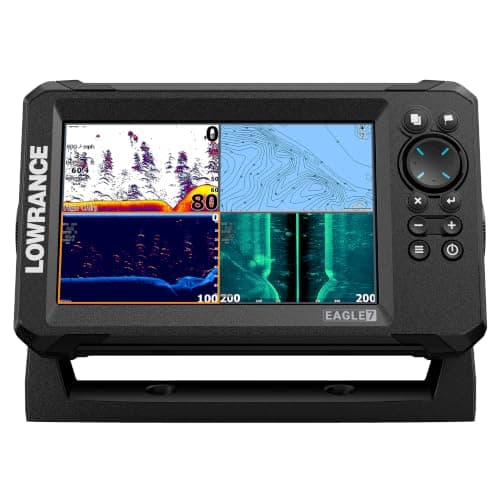
Both ship the same TripleShot HD transducer, the same CHIRP, DownScan and SideScan, the same 600 ft per side and the same C-MAP inland charts. The Eagle 7 publishes 800 x 480 on 7 in; the Eagle 9 publishes 1024 x 600 IPS on 9 in. If you will use SideScan, the extra pixels are the reason to pay more. If you will not, the 7 is the same machine.
Reel & Rig earns a commission from qualifying purchases made through links on this page, at no extra cost to you. It does not change which gear we pick or what we say about it. Full disclosure.
Quick picks
| # | Product | Best for | Price |
|---|---|---|---|
| 1 | Best value of the pair Lowrance Eagle 7 with TripleShot HD 7 in at 800 x 480 and 1000 nits, TripleShot HD, SideScan to 600 ft per side, 550 mA at 12 V. | Jon boats, aluminum boats and any console without much flat space | $599.99 · Check price on Amazon #ad how this is funded · price as of October 12, 2026 |
| 2 | 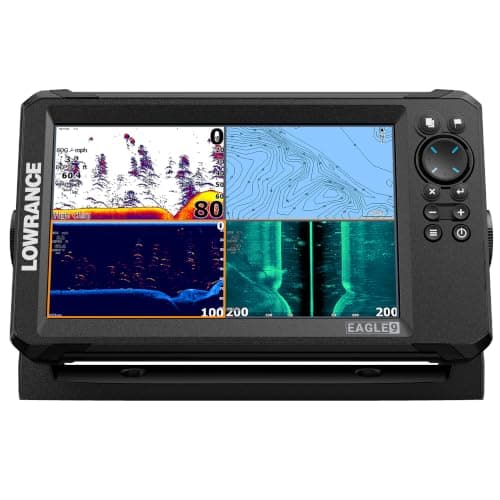 Best screen for imaging Lowrance Eagle 9 with TripleShot HD 9 in IPS at 1024 x 600 and 1000 nits, FishReveal, IPX7, 3,000 waypoints, 640 mA at 12 V. | Anyone who will genuinely use SideScan, and has the dash space | $749.99 · Check price on Amazon #ad how this is funded · price as of October 12, 2026 |
What is genuinely identical
It is worth listing this first, because the marketing does not. Both units publish the same TripleShot HD transducer, the same three sonar modes, the same 600 ft per side SideScan range and the same C-MAP inland cartography covering 17,000+ US lakes.
That means the returns arriving at the two units are the same returns. The fish you can detect, the depth you can read and the structure the transducer can see do not change between them. What changes is how many pixels you get to look at it with.
The published differences, in one table
| Figure | Eagle 7 | Eagle 9 |
|---|---|---|
| Display | 7 in, 800 x 480 | 9 in IPS, 1024 x 600 |
| Brightness | 1000 nits | 1000 nits |
| Transducer | TripleShot HD | TripleShot HD with FishReveal |
| Sonar | CHIRP, DownScan, SideScan | CHIRP, DownScan, SideScan |
| SideScan range | Up to 600 ft per side | Up to 600 ft per side |
| Mapping | C-MAP inland, 17,000+ US lakes | C-MAP inland, 17,000+ US lakes |
| Dimensions | 8.89 x 5.5 x 3.48 in | 11.30 x 6.39 x 3.54 in |
| Current draw | 550 mA @ 12 V | 640 mA @ 12 V |
| Water rating | Not published in this source | IPX7 |
Six of those nine rows are identical. That is the honest summary of this comparison, and it is why the recommendation below is not simply “buy the bigger one”.
Why resolution matters far more on SideScan than on sonar
A traditional CHIRP trace is a graph of depth against time. It has very little fine detail in it by nature, so a coarse screen loses almost nothing. Our reading guide makes the case that the screen is a graph rather than a picture, and on that view extra pixels are close to wasted.
SideScan is the opposite. It is a picture, built from a narrow beam sweeping outward, and the detail is genuinely there in the returns. When you put 600 ft of water per side onto a screen 480 pixels tall, each pixel is covering a large piece of lake bed. Stumps merge. Brush piles become texture rather than objects.
So the split is clean. If you bought the unit for CHIRP and depth, the Eagle 7 gives up nothing that matters. If you bought it because you want to find brush piles and laydowns by scanning, the extra pixels on the 9 are exactly what you are paying for.
The measurement people skip
The Eagle 9 is 11.30 in wide and 6.39 in tall on the gimbal. Before you buy it, put a tape measure on the place it is going to live.
On a bass boat console this is a non-issue. On a jon boat bench, a tiller-steer aluminum boat or a pontoon rail it very often is, and a unit that has to be mounted somewhere awkward because it would not fit anywhere sensible is worse than a smaller unit in the right place.
Our jon boat page and aluminum boat page both lead with mounting space for this reason.
Current draw, and the day it matters
550 mA against 640 mA at full backlight is a 90 mA difference. Over an eight-hour day that is roughly three-quarters of an amp hour — irrelevant on a cranking battery, worth a thought on a small sealed lead-acid pack that is also running a trolling motor.
Both figures are published at full backlight, which is the worst case and also how you will run it on a bright day. If your electronics run off the same small battery as everything else, read our battery sizing page before you choose.
What neither of them publishes
Neither spec sheet used here carries a maximum depth figure. For inland freshwater that is almost never a real constraint, but it is worth saying plainly rather than implying a number we do not have.
The Eagle 7 source also does not carry a water rating where the Eagle 9 publishes IPX7. That is an absence of published information rather than evidence the 7 is not sealed, and we are not going to treat it as either.
Which one, by the boat you actually own
Eagle 7 for a jon boat, a small aluminum boat, a tiller console, a pontoon rail, or any situation where you mostly want CHIRP and charts. It is the same sonar for meaningfully less money and it fits.
Eagle 9 if SideScan is a reason you are buying at all, and the dash is big enough. The pixels are the product.
Neither if you have not yet worked out whether you need imaging. Our five decisions guide puts that question before the brand question, and a cheaper unit bought knowingly beats a dearer one bought hopefully.
So what do I actually buy?
The sonar is identical, so buy the screen you need and the size that fits. If neither of these is the right budget, the third option here is the honest step down.
Lowrance Eagle 7 with TripleShot HD
$599.99Same transducer and same SideScan range as the 9, in a body that fits a small console.
#ad how this is funded · price as of October 12, 2026
Lowrance Eagle 9 with TripleShot HD
$749.991024 x 600 IPS. Worth it specifically if you will use SideScan, not otherwise.
#ad how this is funded · price as of October 12, 2026
Humminbird HELIX 5 CHIRP GPS G3
$349.99No imaging at all, but 4,000 W peak-to-peak CHIRP and AutoChart Live for far less.
#ad how this is funded · price as of October 12, 2026
The picks, in full
Every card below lists the specs we could read off a published page, the URL they came from, and one honest reason you might not want it.
1. Best value of the pair
Lowrance Eagle 7 with TripleShot HD
Lowrance
7 in at 800 x 480 and 1000 nits, TripleShot HD, SideScan to 600 ft per side, 550 mA at 12 V.
The important thing to understand about this pair is how much is identical. The Eagle 7 ships the TripleShot HD transducer, publishes CHIRP, DownScan Imaging and SideScan, and publishes SideScan range to 600 ft per side. Those are the same published figures as the Eagle 9. You are not buying less sonar.
At 8.89 x 5.5 x 3.48 in on the gimbal it fits places the 9 does not. That sounds like a footnote until you measure the flat area on a jon boat bench or a tiller console, at which point it becomes the whole decision. Our installation page covers why the head unit position is decided by the transducer cable run as much as by the dash.
1000 nits is published for both, and it is the figure that matters on open water at midday. A bright 7 in screen beats a dim 9 in one every time, and neither of these is dim.
It also draws 550 mA at 12 V at full backlight, which is the lower of the two. On a small battery running a day, that is worth knowing — the arithmetic is on our battery page.
The drawback
800 x 480 is the same pixel count Lowrance publishes on the 5-inch class, stretched across 7 inches. On a chart or a CHIRP trace that is fine. On a SideScan image 600 ft wide it is the limiting factor, because you are asking roughly 400 pixels of screen height to resolve two 600 ft sweeps. Lowrance publishes no max depth figure for either unit in the source used here, and the Eagle 7 spec does not carry a water rating where the Eagle 9 publishes IPX7.
Published specs
- Display
- 7 in, 800 x 480, 1000 nits
- Viewing angle
- 80 deg top/bottom, 80 deg left/right
- Transducer
- TripleShot HD
- Sonar
- CHIRP, DownScan Imaging, SideScan
- SideScan range
- Up to 600 ft per side
- Mapping
- C-MAP inland, 17,000+ US lakes
- Dimensions
- 8.89 x 5.5 x 3.48 in
- Power draw
- 550 mA @ 12 V, full backlight
- Operating temp
- 5 to 131 deg F
Specs read from L&M Fleet Supply — Lowrance Eagle 7 with TripleShot HD Transducer.
#ad how this is funded · price as of October 12, 2026
2. Best screen for imaging
Lowrance Eagle 9 with TripleShot HD
Lowrance
9 in IPS at 1024 x 600 and 1000 nits, FishReveal, IPX7, 3,000 waypoints, 640 mA at 12 V.
1024 x 600 against 800 x 480 is about 60 per cent more pixels. On a SideScan image that is the difference between a smudge you interpret and a shape you recognize, because imaging sonar is pixel-limited in a way that a traditional CHIRP trace is not.
The panel is published as IPS, where the Eagle 7 publishes a viewing angle of 80 deg top to bottom and left to right. IPS matters when the unit is mounted low and you are standing, or mounted flat and you are looking across it. Lowrance does not publish a viewing-angle figure for the 9 in the source used here, so treat that as a panel-type claim rather than a number.
The transducer is published as TripleShot HD with FishReveal, which overlays the CHIRP returns onto the DownScan image. Our sonar types page explains why that combination is more useful than either view alone.
Storage is published at 3,000 waypoints, 100 routes and 100 trails. If you fish a lot of water and mark everything, that ceiling is the one you will actually reach.
The drawback
11.30 x 6.39 x 3.54 in and 1.98 lb is a genuinely large object on a small boat, and it is the reason this is not simply the better buy. It also draws 640 mA at 12 V against the Eagle 7's 550, so a long day on a small battery costs you more. The sonar package is identical to the cheaper unit, so if you are buying it expecting better returns rather than a better view of the same returns, you are buying the wrong thing.
Published specs
- Display
- 9 in IPS, 1024 x 600, 1000 nits
- Transducer
- TripleShot HD with FishReveal
- Sonar
- CHIRP, DownScan Imaging, SideScan
- SideScan range
- Up to 600 ft per side
- Mapping
- C-MAP inland, 17,000+ US lakes
- Storage
- 3,000 waypoints / 100 routes / 100 trails
- Dimensions
- 11.30 x 6.39 x 3.54 in
- Weight
- 1.98 lb
- Power draw
- 640 mA @ 12 V, full backlight
- Water rating
- IPX7
Specs read from L&M Fleet Supply — Lowrance Eagle 9 with TripleShot HD Transducer.
#ad how this is funded · price as of October 12, 2026
Questions people actually ask
Is the Lowrance Eagle 9 better than the Eagle 7?
It has a bigger, higher-resolution screen and publishes IPX7, but the transducer, sonar modes, SideScan range and charts are identical. It is a better view of the same information, not better information.
Do the Eagle 7 and Eagle 9 use the same transducer?
Both ship TripleShot HD, and both publish SideScan to 600 ft per side. The Eagle 9 transducer is published with FishReveal, which overlays CHIRP returns onto the DownScan image.
Does screen resolution matter on a fish finder?
It matters a lot on SideScan and DownScan, which are pictures built from fine detail, and very little on traditional CHIRP, which is a graph of depth against time. Buy resolution if you will use imaging.
Will an Eagle 9 fit on a jon boat?
Measure first. It is published at 11.30 x 6.39 in on the gimbal, which is a large object on a jon boat bench or a tiller console. The Eagle 7 at 8.89 x 5.5 in fits far more places.
How much power does a Lowrance Eagle draw?
Lowrance publishes 550 mA at 12 V for the Eagle 7 and 640 mA for the Eagle 9, both at full backlight. Over a long day on a small battery the difference is roughly three-quarters of an amp hour.
Read next
Sources
Prices on this page come from the retailer at request time and change without notice. If we cannot get a live one we say “check price” rather than show you a number that has gone stale. How we pick.