Electronics
The best fish finder for ponds and small lakes
Small water rewards a small unit. Depth range and screen size are the two things you can stop paying for.
By Sawyer V. · Last updated · How we pick
The short answer
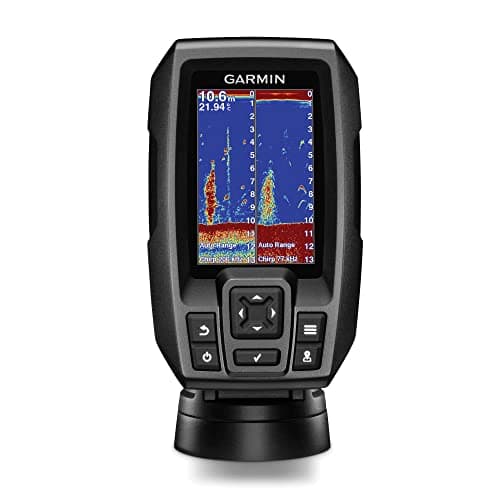
On water under about 25 ft deep, a 3.5 to 4.3 in unit with dual-frequency sonar is enough. The Garmin STRIKER 4 publishes 77/200 kHz CHIRP with built-in GPS; the Humminbird PiranhaMAX 4 publishes 200/455 kHz on a 4.3 in display. Buy the higher frequency and the narrow beam, not the depth rating.
Reel & Rig earns a commission from qualifying purchases made through links on this page, at no extra cost to you. It does not change which gear we pick or what we say about it. Full disclosure.
Quick picks
| # | Product | Best for | Price |
|---|---|---|---|
| 1 | Best pond fish finder Garmin STRIKER 4 3.5 in color display, 77/200 kHz dual-beam CHIRP, 200 W RMS, with built-in GPS and a waypoint map. | Anyone who wants to mark spots and come back to them | $139.99 · Check price on Amazon #ad how this is funded · price as of October 12, 2026 |
| 2 | 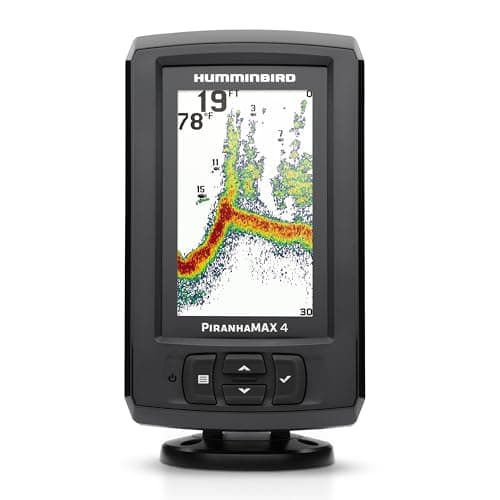 Best screen for the money Humminbird PiranhaMAX 4 4.3 in 256-color display at 272 x 480, 200/455 kHz Dual Beam with 28 and 16 degree cones, to 600 ft. | Reading structure in the shallows, without GPS | $139.00 · Check price on Amazon #ad how this is funded · price as of October 12, 2026 |
What small water changes
Almost every fish finder specification is designed around finding fish in deep water. On a pond, most of them stop mattering.
Depth range is irrelevant. A unit published to 600 ft and a unit published to 300 ft perform identically in 12 ft of water. Do not pay for depth.
Transmit power is nearly irrelevant. Power buys penetration through deep water and thermoclines. In the shallows it mostly buys surface clutter.
Cone angle matters more. In 10 ft of water a 28-degree cone covers a circle about 5 ft across, and a 16-degree cone covers about 2 ft 10 in. Narrow is what gives you detail; wide is what turns a fish and the weed beside it into one smear.
| Figure | STRIKER 4 | PiranhaMAX 4 |
|---|---|---|
| Display | 3.5 in color | 4.3 in, 272 x 480, 256 colors |
| Frequencies | 77 / 200 kHz CHIRP | 200 / 455 kHz Dual Beam |
| Cone | Not published as a degree figure | 28 and 16 degrees at -10 dB |
| Power | 200 W RMS | 300 W RMS |
| GPS | Yes, waypoints | No |
The choice, put simply
If you fish the same pond repeatedly, take the STRIKER 4 for the GPS. Marking a stump and coming back to it is worth more on small water than anywhere else, because there are only so many spots and you will fish all of them.
If you fish a lot of different small waters and never need to return to a specific point, take the PiranhaMAX 4 for the bigger screen and the 455 kHz narrow beam.
Mounting it on something small
Most pond fishing happens off a jon boat, a canoe, a kayak or a small aluminum boat, and the transducer is the hard part on all of them.
It has to sit below the hull in clean water, with no bubbles passing over the face. Behind a rivet line, behind a strake or in the wash of a trolling motor prop are all places it will not read.
Our installation guide covers the transom option, our canoe and small craft page covers clamp-on arms, and our kayak page covers the scupper and in-hull options.
Power, which is the other half of a portable setup
Neither unit publishes a current draw figure, which is a genuine gap in both specifications. What they do publish is the input range, and the PiranhaMAX’s 10.8–20 VDC is the useful number: a small sealed lead-acid battery drops well below 12 V as it discharges, and a unit that tolerates that keeps working.
A 7 Ah battery runs either of these for a long day. Our marine batteries page covers sizing, and the same battery should not be shared with a trolling motor — the voltage sag when the motor loads up puts noise straight onto the sonar screen.
What you will actually see
Not many fish arches. In shallow water a fish passes through the cone too quickly to draw a full arch, so it shows as a dash or a blob.
What you will see clearly, and what is worth more, is structure: where the bottom hardens, where a weed line ends, where the bottom drops from 6 ft to 11 ft. Fish live on those edges, and finding the edges is the real job. Our reading a fish finder page covers what the returns mean.
So what do I actually buy?
GPS if you fish one pond repeatedly, screen and narrow beam if you fish many. Neither needs the depth rating you are paying for.
Garmin STRIKER 4
$139.9977/200 kHz CHIRP with waypoint GPS. The one to buy if you want to mark spots.
#ad how this is funded · price as of October 12, 2026
Humminbird PiranhaMAX 4
$139.004.3 in screen and a published 16 degree cone at 455 kHz. Better detail in the shallows.
#ad how this is funded · price as of October 12, 2026
The picks, in full
Every card below lists the specs we could read off a published page, the URL they came from, and one honest reason you might not want it.
1. Best pond fish finder
Garmin STRIKER 4
Garmin
3.5 in color display, 77/200 kHz dual-beam CHIRP, 200 W RMS, with built-in GPS and a waypoint map.
Built-in GPS is the reason to pick this one on small water. On a pond you are not navigating — you are marking. The stump, the spring hole, the edge of the old creek channel: mark them once and they are there next spring.
200 kHz is the frequency that matters here. It produces a narrower cone than 77 kHz, which means better detail and less clutter in shallow water, and on a pond you are never asking the unit to reach deep.
CHIRP sweeps a range of frequencies rather than pulsing one, which separates targets that a single-frequency unit shows as one return. Our sonar types page explains the mechanism.
The published transom and trolling-motor mounts make this straightforward on a small boat, and the built-in flasher mode makes it usable through the ice as well, which is a real second use for a pond unit.
The drawback
3.5 in is genuinely small, and split-screening sonar and GPS on it is cramped. The GPS gives you a waypoint map and no charts, so it will not show you the pond's contours — only the spots you mark yourself. Garmin does not publish a current draw for the unit, which matters on the small battery a pond boat carries. And there is no down-imaging or side-imaging at this level.
Published specs
- Display
- 3.5 in color
- Transducer
- Dual-beam CHIRP, 77/200 kHz, transom + trolling motor mounts
- Transmit power
- 200 W RMS / 1,600 W peak-to-peak
- GPS
- Built-in high-sensitivity, waypoint map
- Extras
- Built-in flasher, sonar history rewind, speed
Specs read from Fish307 — Garmin STRIKER 4 FishFinder with 77/200 kHz transducer.
#ad how this is funded · price as of October 12, 2026
2. Best screen for the money
Humminbird PiranhaMAX 4
Humminbird
4.3 in 256-color display at 272 x 480, 200/455 kHz Dual Beam with 28 and 16 degree cones, to 600 ft.
455 kHz is the highest frequency of any unit on this page, and on shallow water it is the right one. Higher frequency means a narrower cone — the published 16 degrees against 28 at 200 kHz — and a narrow cone in 8 ft of water is what separates a fish from the weed it is sitting in.
4.3 in at 272 x 480 is a meaningfully bigger and sharper screen than the STRIKER 4’s 3.5 in, and on a unit you are reading rather than navigating with, screen area is what you are buying.
The published 10.8–20 VDC input range is the practical detail for pond use. It will run happily off a small sealed lead-acid battery whose voltage sags as it discharges, which is exactly what a portable setup does.
Published dimensions of 3.91 x 7.34 x 3.62 in on the gimbal mount tell you whether it fits the space you have, which on a jon boat or a canoe thwart is a real question.
The drawback
No GPS at all, so you cannot mark a spot and return to it — on a pond you fish repeatedly, that is the feature you will miss most. The 600 ft published depth rating is irrelevant on water under 25 ft and you are paying for it anyway. Dual Beam is not CHIRP, so target separation is worse than the STRIKER's. And 300 W RMS is more power than shallow water needs, which shows up as surface clutter you have to tune out.
Published specs
- Display
- 4.3 in, 272H x 480V, 256-color TFT
- Transducer
- XNT 9 28 T, transom mount
- Sonar
- Dual Beam, 200/455 kHz
- Coverage
- 28 deg and 16 deg @ -10 dB
- Max depth
- 600 ft @ 200 kHz / 320 ft @ 455 kHz
- Power output
- 2,400 W peak-to-peak / 300 W RMS
- Dimensions
- 3.91 W x 7.34 H x 3.62 D in (gimbal)
- Input
- 10.8-20 VDC
Specs read from L&M Fleet Supply — Humminbird PiranhaMAX 4.
#ad how this is funded · price as of October 12, 2026
Questions people actually ask
Do I need a fish finder on a pond?
Not to catch fish, but it changes what you learn. On small water the value is in mapping the structure — where the bottom hardens, where weed ends, where it drops off — rather than in spotting individual fish.
What frequency fish finder is best for shallow water?
The higher one. 200 kHz and above gives a narrower cone and better detail; 455 kHz narrows it further to a published 16 degrees. Low frequencies are for penetrating deep water you do not have.
Does depth rating matter for pond fishing?
No. A unit rated to 600 ft and one rated to 300 ft behave identically in 12 ft of water. It is the specification you can most safely ignore on small water.
Can I run a fish finder off the trolling motor battery?
You can, but the voltage sags every time the motor loads up and that shows as noise on the sonar screen. A small separate 7 Ah battery runs either of these units for a full day.
Read next
Sources
Prices on this page come from the retailer at request time and change without notice. If we cannot get a live one we say “check price” rather than show you a number that has gone stale. How we pick.