Electronics
Humminbird HELIX 5 against Lowrance Eagle 7: power against imaging
These two units answer the same budget question in opposite ways, and each one publishes the figure the other leaves blank.
By Sawyer V. · Last updated · How we pick
The short answer
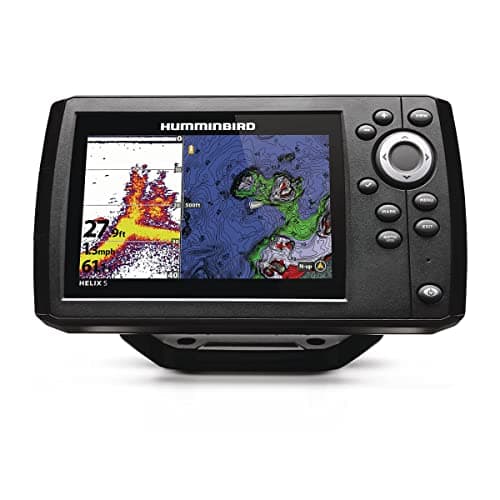
The HELIX 5 publishes 4,000 W peak-to-peak, 1,200 ft and AutoChart Live, with no imaging at all. The Eagle 7 publishes DownScan and SideScan to 600 ft per side, with no power output figure. Buy the Humminbird if you fish deep or want to map your own water. Buy the Lowrance if you want to see structure as a picture.
Reel & Rig earns a commission from qualifying purchases made through links on this page, at no extra cost to you. It does not change which gear we pick or what we say about it. Full disclosure.
Quick picks
| # | Product | Best for | Price |
|---|---|---|---|
| 1 | Best for depth and self-mapping Humminbird HELIX 5 CHIRP GPS G3 5 in at 800 x 480, Dual Spectrum CHIRP, 4,000 W peak-to-peak, 1,200 ft, AutoChart Live. | Deeper lakes, and anyone who wants to chart water nobody has surveyed | $349.99 · Check price on Amazon #ad how this is funded · price as of October 12, 2026 |
| 2 | 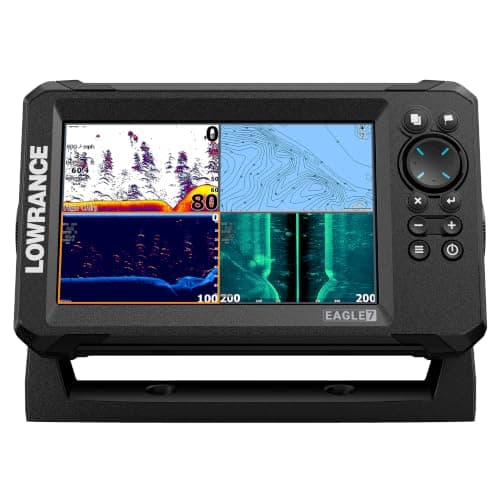 Best for seeing structure Lowrance Eagle 7 with TripleShot HD 7 in at 800 x 480 and 1000 nits, CHIRP plus DownScan and SideScan to 600 ft per side. | Shallower water, brush piles, laydowns and anyone who wants imaging | $599.99 · Check price on Amazon #ad how this is funded · price as of October 12, 2026 |
Each one publishes what the other leaves blank
This is the unusual thing about this pair, and it shapes the whole comparison. Humminbird publishes transmit power and maximum depth. Lowrance publishes brightness and imaging range. Neither publishes the other’s figures.
That is not a trick. It reflects what each maker thinks the buyer cares about, and it means a straight specification-for-specification comparison is impossible. What follows compares what is actually stated.
| Figure | HELIX 5 CHIRP GPS G3 | Eagle 7 TripleShot HD |
|---|---|---|
| Display | 5 in, 800 x 480 color TFT | 7 in, 800 x 480 |
| Brightness | Not published | 1000 nits |
| Sonar | Dual Spectrum CHIRP only | CHIRP, DownScan, SideScan |
| Imaging range | None | SideScan to 600 ft per side |
| Transmit power | 4,000 W P-P / 500 W RMS | Not published |
| Max depth | 1,200 ft (3,000 ft w/ 50 kHz) | Not published |
| Mapping | Basemap + AutoChart Live (8 h) | C-MAP inland, 17,000+ lakes |
| Dimensions | 7.55 x 4.64 x 3.3 in | 8.89 x 5.5 x 3.48 in |
| Current draw | 615 mA | 550 mA @ 12 V |
The published figure that surprises people
The 5 in unit draws more current than the 7 in one. 615 mA against 550 mA, both published.
Screen area is not the only thing consuming power — transmit power is, and the HELIX 5 is pushing 500 W RMS through its transducer. If you assumed the smaller unit was the frugal one because every other piece of electronics works that way, the spec sheet says otherwise.
It is a small difference in absolute terms. It is a useful reminder that on fish finders you should read the published draw rather than infer it from the screen size, particularly if you are running off the sort of small battery our battery page covers.
Imaging or power: which absence hurts more
The honest way to choose here is to work out which missing capability you would actually notice.
You would notice the missing imaging if you fish reservoirs with brush piles, laydowns and standing timber, or if you like to idle a flat and build a picture before you cast. This is most bass fishing on most impoundments, and it is why imaging sells.
You would notice the missing power if you fish deep, cold, clear lakes where the fish sit at 60 ft and the return is faint, or stained water where a weak signal disappears into noise. Trout and lake-trout water is the clearest case.
You would notice the missing AutoChart Live if your water is not well-surveyed. A farm pond, a small state lake, a new reservoir — none of those are in C-MAP’s 17,000 lakes in any useful detail, and drawing your own contours is the only way to get them.
The screen comparison is not what it looks like
Both publish 800 x 480. One spreads it over 5 in, the other over 7 in.
That means the Eagle 7 shows exactly the same amount of information, just larger. It is easier to read at a glance and easier to read at distance, and it is not more detailed. If you were hoping the bigger screen would resolve finer sonar detail, it will not.
It does make split screens usable. Running CHIRP alongside DownScan on a 5 in panel at this resolution leaves each pane very small; on 7 in it is workable. That is a real argument for the Lowrance if you intend to run two views at once.
Which to buy
HELIX 5 for deep or stained water, for anyone who wants to map their own lake, and for anyone whose budget stops well short of the Lowrance. It is the stronger sonar on the published numbers.
Eagle 7 for reservoir and impoundment fishing where structure is the target, for anyone who wants a bright 7 in screen, and for anyone who will use SideScan rather than merely own it.
If imaging is the reason you are buying, our under $500 page and main roundup both cover the step up from here.
So what do I actually buy?
The choice is between published power and published imaging, because no unit here offers both at this money. Decide which absence you would actually notice on your water.
Humminbird HELIX 5 CHIRP GPS G3
$349.994,000 W peak-to-peak, 1,200 ft and AutoChart Live. No imaging of any kind.
#ad how this is funded · price as of October 12, 2026
Lowrance Eagle 7 with TripleShot HD
$599.99SideScan to 600 ft per side on a 1000-nit 7 in screen. No published power figure.
#ad how this is funded · price as of October 12, 2026
Garmin STRIKER 4
$139.99If both are over budget: dual-beam CHIRP and GPS at a fraction of the price.
#ad how this is funded · price as of October 12, 2026
The picks, in full
Every card below lists the specs we could read off a published page, the URL they came from, and one honest reason you might not want it.
1. Best for depth and self-mapping
Humminbird HELIX 5 CHIRP GPS G3
Humminbird
5 in at 800 x 480, Dual Spectrum CHIRP, 4,000 W peak-to-peak, 1,200 ft, AutoChart Live.
4,000 W peak-to-peak and 500 W RMS is the headline figure, and it is a real one — Humminbird publishes it and Lowrance does not publish an equivalent for the Eagle 7. Transmit power is what buys you a readable return in deep water and in water with a lot of suspended sediment.
1,200 ft standard is published, extending to 3,000 ft with an optional 50 kHz transducer. For inland freshwater that is far more than anyone needs, which is the point: you will never be near the ceiling.
AutoChart Live is the feature that genuinely has no counterpart on the Eagle 7 spec. It records eight hours of your own depth data and draws contours of water that may not be on any chart. On a small lake or a farm pond that is worth more than any imaging mode, and our mapping page makes that argument in full.
Dual Spectrum CHIRP is published in three modes: narrow 180–240 kHz, wide 140–200 kHz and full 150–220 kHz, with coverage at 20, 42 and 60 deg. Wide mode is the one that finds fish; narrow is the one that separates them.
The drawback
No Down Imaging and no Side Imaging at all — this is the CHIRP-only unit in the HELIX 5 line, and if you want to look at brush piles as pictures it simply cannot. The screen is 5 in at 800 x 480 against 7 in at the same pixel count, so it is smaller in every sense. It also draws 615 mA at 12 V, which is more than the physically larger Eagle 7.
Published specs
- Display
- 5 in, 800H x 480V color TFT
- Transducer
- XNT 9 HW T
- Sonar
- Dual Spectrum CHIRP: narrow 180-240, wide 140-200, full 150-220 kHz
- Coverage
- 20, 42 and 60 deg @ -10 dB
- Max depth
- 1,200 ft standard (3,000 ft with optional 50 kHz)
- Power output
- 4,000 W peak-to-peak / 500 W RMS
- Mapping
- Humminbird Basemap, AutoChart Live (8 h)
- Waypoints
- 2,750 waypoints / 45 routes / 50 tracks
- Dimensions
- 7.55 W x 4.64 H x 3.3 D in (gimbal)
- Power draw
- 615 mA
Specs read from Rogers Sporting Goods — Humminbird HELIX 5 CHIRP GPS G3.
#ad how this is funded · price as of October 12, 2026
2. Best for seeing structure
Lowrance Eagle 7 with TripleShot HD
Lowrance
7 in at 800 x 480 and 1000 nits, CHIRP plus DownScan and SideScan to 600 ft per side.
SideScan to 600 ft per side is the capability the HELIX 5 does not have. Sweeping a flat and seeing where the brush actually is, rather than driving over it until the trace changes, is a genuinely different way to fish.
The screen is 7 in against 5 in, at the same published 800 x 480. Same pixels, bigger pixels — which is a real benefit for a set of aging eyes and a real limitation for imaging detail, as our Eagle 7 against Eagle 9 page sets out.
1000 nits is published, and it is the specification most worth having on open water at noon. Humminbird does not publish a brightness figure for the HELIX 5 in the source used here.
C-MAP inland covers 17,000+ US lakes out of the box. If your water is on that list you start with contours on day one, where AutoChart Live asks you to drive the lake first.
The drawback
Lowrance publishes no transmit power figure and no maximum depth figure for this unit in the source used here, so if you fish genuinely deep water you are buying without the number that would tell you whether it copes. There is no equivalent to AutoChart Live on the published spec, so unsurveyed water stays blank. And it costs meaningfully more than the HELIX 5.
Published specs
- Display
- 7 in, 800 x 480, 1000 nits
- Viewing angle
- 80 deg top/bottom, 80 deg left/right
- Transducer
- TripleShot HD
- Sonar
- CHIRP, DownScan Imaging, SideScan
- SideScan range
- Up to 600 ft per side
- Mapping
- C-MAP inland, 17,000+ US lakes
- Dimensions
- 8.89 x 5.5 x 3.48 in
- Power draw
- 550 mA @ 12 V, full backlight
- Operating temp
- 5 to 131 deg F
Specs read from L&M Fleet Supply — Lowrance Eagle 7 with TripleShot HD Transducer.
#ad how this is funded · price as of October 12, 2026
Questions people actually ask
Is the Humminbird HELIX 5 or the Lowrance Eagle 7 better?
They are built for different water. The HELIX 5 publishes 4,000 W peak-to-peak, 1,200 ft and AutoChart Live but has no imaging. The Eagle 7 publishes DownScan and SideScan to 600 ft per side but no transmit power or depth figure.
Does the HELIX 5 CHIRP GPS G3 have down imaging?
No. This is the CHIRP-only model in the HELIX 5 line. Humminbird publishes Dual Spectrum CHIRP in narrow, wide and full modes, and no imaging modes at all.
Which fish finder is better for deep water?
On published figures, the HELIX 5. It states 4,000 W peak-to-peak, 500 W RMS and a 1,200 ft maximum depth. Lowrance publishes neither figure for the Eagle 7 in the source used here.
What is AutoChart Live and does the Eagle 7 have it?
It records up to eight hours of your own depth soundings and draws contour maps of water that may not be charted. Humminbird publishes it on the HELIX 5. There is no equivalent on the Eagle 7 published spec.
Does a bigger fish finder screen show more detail?
Not if the resolution is the same. Both units publish 800 x 480, so the 7 in Eagle shows identical detail at a larger size. It does make split screens genuinely usable, which a 5 in panel at this resolution does not.
Read next
Sources
Prices on this page come from the retailer at request time and change without notice. If we cannot get a live one we say “check price” rather than show you a number that has gone stale. How we pick.