Electronics
Humminbird HELIX 5 against HELIX 5 DI: one transducer apart
Two units that share a case, a screen, a GPS chip and a power budget. Everything the extra money buys is on the end of the cable.
By Sawyer V. · Last updated · How we pick
The short answer
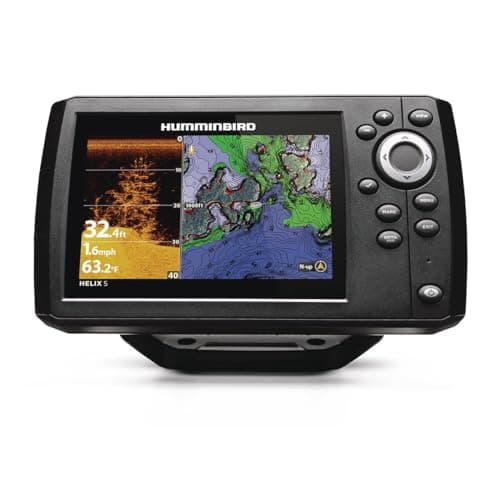
Buy the DI. The two units publish the same 5 in 800 x 480 screen, the same 4,000 W peak-to-peak output, the same 615 mA draw, the same 20, 42 and 60 degree cones, the same Basemap and AutoChart Live, and the same case dimensions. The whole difference is the transducer: the DI ships an XNT 9 HW DI T and adds 455 kHz Down Imaging to a published 350 ft. The step between their prices is the smallest on this site. Skip it only if you fish deeper than 350 ft or specifically want the narrow 180–240 kHz CHIRP mode the 2D listing publishes.
Reel & Rig earns a commission from qualifying purchases made through links on this page, at no extra cost to you. It does not change which gear we pick or what we say about it. Full disclosure.
Quick picks
| # | Product | Best for | Price |
|---|---|---|---|
| 1 | Best of the pair Humminbird HELIX 5 CHIRP DI GPS G3 XNT 9 HW DI T transducer, 455 kHz Down Imaging to a published 350 ft, on the same head unit as the 2D model. | Almost everyone buying a 5 inch Humminbird | $375.66 · Check price on Amazon #ad how this is funded · price as of October 12, 2026 |
| 2 | 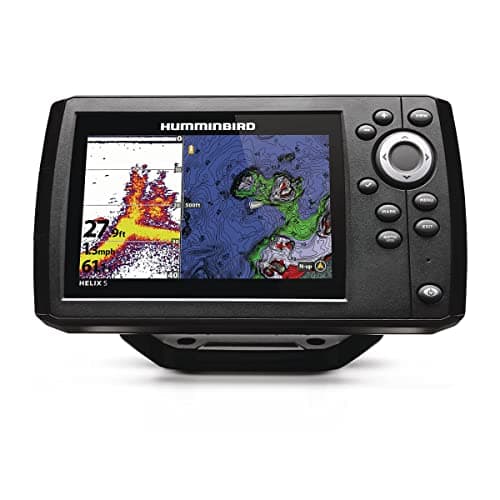 The one to buy if you fish deep or open water Humminbird HELIX 5 CHIRP GPS G3 XNT 9 HW T transducer, published 1,200 ft standard and 3,000 ft with an optional 50 kHz transducer, plus a narrow 180-240 kHz CHIRP mode. | Deep lakes, trolling open basins, and anyone who will not use imaging | $349.99 · Check price on Amazon #ad how this is funded · price as of October 12, 2026 |
What is genuinely identical
It is worth laying this out plainly, because the model names make the pair sound further apart than the published figures do. Every one of these is the same on both units.
- 5 in display, 800H x 480V, 16-bit color
- Beam coverage: 20, 42 and 60 degrees at −10 dB
- Standard sonar depth: 1,200 ft
- Power output: 4,000 W peak-to-peak, 500 W RMS
- Current draw: 615 mA
- Input: 10.8–20 VDC
- Internal GPS with Humminbird Basemap, 10,000-plus lakes plus coastal
- AutoChart Live with eight hours of recording built in
- LakeMaster, CoastMaster and Navionics chart compatibility
- Gimbal dimensions: 7.55 W x 4.64 H x 3.3 D in
- Full-mode CHIRP span: 150–220 kHz
That is the screen, the processor’s navigation feature set, the power budget, the physical footprint and the mounting hardware. The same case goes on the same bracket and draws the same current from the same battery.
The published differences, in one table
Both columns are read from the retailer specification pages linked at the bottom of this page. Where one retailer publishes a figure and the other does not, the table says so rather than filling the gap.
| Figure | HELIX 5 CHIRP GPS G3 | HELIX 5 CHIRP DI GPS G3 |
|---|---|---|
| Transducer | XNT 9 HW T | XNT 9 HW DI T |
| Sonar | Dual Spectrum CHIRP 2D | Dual Spectrum CHIRP + CHIRP Down Imaging |
| Frequencies supported | 50/80/200 kHz | 50/83/200/455 kHz |
| CHIRP modes published | Narrow 180-240, wide 140-200, full 150-220 kHz | 83/200 (75-155 / 130-250), full 150-220 kHz |
| Down Imaging | None | 455 kHz |
| Down Imaging depth | Not applicable | 350 ft |
| Max depth, standard | 1,200 ft | 1,200 ft |
| Max depth, optional 50 kHz | 3,000 ft | Not published |
| Waypoints / routes / tracks | 2,750 / 45 / 50 | Not published |
| Warranty | Not published | 1-year limited |
| Screen, power, draw, cones, size | Identical on both, see the list above | |
Eleven rows of specification and only four of them describe the head unit at all. The rest is the thing on the end of the cable.
The transducer is the product
This is the useful general lesson, and it applies far beyond these two boxes.
A fish finder is a screen, a processor and a transducer. The screen decides how well you can see the data. The transducer decides what data exists at all. Everything Humminbird calls “DI” on this model is a different lump of ceramic on the transom, and the head unit simply knows what to do when it is plugged in.
That is why the price step between these two is so small, and it is also why the step from either of them to a MEGA imaging unit is so large — that jump buys a genuinely different transducer and a bigger screen to put the picture on. Our installation page makes the same point from the other end: the transducer mount is the whole job, and a good unit with a badly mounted transducer shows you nothing.
What Down Imaging actually shows, and what it does not
Down imaging is a high-frequency, very thin beam that produces a near-photographic slice of what is directly under the boat. At 455 kHz it resolves individual branches on a laydown, the posts under a dock and the edge of a weed line.
What it is good at: telling cover from fish. On 2D CHIRP a crappie sitting in a brush pile is an arch inside a mess. On down imaging it is a dot beside a branch.
What it is bad at: depth and speed. The published 350 ft ceiling is a third of the standard sonar range, high frequency loses energy quickly in water, and the thin beam means you see less to each side of the boat than 2D does. Our sonar types page works through the trade in detail.
What it is not: side imaging, and not live sonar. It looks down, not out, and it draws history as you move rather than showing the present. If what you actually want is to watch a lure fall next to a fish, that is a different and much more expensive category — our live sonar comparison covers what that really costs.
The 350 foot ceiling, and who it genuinely rules out
Almost nobody, on the water this site is written for.
Most freshwater fishing in the United States happens in under 60 ft, and a great deal of it in under 25. A 350 ft imaging ceiling is not a constraint on a reservoir, a river, a pond or any natural lake outside a short list of deep ones.
It matters if you fish deep natural lakes, mountain reservoirs or the Great Lakes offshore, where you may be marking fish at depths the DI channel simply cannot reach. In that case the 2D unit’s published 3,000 ft option with an optional 50 kHz transducer is the only figure in this comparison that speaks to your problem.
For everyone else, the 1,200 ft standard sonar on both units is already far more than the water holds.
The CHIRP mode difference, which nobody mentions
Here is the part of this comparison we cannot close honestly, and it is worth stating plainly rather than glossing.
Rogers publishes the 2D unit’s Dual Spectrum CHIRP as narrow 180–240 kHz, wide 140–200 kHz and full 150–220 kHz. L&M publishes the DI unit’s as 83/200 kHz with spans of 75–155 and 130–250 kHz, plus the same full 150–220 kHz mode.
Those are different descriptions of the same feature name, from two different retailers. The DI set includes a low-frequency 83 kHz span that penetrates deeper and covers wider; the 2D set includes a narrow 180–240 kHz band that separates targets more finely. We do not know whether that reflects a real difference in what the two transducers can do or simply two shops writing their spec tables differently, and Humminbird does not publish a figure that resolves it.
What that means for you: not much, practically. Both units publish the same beam angles, the same power and the same full CHIRP mode, which is the mode most people leave the unit in. We mention it because it is the one row in the table where the pair might not be identical under the plastic, and pretending otherwise would be the easy thing to do.
Which one, by the water you fish
Brush piles, docks, laydowns, standing timber. The DI, without hesitation. This is the exact job down imaging exists for, and it is most of crappie and bass fishing.
A first fish finder, by someone still learning to read sonar. The DI. The imaging view is readable on day one and the 2D view is not, and a screen you can read is the one you will actually use. Our beginner fish finder page makes the same argument at more length.
Trolling open water for walleye or suspended fish. Either, and the 2D unit costs less. You will be reading the 2D screen regardless; down imaging shows you a thin strip directly under the hull, which is not where the fish you are trolling for are.
Deep natural lakes and reservoirs. The 2D unit, specifically for the published 3,000 ft option.
Ice. Either works, and neither is ideal. Our flasher against fish finder page explains why a flasher still wins for vertical jigging, and our ice electronics page covers the conversion kit you would need either way.
If you want side imaging too. Neither. That is a different transducer and a bigger screen, and it starts at the HELIX 7 MEGA SI. Our under $1000 page covers that bracket.
What neither of them publishes
Three gaps, stated because they are the figures a buyer would want and cannot get.
Screen brightness in nits. Neither retailer publishes it. On a 5 in screen in open sun this is a real question, and both competitors on our HELIX 5 against Eagle 7 page publish 1000 nits where Humminbird publishes nothing.
An IP water-ingress rating. Not published for either unit on the pages we read. On a boat, that is not a trivial omission.
Waypoint capacity on the DI model. Rogers publishes 2,750 waypoints, 45 routes and 50 tracks for the 2D unit. L&M publishes no equivalent for the DI. They are the same head unit and the figures are almost certainly the same, but we are not going to assert a number that nobody printed.
You will also need a battery and a mount, neither of which comes with either unit. Our fish finder battery page does the amp-hour arithmetic on that 615 mA draw, and if you are rigging a small boat, a mounting arm and transducer bracket is the other thing to budget for.
The honest summary
These are the same fish finder with two different transducers in the box, sold a short step apart. For the overwhelming majority of freshwater anglers the imaging channel is worth that step, and for the small number who fish very deep water or troll open basins it is not.
What should not happen is anyone agonizing over it. The screen, the GPS, the mapping, the power and the mounting are the same unit, so whichever you buy, you have bought the same machine.
So what do I actually buy?
Buy the DI unless you have a specific reason not to. If you want imaging on a bigger screen with side imaging as well, the third option here is the next real step up rather than a variation on the same unit.
Humminbird HELIX 5 CHIRP DI GPS G3
$375.66XNT 9 HW DI T and 455 kHz down imaging to a published 350 ft. The one to buy.
#ad how this is funded · price as of October 12, 2026
Humminbird HELIX 5 CHIRP GPS G3
$349.99Same head unit, 2D only, with a published 3,000 ft option on a 50 kHz transducer.
#ad how this is funded · price as of October 12, 2026
Humminbird HELIX 7 CHIRP MEGA SI GPS G4
$699.00A genuinely different machine: MEGA down and side imaging, 250 ft per side, 7 in screen.
#ad how this is funded · price as of October 12, 2026
The picks, in full
Every card below lists the specs we could read off a published page, the URL they came from, and one honest reason you might not want it.
1. Best of the pair
Humminbird HELIX 5 CHIRP DI GPS G3
Humminbird
XNT 9 HW DI T transducer, 455 kHz Down Imaging to a published 350 ft, on the same head unit as the 2D model.
The reason to buy this one is not that it is better electronics. It is the same electronics. L&M Fleet Supply and Rogers Sporting Goods publish identical figures for the screen (5 in, 800H x 480V, 16-bit), the power output (4,000 W peak-to-peak, 500 W RMS), the current draw (615 mA), the input range (10.8–20 VDC), the beam coverage (20, 42 and 60 degrees at −10 dB) and the gimbal dimensions (7.55 x 4.64 x 3.3 in).
What you are paying for is the XNT 9 HW DI T transducer in the box instead of the XNT 9 HW T, and the 455 kHz Down Imaging channel that comes with it. Humminbird publishes 455 kHz DI to 350 ft, alongside the 1,200 ft standard sonar depth both units share.
Down Imaging is worth having on a small screen for one specific reason: it is the easiest sonar view to read. Traditional CHIRP returns are arches and blobs that take a season to interpret; a down imaging picture looks like what is under the boat. Our reading a fish finder page makes the case that 2D sonar is a graph of time rather than a photograph, which is exactly the part beginners find hard.
The 455 kHz channel is also what separates fish from cover. Over a brush pile, a laydown or standing timber, 2D CHIRP gives you a messy return and down imaging gives you branches with fish beside them. That is the whole reason our crappie fish finder page specifies a DI unit, and the single most common use this hull size gets.
The drawback
The published Down Imaging ceiling is 350 ft, against 1,200 ft for the standard sonar on both units — so on genuinely deep water the imaging channel stops long before the sonar does. L&M's listing for this model also publishes the Dual Spectrum CHIRP modes as 83/200 kHz (75-155 and 130-250 kHz) plus Full, and does not list the narrow 180-240 kHz mode that Rogers publishes for the 2D unit; we cannot tell from two retailers' pages whether that is a hardware difference or a listing difference, and Humminbird does not resolve it. L&M publishes a 1-year limited warranty, which is short for this money.
Published specs
- Display
- 5 in widescreen, 800H x 480V, 16-bit color
- Transducer
- XNT 9 HW DI T
- Sonar
- Dual Spectrum CHIRP 83/200 kHz (75-155 / 130-250 kHz)
- Down Imaging
- 455 kHz (420-520 kHz)
- Coverage
- 20, 42 and 60 deg @ -10 dB
- Max depth
- 1,200 ft sonar / 350 ft Down Imaging
- Power output
- 4,000 W peak-to-peak / 500 W RMS
- Mapping
- Built-in GPS, AutoChart Live (8 h), LakeMaster/Navionics ready
- Dimensions
- 7.55 W x 4.64 H x 3.3 D in (gimbal)
Specs read from L&M Fleet Supply — Humminbird HELIX 5 CHIRP DI GPS G3.
#ad how this is funded · price as of October 12, 2026
2. The one to buy if you fish deep or open water
Humminbird HELIX 5 CHIRP GPS G3
Humminbird
XNT 9 HW T transducer, published 1,200 ft standard and 3,000 ft with an optional 50 kHz transducer, plus a narrow 180-240 kHz CHIRP mode.
Rogers publishes two things for this unit that the DI listing does not, and both point the same way: at depth and at open water.
The first is 3,000 ft with an optional 50 kHz transducer, against 1,200 ft on the standard one. That is not a figure most freshwater anglers will ever need, and if you are one of the few who do, it exists only on this side of the pair as published.
The second is the published CHIRP mode set: narrow 180–240 kHz, wide 140–200 kHz, full 150–220 kHz. A narrow high-frequency band gives the tightest target separation this platform publishes, which is what you want when you are trying to pick individual fish out of a tight school rather than see structure. Our sonar types page covers why frequency and cone width trade against each other.
Rogers also publishes the navigation capacity for this unit — 2,750 waypoints, 45 routes, 50 tracks and 20,000 track points — which L&M does not list for the DI version. Both ship Humminbird Basemap with 10,000-plus lakes and AutoChart Live with eight hours of recording. Our mapping page covers what AutoChart Live actually does.
If you troll open basins for walleye or suspended fish, you will look at the 2D screen almost all of the time anyway. There is no dishonest reason to buy down imaging you will never open.
The drawback
No imaging at all, and on a 5 inch screen that is the view most people find readable. You also lose the 455 kHz channel entirely, so separating fish from brush is back to interpreting 2D arches. Rogers publishes 50/80/200 kHz for the supported frequencies where L&M publishes 50/83/200/455 for the DI — 80 against 83 kHz is almost certainly a listing typo rather than a real difference, and neither retailer resolves it. Rogers publishes no warranty term for this unit at all.
Published specs
- Display
- 5 in, 800H x 480V color TFT
- Transducer
- XNT 9 HW T
- Sonar
- Dual Spectrum CHIRP: narrow 180-240, wide 140-200, full 150-220 kHz
- Coverage
- 20, 42 and 60 deg @ -10 dB
- Max depth
- 1,200 ft standard (3,000 ft with optional 50 kHz)
- Power output
- 4,000 W peak-to-peak / 500 W RMS
- Mapping
- Humminbird Basemap, AutoChart Live (8 h)
- Waypoints
- 2,750 waypoints / 45 routes / 50 tracks
- Dimensions
- 7.55 W x 4.64 H x 3.3 D in (gimbal)
- Power draw
- 615 mA
Specs read from Rogers Sporting Goods — Humminbird HELIX 5 CHIRP GPS G3.
#ad how this is funded · price as of October 12, 2026
Questions people actually ask
What is the difference between the HELIX 5 and the HELIX 5 DI?
The transducer. The DI ships an XNT 9 HW DI T and adds a 455 kHz Down Imaging channel to a published 350 ft; the standard unit ships an XNT 9 HW T with 2D sonar only. The screen, GPS, mapping, 4,000 W output, 615 mA draw, beam angles and case dimensions are published identically on both.
Is the HELIX 5 DI worth the extra money?
For most freshwater fishing, yes. The price step between them is the smallest between any two fish finders on this site, and down imaging is the view that separates fish from brush and is far easier for a new owner to read than 2D arches.
How deep does HELIX 5 Down Imaging go?
Humminbird publishes 455 kHz Down Imaging to 350 ft. The standard sonar on both the DI and the non-DI unit is published to 1,200 ft, so the imaging channel stops well before the sonar does.
Does the HELIX 5 DI have side imaging?
No. Down Imaging looks straight down in a thin slice; side imaging scans outward from the hull and needs a different transducer. On Humminbird that starts with the MEGA SI units on a 7 in screen.
Do the HELIX 5 and HELIX 5 DI use the same mapping?
Yes. Both publish internal GPS with Humminbird Basemap covering 10,000-plus lakes plus coastal, AutoChart Live with eight hours of recording, and compatibility with LakeMaster, CoastMaster and Navionics charts.
Which HELIX 5 should I buy for crappie fishing?
The DI. Crappie hold in brush piles and standing timber, and the 455 kHz imaging channel is what tells a fish from a branch. That is why our crappie fish finder page specifies a down imaging unit.
Do the two units draw different amounts of power?
No. Both publish 615 mA at 10.8 to 20 VDC and 4,000 W peak-to-peak output, so the same battery lasts the same length of time on either.
Read next
Sources
Prices on this page come from the retailer at request time and change without notice. If we cannot get a live one we say “check price” rather than show you a number that has gone stale. How we pick.