Electronics
Garmin LiveScope against Lowrance ActiveTarget: what live sonar really costs
Five pages on this site mention live sonar as the thing above the budget. This is the page that says what it is, what it publishes, and what it actually costs.
By Sawyer V. · Last updated · How we pick
The short answer
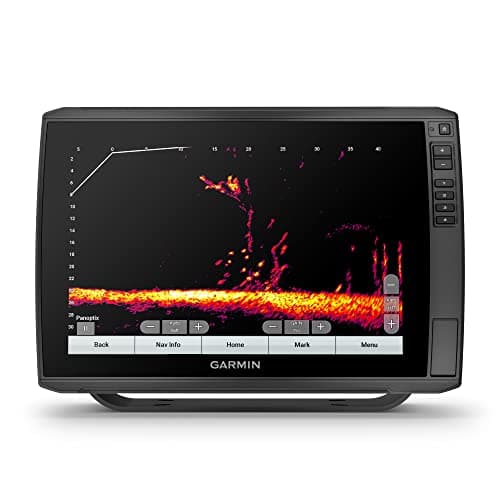
Both publish a 200 ft maximum and a 20 degree beam. The real decision is which brand of chartplotter you already own, because neither system includes a display and neither one will run on the fish finders this site normally recommends. Budget for the sonar plus a compatible head unit, or do not budget for it at all.
Reel & Rig earns a commission from qualifying purchases made through links on this page, at no extra cost to you. It does not change which gear we pick or what we say about it. Full disclosure.
Quick picks
| # | Product | Best for | Price |
|---|---|---|---|
| 1 | Best live sonar system Garmin LiveScope Plus System (GLS 10 and LVS34) GLS 10 black box plus LVS34 transducer, 530-1,100 kHz, 200 ft, 135 deg front to back by 20 deg side to side. | Anyone already running a compatible Garmin GPSMAP or ECHOMAP | $1,439.99 · Check price on Amazon #ad how this is funded · price as of October 12, 2026 |
| 2 | 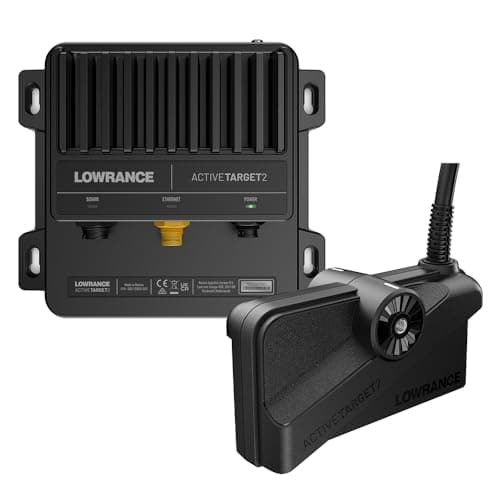 Best for an existing Lowrance network Lowrance ActiveTarget 2 (module, transducer and mounts) Module plus transducer and mounts, 650-1,300 kHz, 200 ft, 20 x 180 deg beam, 1.5 A at 13.8 V. | Anyone already running HDS Pro, HDS Live, HDS Carbon or Elite FS | $1,399.00 · Check price on Amazon #ad how this is funded · price as of October 12, 2026 |
| 3 | 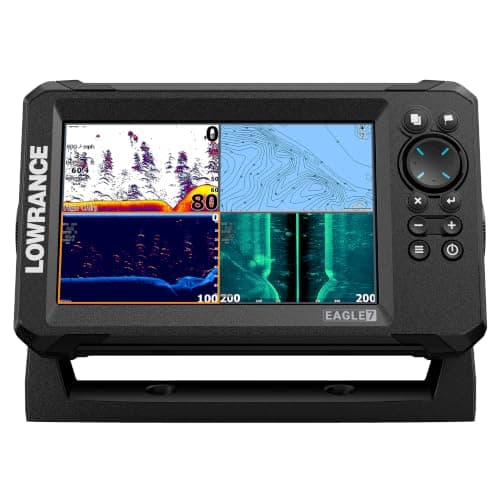 What most readers should buy instead Lowrance Eagle 7 with TripleShot HD 7 in at 800 x 480 and 1000 nits, CHIRP plus DownScan and SideScan to 600 ft per side, 550 mA. | Almost everyone reading this page | $599.99 · Check price on Amazon #ad how this is funded · price as of October 12, 2026 |
The price on the box is not the price
This is the most useful thing on the page, so it goes first. Neither of these systems is a fish finder. Both are sonar modules that need a compatible display you buy separately.
Garmin publishes the LiveScope pairing list as GPSMAP 9000, GPSMAP 9000xsv, GPSMAP x3, ECHOMAP Ultra 2 and ECHOMAP UHD2. Lowrance publishes ActiveTarget 2 as interfacing over Ethernet to HDS Pro, HDS Live, HDS Carbon and Elite FS.
Now read those lists against what this site actually recommends. The main roundup leads with STRIKER, PiranhaMAX, HELIX and Eagle units. None of them appears on either compatibility list.
So for most readers here the real entry cost is the sonar system plus a compatible chartplotter, which roughly doubles it. That is not a reason never to buy live sonar. It is a reason to know the number before you start.
The published figures, side by side
| Figure | Garmin LiveScope Plus (LVS34) | Lowrance ActiveTarget 2 |
|---|---|---|
| Frequencies | 530 to 1,100 kHz | 650 to 1,300 kHz |
| Max depth / distance | 61 m (200 ft) | 200 ft (60.96 m) |
| Beam / field of view | 135 deg front to back, 20 deg side to side | 20 x 180 deg |
| Power draw | Not published | 1.5 A max at 13.8 V |
| Transducer cable | Not published in the spec table | 7.62 m (25 ft) |
| Transducer weight | 1,018 g (2.25 lb) | Module 1.86 kg (4.12 lb) |
| Operating temperature | -10 to 40 C (14 to 104 F) | Module -15 to 55 C (5 to 131 F) |
| Display included | No | No |
The headline range figures are effectively identical: both makers publish 200 ft, and Garmin qualifies it as dependent on water conditions. Nobody is winning this on reach.
What the numbers do and do not tell you
Frequency is the one real difference. Lowrance publishes a higher band at both ends, 650–1,300 against 530–1,100 kHz. Higher frequency generally resolves finer detail over shorter distances; lower frequency generally reaches further through water with less detail.
That is physics rather than marketing, and it is the same principle our sonar types page applies to CHIRP and imaging. What it does not let you do is conclude which screen looks better, because neither maker publishes a target-separation figure and image processing matters at least as much as frequency.
The beam numbers are written differently and describe similar shapes. Garmin gives 135 by 20 degrees; Lowrance gives 20 by 180. Both are a narrow slice in one axis and a wide fan in the other. Do not read the 180 against the 135 as a 33 per cent advantage — they are not necessarily measured the same way.
Only one publishes power draw. Lowrance states 1.5 A maximum at 13.8 V. Garmin’s LVS34 specification table does not carry a figure, which is awkward if you are sizing a battery for a long day.
Brand lock-in is the actual decision
Everything above is close enough that it should not decide your purchase. What decides it is what is already on your boat.
If you run a compatible Garmin chartplotter, buy LiveScope. If you run a compatible Lowrance display, buy ActiveTarget. Crossing brands means replacing the display too, and at that point you are rebuilding the whole electronics package rather than adding to it.
If you run neither — which covers most readers of this site — then you are choosing an ecosystem, not a transducer, and that is a much larger decision than this page. Our brand comparison is the better starting point for it.
Who should genuinely buy this
Tournament anglers, where locating and watching individual fish converts directly into weight at the scales, and the cost is a business expense.
Anglers targeting suspended fish — crappie over brush in deep water, walleye suspended over basins. Watching a jig fall to a fish you can see is a different activity from fishing blind, and this is where live sonar earns its reputation.
People who already own the compatible display. If the head unit is already there, the decision is just the sonar module and the maths is much better.
Nearly everyone else is better served by spending a fraction of it on conventional imaging and the rest on fishing. Our under $1000 page is where that budget goes furthest.
What to learn first, if you are considering it
Live sonar is harder to read than a conventional screen, not easier. You are interpreting a moving slice of water from a transducer that rotates, which means orientation is something you have to hold in your head.
Anyone who cannot yet read a conventional sonar return fluently — tell bottom hardness from a trace, recognize bait from clutter, judge depth of a return at a glance — will not get value from live sonar, because the harder display does not remove the need for the easier skill.
Our reading guide covers the conventional screen, and it is genuinely the prerequisite rather than a consolation prize.
What this page is not claiming
We have not compared image quality, because that cannot be done from published specifications and this site does not claim testing it has not done. Neither maker publishes a target-separation figure, so any statement about which looks clearer would be opinion dressed as fact.
We have also not put a catch-rate figure anywhere on this page. Claims that live sonar increases catch rates by a specific percentage are common and we have no source for one, so there is not a number here.
Everything above is what Garmin and Lowrance publish about their own products, plus the compatibility lists they publish, plus arithmetic. Where a figure is missing — the Garmin power draw, the Garmin cable length — the table says so rather than guessing.
So what do I actually buy?
Buy the system that matches the display you already own. If you do not own a compatible display, the honest answer is the third option here.
Garmin LiveScope Plus System (GLS 10 and LVS34)
$1,439.99530-1,100 kHz, 200 ft, three viewing modes. Needs a compatible GPSMAP or ECHOMAP.
#ad how this is funded · price as of October 12, 2026
Lowrance ActiveTarget 2 (module, transducer and mounts)
$1,399.00650-1,300 kHz, 200 ft, 1.5 A published. Needs HDS Pro, HDS Live, HDS Carbon or Elite FS.
#ad how this is funded · price as of October 12, 2026
Lowrance Eagle 7 with TripleShot HD
$599.99SideScan to 600 ft per side, works on its own, a fraction of the price. Start here.
#ad how this is funded · price as of October 12, 2026
The picks, in full
Every card below lists the specs we could read off a published page, the URL they came from, and one honest reason you might not want it.
1. Best live sonar system
Garmin LiveScope Plus System (GLS 10 and LVS34)
Garmin
GLS 10 black box plus LVS34 transducer, 530-1,100 kHz, 200 ft, 135 deg front to back by 20 deg side to side.
A published field of view of 135 degrees front to back by 20 degrees side to side is the figure that explains what this does. It is a tall, narrow slice of water aimed wherever the transducer points — so you sweep it like a torch beam rather than reading a trace of where the boat has already been.
The system is published as the GLS 10 sonar black box plus the LVS34 transducer. Three viewing modes are published — forward, down and perspective — with perspective requiring the separate bracket.
530 to 1,100 kHz is the published frequency range, lower at the bottom end than the Lowrance. Lower frequencies generally carry further and resolve less finely; higher ones do the reverse, which is the trade running underneath both of these systems.
Garmin publishes the transducer at 1,018 g (2.25 lb) and 161.7 x 77.5 x 47.8 mm. That is a substantial object to hang off a trolling motor shaft, and our installation page is worth reading before you commit to a mounting position.
The drawback
It does not work on its own. Garmin's own pairing guide lists GPSMAP 9000, 9000xsv and x3, ECHOMAP Ultra 2 and ECHOMAP UHD2 — and the STRIKER line this site recommends elsewhere is not among them, so a STRIKER owner is buying a chartplotter too. Garmin publishes no power draw figure in the LVS34 specification table, which is a real omission when the thing runs off a battery you are also carrying. And the published 200 ft maximum is qualified as dependent on water conditions.
Published specs
- System
- GLS 10 sonar black box plus the LVS34 transducer
- Frequencies
- 530 to 1,100 kHz
- Max depth / distance
- 61 m (200 ft), published as dependent on water conditions
- Field of view
- 135 deg front to back, 20 deg side to side
- Viewing modes
- Forward, down and perspective (perspective needs the bracket)
- Transducer size
- 161.7 x 77.5 x 47.8 mm (6.37 x 3.05 x 1.88 in)
- Transducer weight
- 1,018 g (2.25 lb)
- Operating temperature
- -10 to 40 C (14 to 104 F)
- Display required
- A compatible chartplotter, sold separately. Garmin's pairing guide lists GPSMAP 9000, 9000xsv and x3, ECHOMAP Ultra 2 and ECHOMAP UHD2
- Power draw
- Garmin does not publish one in the LVS34 specification table
Specs read from Garmin - LiveScope Plus LVS34 Transducer Specifications.
#ad how this is funded · price as of October 12, 2026
2. Best for an existing Lowrance network
Lowrance ActiveTarget 2 (module, transducer and mounts)
Lowrance
Module plus transducer and mounts, 650-1,300 kHz, 200 ft, 20 x 180 deg beam, 1.5 A at 13.8 V.
650 to 1,300 kHz is a higher band than the Garmin at both ends. Higher frequency generally means finer target separation, which is the single thing live sonar is bought for, though neither maker publishes a target-separation figure you could compare.
A published current drain of 1.5 A maximum at 13.8 V is the number Garmin does not give you, and it matters. On a boat where the trolling motor and the electronics share a battery, knowing the draw is how you size the pack — the arithmetic is on our battery page.
The kit is published as module, transducer and mounts with a 7.62 m (25 ft) transducer cable, and the module interfaces over Ethernet. Twenty-five feet is generous and it matters on a bigger boat where the display is a long way from the bow.
Beamwidth is published as 20 x 180 degrees. Read that alongside Garmin’s 135 by 20 and the two are closer than the different wording suggests: a narrow slice in one axis, a wide fan in the other.
The drawback
Same fundamental problem: it is published as needing an HDS Pro, HDS Live, HDS Carbon or Elite FS display over Ethernet. The Eagle series this site recommends is not on that list, so an Eagle owner upgrading to ActiveTarget is buying a new display as well. Stock on the complete kit was thin at the time of writing — low enough that it may be gone before you read this. And at 1.86 kg for the module alone, this is a permanent installation rather than something you move between boats.
Published specs
- System
- ActiveTarget 2 module plus transducer and mounts
- Frequencies
- 650 to 1,300 kHz
- Max depth
- 200 ft (60.96 m)
- Beamwidth
- 20 deg x 180 deg
- Transducer cable
- 7.62 m (25 ft)
- Power supply
- 12/24 V DC, operating range 10.8 to 31.2 V DC
- Current drain
- 1.5 A at 13.8 V maximum
- Module operating temperature
- -15 to 55 C (5 to 131 F)
- Display required
- A compatible display, sold separately. Published as Ethernet to HDS Pro, HDS Live, HDS Carbon or Elite FS
- Module weight
- 1.86 kg (4.12 lb)
Specs read from Lowrance - ActiveTarget 2 Specifications.
#ad how this is funded · price as of October 12, 2026
3. What most readers should buy instead
Lowrance Eagle 7 with TripleShot HD
Lowrance
7 in at 800 x 480 and 1000 nits, CHIRP plus DownScan and SideScan to 600 ft per side, 550 mA.
This is on the page because the buyer-first answer to “which live sonar should I buy” is usually “none of them, yet”, and a comparison page that will not say so is not being straight with you.
SideScan to a published 600 ft per side finds brush piles, laydowns and timber. That is the job most people think they are buying live sonar for, and a unit at a fraction of the price already does it.
It also works on its own. No black box, no second display, no network — the transducer and the head unit are the whole purchase, which is the single biggest practical difference on this page.
Our Eagle 7 against Eagle 9 page covers the screen-size decision, and our five decisions guide covers whether you need imaging at all.
The drawback
It is not live sonar and this page should not pretend otherwise. You cannot watch a fish react to a lure in real time with it, and for someone fishing competitively that is a genuine capability gap rather than a luxury. Lowrance publishes no transmit power figure and no maximum depth figure for it either.
Published specs
- Display
- 7 in, 800 x 480, 1000 nits
- Viewing angle
- 80 deg top/bottom, 80 deg left/right
- Transducer
- TripleShot HD
- Sonar
- CHIRP, DownScan Imaging, SideScan
- SideScan range
- Up to 600 ft per side
- Mapping
- C-MAP inland, 17,000+ US lakes
- Dimensions
- 8.89 x 5.5 x 3.48 in
- Power draw
- 550 mA @ 12 V, full backlight
- Operating temp
- 5 to 131 deg F
Specs read from L&M Fleet Supply — Lowrance Eagle 7 with TripleShot HD Transducer.
#ad how this is funded · price as of October 12, 2026
Questions people actually ask
What is the best live fish finder?
Garmin LiveScope Plus and Lowrance ActiveTarget 2 publish nearly identical headline figures — both 200 ft maximum with a 20 degree narrow axis. The right one is whichever matches the chartplotter brand already on your boat.
Does LiveScope work on its own?
No. It is a sonar black box and transducer that needs a compatible display. Garmin's pairing guide lists GPSMAP 9000, 9000xsv and x3, ECHOMAP Ultra 2 and ECHOMAP UHD2 — the STRIKER series is not among them.
Will ActiveTarget work with a Lowrance Eagle?
Lowrance publishes ActiveTarget 2 as interfacing over Ethernet to HDS Pro, HDS Live, HDS Carbon and Elite FS. The Eagle series is not on that published list, so budget for a compatible display as well.
How deep does live sonar reach?
Both makers publish a 200 ft maximum — Garmin as 61 m and Lowrance as 60.96 m. Garmin qualifies its figure as dependent on water conditions. Neither is limited by depth for most freshwater fishing.
Is live sonar worth it for a casual angler?
Usually not. The real cost is the sonar plus a compatible display, and it is harder to read than a conventional screen rather than easier. Conventional side imaging already finds structure for a fraction of the money.
What is the difference between LiveScope and ActiveTarget frequencies?
Lowrance publishes 650 to 1,300 kHz and Garmin publishes 530 to 1,100 kHz. Higher frequencies generally resolve finer detail at shorter range, but neither maker publishes a target separation figure you could compare directly.
Read next
Sources
Prices on this page come from the retailer at request time and change without notice. If we cannot get a live one we say “check price” rather than show you a number that has gone stale. How we pick.