Ice
The best line for ice fishing, and why it goes lighter than you expect
Thin line lets a 1/32 oz jig drop naturally. Thick line holds it up, and the drop is the entire presentation.
By Sawyer V. · Last updated · How we pick
The short answer
Spool 2–4 lb line for ice. The reason is not visibility, it is the fall: water resistance on a thick line physically holds a 1/32 oz jig up and flattens its drop, and the drop is when winter fish take it. Monofilament is the forgiving default; fluorocarbon buys lower stretch in cold water at the cost of stiffness.
Reel & Rig earns a commission from qualifying purchases made through links on this page, at no extra cost to you. It does not change which gear we pick or what we say about it. Full disclosure.
Quick picks
| # | Product | Best for | Price |
|---|---|---|---|
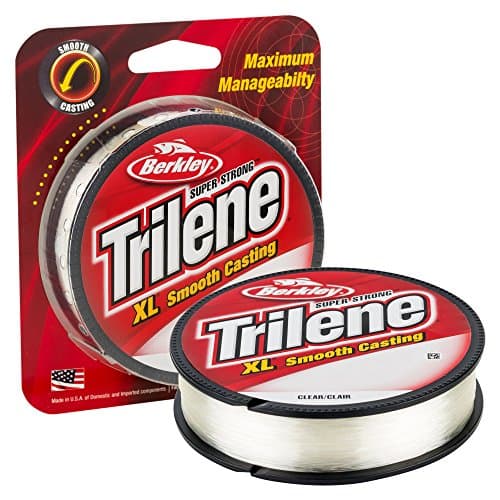
| 1 | Best first ice line Berkley Trilene XL Monofilament Line 6 lb measures 0.009 in and 8 lb measures 0.010 in, so the light end of this range is genuinely thin. | Panfish and general ice work | $8.97 · Check price on Amazon #ad how this is funded · price as of October 19, 2026 |
| 2 | 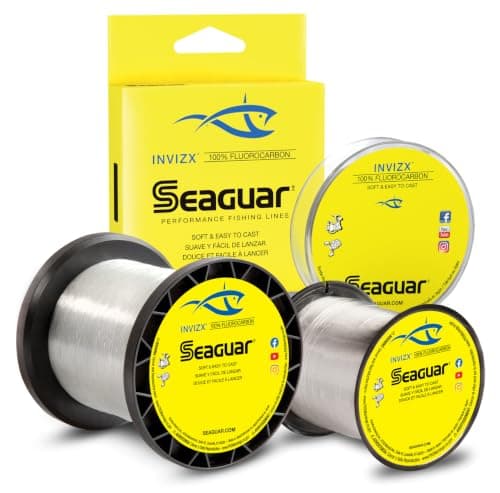 Best for deep water and soft bites Seaguar InvizX Fluorocarbon Line Low stretch and a fast sink rate, at 0.009 in for 8 lb and 0.010 in for 10 lb. | Walleye at depth, and finicky fish | $23.26 · Check price on Amazon #ad how this is funded · price as of October 19, 2026 |
The fall is the presentation
Almost everything about ice line follows from one fact: winter fish overwhelmingly take a jig as it drops, not as it sits and not as it rises.
A 1/32 oz jig weighs about 0.9 grams. Water resistance acting on the line above it is a meaningful fraction of that. Put thick line on and the jig falls slowly, at an angle, and with none of the darting motion it was designed to produce. Put thin line on and it drops the way the maker intended.
This is why the light-line advice on ice is more emphatic than in summer. In open water, heavy line costs you some casting distance and some bites. On ice with a tiny jig, it changes what the lure does.
The diameters, side by side
| Test | Trilene XL mono | Seaguar InvizX fluoro |
|---|---|---|
| 4 lb | — | 0.007 in |
| 6 lb | 0.009 in | 0.008 in |
| 8 lb | 0.010 in | 0.009 in |
| 10 lb | 0.011 in | 0.010 in |
Note that fluorocarbon is marginally thinner at the same test, by about a thousandth of an inch. That is real but small, and it is not the reason to choose it — stretch is.
Why braid is a mixed answer on ice
On paper braid should win outright: 10 lb Power Pro measures 0.006 inches, which is thinner than 4 lb fluorocarbon, and it has effectively no stretch.
In practice it has one specific cold-weather problem. Braid is porous and absorbs water; that water freezes in the guides and on the spool, and a frozen braid becomes a stiff, unmanageable thing that will not lie flat.
Anglers who do use braid on ice generally fish it inside a heated shelter, or run a short fluorocarbon leader and accept the maintenance. For a first winter, mono avoids the entire problem.
How much to put on
Very little, and this surprises people. You are fishing in fifteen to forty feet of water, straight down, and a fish that runs has nowhere horizontal to go.
Fifty yards is plenty on an ice reel. If you are using a small spinning reel that holds 110 yards of 4 lb, you can fill it with cheap backing and put a working length of good line on top.
The habit that matters more than the choice
Re-tie often. Cold line is more brittle, ice abrades it at the hole edge, and the first foot above the jig takes all of that punishment.
Cut back and re-tie after every few fish, and certainly after any fish you had to work up through the ice edge. It costs a minute and it is the cheapest insurance in the sport.
The picks, in full
Every card below lists the specs we could read off a published page, the URL they came from, and one honest reason you might not want it.
1. Best first ice line
Berkley Trilene XL Monofilament Line
Berkley
6 lb measures 0.009 in and 8 lb measures 0.010 in, so the light end of this range is genuinely thin.
Monofilament is the right first ice line for the same reason it is the right first line anywhere: it knots forgivingly, and on ice you are tying small knots with cold hands, which is exactly when forgiveness matters.
The published diameter ladder is the useful part. Trilene XL runs 6 lb at 0.009 inches, 8 lb at 0.010 and 10 lb at 0.011. For ice you want the bottom of that range or below it — the lighter tests in the same family are thinner still.
Mono also has one genuine winter advantage over braid: it absorbs less water, so it freezes into the guides less readily. A line that ices up in the guides is a line you spend the afternoon picking at.
The drawback
Monofilament stretches, and stretch is worse on ice than in summer. At twenty-five feet, straight down, a soft bite on a stretchy line can be absorbed entirely — which is exactly the argument for fluorocarbon below.
Published specs
- 6 lb diameter
- 0.009 in / 0.23 mm
- 8 lb diameter
- 0.010 in / 0.25 mm
- 10 lb diameter
- 0.011 in / 0.28 mm
- 12 lb diameter
- 0.013 in / 0.33 mm
- 17 lb diameter
- 0.015 in / 0.38 mm
- Spool sizes
- 110 to 1000 yd
- Made in
- USA
Specs read from Tackle Warehouse — Berkley Trilene XL Monofilament Line.
#ad how this is funded · price as of October 19, 2026
2. Best for deep water and soft bites
Seaguar InvizX Fluorocarbon Line
Seaguar
Low stretch and a fast sink rate, at 0.009 in for 8 lb and 0.010 in for 10 lb.
Fluorocarbon earns its place on ice for a different reason than in open water. The invisibility still helps in the very clear water winter tends to produce, but the property that matters is low stretch.
You are fishing straight down, often at twenty to forty feet, and detecting a bite that barely registers. Every foot of stretch between you and the jig is signal you lose.
Seaguar publishes InvizX as 100% fluorocarbon, made in Japan, and describes it as softer and more supple than typical fluorocarbon — which matters here, because ordinary fluorocarbon gets noticeably stiffer as it gets colder.
The drawback
It is the stiffest option in cold weather, and stiffness becomes memory: the line comes off the spool in coils that hang in the hole. That is genuinely annoying at ten degrees, and it is the reason plenty of good ice anglers stay on mono.
Published specs
- 8 lb diameter
- 0.009 in / 0.23 mm
- 10 lb diameter
- 0.010 in / 0.26 mm
- 12 lb diameter
- 0.011 in / 0.28 mm
- 15 lb diameter
- 0.013 in / 0.33 mm
- 20 lb diameter
- 0.016 in / 0.40 mm
- Spool sizes
- 200, 600, 1000, 3000 yd
- Material
- 100% fluorocarbon, made in Japan
Specs read from Tackle Warehouse — Seaguar InvizX Fluorocarbon Line.
#ad how this is funded · price as of October 19, 2026
Questions people actually ask
What pound test line for ice fishing?
Two to four pound test for panfish, up to six or eight for walleye and pike. Light line matters because water resistance on thicker line holds a 1/32 oz jig up and flattens its fall, and the fall is when winter fish take it.
Is fluorocarbon or mono better for ice fishing?
Mono is more forgiving to knot with cold hands and ices up in the guides less. Fluorocarbon stretches less, which genuinely helps detect a soft bite at twenty-five feet, at the cost of more memory and coiling in the cold.
Can you use braid for ice fishing?
You can, and it has the best numbers on paper — 10 lb Power Pro is 0.006 in with no stretch. The problem is that braid absorbs water which then freezes in the guides. It works best inside a heated shelter or with a fluorocarbon leader.
How much line do you need on an ice fishing reel?
About fifty yards is plenty. You are fishing straight down in fifteen to forty feet and a fish has nowhere horizontal to run, so most of a full spool never leaves the reel.
Read next
Sources
Prices on this page come from the retailer at request time and change without notice. If we cannot get a live one we say “check price” rather than show you a number that has gone stale. How we pick.