Tackle
The best fillet knife: pick the blade length, not the brand
Four published blade lengths, and the fish on your board decides which one.
By Sawyer V. · Last updated · How we pick
The short answer
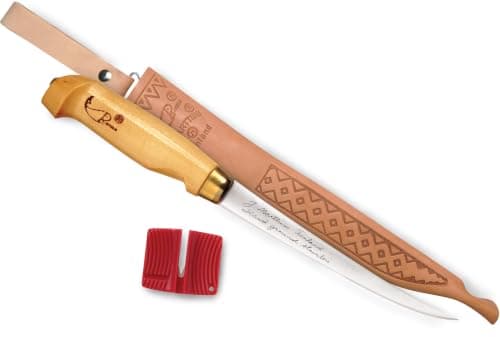
Choose the blade length for the fish: 4 in for panfish, 6 in for the general case, 7 1/2 in for walleye and bass, 9 in for pike and big catfish. The Rapala Fish ’n Fillet publishes all four, with a progressively tapered flexible blade, a birch handle and a leather sheath.
Reel & Rig earns a commission from qualifying purchases made through links on this page, at no extra cost to you. It does not change which gear we pick or what we say about it. Full disclosure.
Quick picks
| # | Product | Best for | Price |
|---|---|---|---|
| 1 | Best fillet knife Rapala Fish 'n Fillet Knife Published in 4, 6, 7 1/2 and 9 in, full-tang European stainless, birch handle, leather sheath and a sharpener included. | Anyone who keeps fish and wants one knife that fits their board | $21.59 · Check price on Amazon #ad how this is funded · price as of October 12, 2026 |
Length is the decision. Here is the mapping
A blade should be a little longer than the fish is deep, so one pass takes the fillet off rather than three sawing passes. Too short and you saw; too long and you lose control of the tip on a small fish.
| Blade | Fish | Why |
|---|---|---|
| 4 in | Bluegill, crappie, perch | Control on a small body; a long blade is unusable here |
| 6 in | Crappie to small walleye | The general answer if you buy one knife |
| 7 1/2 in | Walleye, bass, channel catfish | One clean pass down a full-size fillet |
| 9 in | Pike, big catfish, salmon | Reach for a deep-bodied or long fish |
If you fish for panfish and nothing else, buy the 4 or the 6. If you fish for whatever is biting, the 7 1/2 in handles a pile of crappie slightly awkwardly and a walleye perfectly, which is the better compromise.
Flex, and why a stiff knife is the wrong tool
A fillet blade has to bend. The cut that separates flesh from skin is made by laying the blade almost flat and letting it follow the skin, and a stiff blade cannot follow anything — it either cuts through the skin or leaves meat behind.
Progressive taper is how a single blade does both jobs. The base is thick enough to push through the rib section behind the head; the last third is thin enough to lie flat and ride.
This is also why a kitchen boning knife is not a fillet knife, and why a very cheap fillet knife with a uniformly thin blade feels floppy and vague at the base.
Sharpening is not optional
A dull fillet knife is the most dangerous thing in this article. It slides off the skin instead of biting, and it slides toward your other hand.
The included single-stage sharpener is enough for touch-ups between sessions. Filleting soft fish flesh does not blunt a knife much; the ribs and the cutting board do. Two or three pulls before you start is the habit worth building.
If you want the edge back properly rather than touched up, that is a whetstone job, and you can find sharpening stones on Amazon for less than the knife.
Why there is only one knife on this page
Because this site only puts a product in front of you when the maker publishes enough for the recommendation to be checked. Most fillet knives are sold on photographs and adjectives — no blade thickness, no steel grade, no flex figure — and picking between them would mean guessing.
The Fish ’n Fillet publishes four lengths, its construction, its tang, its handle material and what is in the box, which is enough to say what it is good at and what it is not. Our brands page sets out why we treat a published spec as the entry requirement.
The electric knife question
If you clean twenty panfish at a time, an electric fillet knife is genuinely faster and less tiring, and it is the one place where a powered tool beats a good hand knife on results rather than just on effort.
It is a different purchase with different failure modes — blades, batteries or a cord — and we do not have published specifications for one we would stand behind, so we are not naming a model. The category is here if you want to look: electric fillet knives on Amazon.
For one to five fish at a time, a hand knife is faster once you count setup, and it does not need charging.
So what do I actually buy?
Buy the length that matches the fish on your board, and keep the sheath. A knife with a home stays sharp; a knife loose in a drawer does not.
Rapala Fish 'n Fillet Knife
$21.59Four published blade lengths. The 7 1/2 in is the one to buy if you only buy one.
#ad how this is funded · price as of October 12, 2026
Bubba Forged Fishing Pliers (11 in)
$43.19The other half of the cleaning-table kit: unhooking, and getting a hook out of a fish you are keeping.
#ad how this is funded · price as of October 12, 2026
The picks, in full
Every card below lists the specs we could read off a published page, the URL they came from, and one honest reason you might not want it.
1. Best fillet knife
Rapala Fish 'n Fillet Knife
Rapala
Published in 4, 6, 7 1/2 and 9 in, full-tang European stainless, birch handle, leather sheath and a sharpener included.
The published detail that matters most is progressively tapered. The blade gets thinner toward the tip, so the tip flexes and the base does not. That is exactly what filleting needs: a stiff section to drive through a rib cage and a flexible section to ride along the skin without cutting into it.
Full-tang construction means the steel runs the whole length of the handle. Fillet knives fail at the joint between blade and handle, because that is where you apply twisting force when a blade catches in a spine. A full tang removes the weak point.
The handle is published as birch. Wood is unfashionable and it is genuinely good here — it stays grippy when wet in a way that polished plastic does not, and it does not get cold enough to hurt in November.
A tooled leather sheath with a free-swing belt loop and a single-stage sharpener are included. A fillet knife that lives loose in a drawer gets dull and dangerous; a sheath is the difference.
The drawback
Rapala does not publish a weight, a blade thickness or a steel grade beyond "European stainless", so you cannot compare its edge retention against a knife that does publish those numbers. A leather sheath also needs drying out — put a wet knife back in leather repeatedly and you will corrode the blade in the one place you never look. And birch needs occasional oil; it is not a maintenance-free handle.
Published specs
- Blade lengths
- 4, 6, 7 1/2 and 9 in
- Blade
- Progressively tapered, flexible, full-tang European stainless steel
- Handle
- Birch
- Sheath
- Tooled leather Laplander with free-swing belt loop
- Included
- Single-stage sharpener
- Made by
- Marttiini
- Weight
- Rapala does not publish a weight
Specs read from Rapala - Fish 'n Fillet Knives.
#ad how this is funded · price as of October 12, 2026
Questions people actually ask
What size fillet knife do I need?
Match it to the fish. 4 in for panfish, 6 in as a general answer, 7 1/2 in for walleye, bass and channel catfish, 9 in for pike and big catfish. The blade should be a little longer than the fish is deep.
Should a fillet knife be flexible or stiff?
Both, in different parts of the blade. A progressively tapered blade is stiff at the base so it can push through ribs, and flexible at the tip so it can lie flat and follow the skin.
Is an electric fillet knife better?
For volume, yes — twenty panfish is much faster with one. For a handful of fish, a sharp hand knife is quicker once you count setup and it never needs charging.
How often should I sharpen a fillet knife?
A couple of pulls through a sharpener before every session. Fish flesh does not dull a blade much; ribs and the cutting board do, and a dull fillet knife is the one most likely to cut you.
Read next
Sources
Prices on this page come from the retailer at request time and change without notice. If we cannot get a live one we say “check price” rather than show you a number that has gone stale. How we pick.