Tackle
Chest packs, slings and vests: carrying tackle when you cannot put it down
A backpack works because you can take it off. Standing thigh-deep in moving water, you cannot, and that single fact decides the whole category.
By Sawyer V. · Last updated · How we pick
The short answer
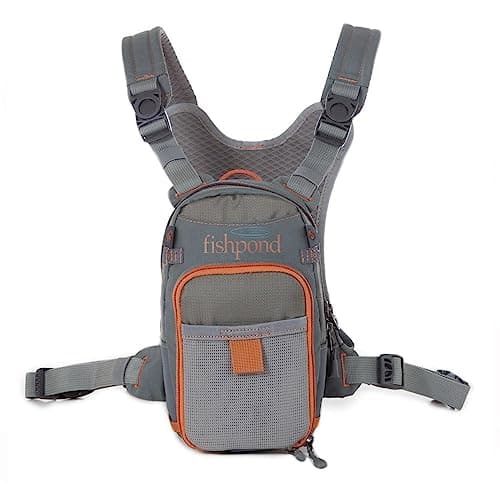
Buy a chest pack if you wade deep and carry little - the Fishpond Canyon Creek is published at 9 x 5 x 4.5 in and 1 lb, holds up to four fly boxes, and keeps everything above the water line. Buy a sling if you carry more than that: the Orvis Mini Sling is published at 300 g with a left-shoulder design that frees the casting arm. A vest is the right answer only if you need a lot of pockets in front of you and do not mind wearing a garment. The decision is not capacity. It is where the weight sits and whether you can open the thing one-handed while standing in current - which is why our fishing backpack page is a different page about a different problem.
Reel & Rig earns a commission from qualifying purchases made through links on this page, at no extra cost to you. It does not change which gear we pick or what we say about it. Full disclosure.
Quick picks
| # | Product | Best for | Price |
|---|---|---|---|
| 1 | Best wading pack Fishpond Canyon Creek Chest Pack Published at 9 x 5 x 4.5 in and 1 lb in 420D recycled nylon, with seven tool points, a zip-down fly bench and an integrated net slot. | Deep wading, small streams, and anyone who carries four fly boxes or fewer | $89.95 · Check price on Amazon #ad how this is funded · price as of October 26, 2026 |
| 2 | 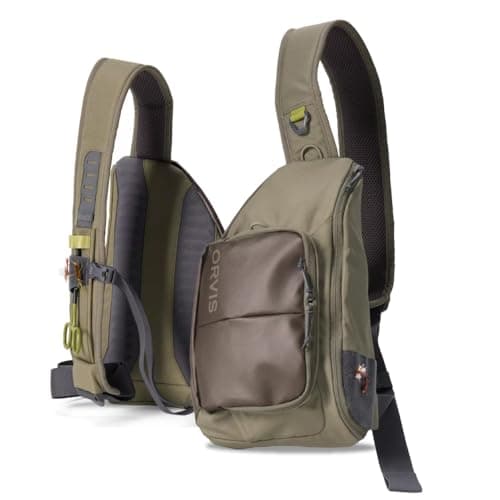 Best sling for a light kit Orvis Mini Sling Pack Published at 300 g in 600 denier recycled CORDURA with a TPU coating, with a left-shoulder design that keeps the casting arm clear. | Anyone who wants the pack out of the way until they need it | $98.00 · Check price on Amazon #ad how this is funded · price as of October 26, 2026 |
| 3 | 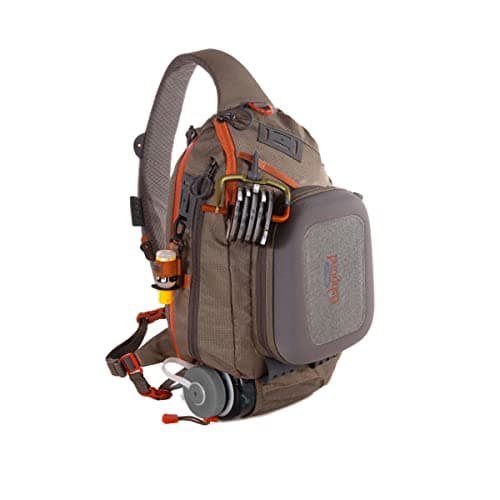 Best bigger sling Fishpond Summit Sling 2.0 Three large main compartments and a long list of exterior attachment points - and almost no published figures to check them against. | Full days, changeable weather, and anyone carrying a layer as well as tackle | $129.95 · Check price on Amazon #ad how this is funded · price as of October 26, 2026 |
| 4 | 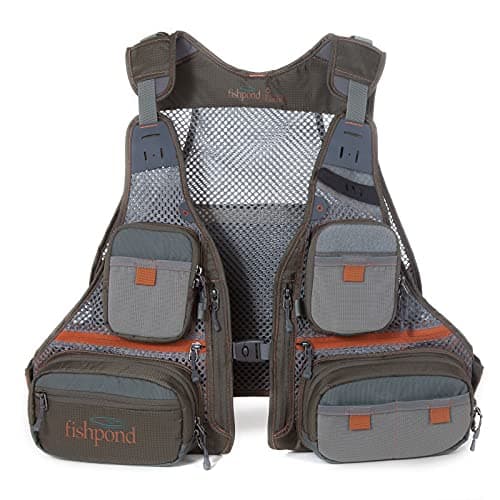 Best vest Fishpond Sagebrush Pro Mesh Vest Published at 1.6 lb in 210D recycled nylon with a mesh body, 17 pockets, and one size fits most. | Anyone who wants everything in front of them, in summer | $169.95 · Check price on Amazon #ad how this is funded · price as of October 26, 2026 |
Why a backpack is the wrong answer here
This site already has a fishing backpack page and a tackle bag page, and both are built around the 3700 utility-box footprint - the standard that governs bank and boat tackle. Neither applies here, and the reason is worth stating because it is the whole premise.
A backpack works because you take it off. You set it on the bank, open it, get what you need, close it, put it back on. Standing thigh-deep in moving current there is nowhere to set anything down, nothing is dry, and taking a pack off means holding it with the hand that is not holding the rod.
So every product on this page is designed around one requirement: it opens while you are wearing it, with one hand, without going in the water. A chest pack is already in front of you. A sling swings round on its strap. A vest never moves at all. That is the category.
The four form factors, and who each is for
| Format | Where the weight sits | Published capacity | Published weight | Right for |
|---|---|---|---|---|
| Chest pack | High on the chest | Up to 4 fly boxes | 1 lb | Deep wading, small kits |
| Mini sling | One shoulder, rides on the back | Not published by Orvis | 300 g / 0.66 lb | A light kit you want out of the way |
| Full sling | One shoulder, rides on the back | Not published | Not published | Full days, a layer as well as tackle |
| Vest | Both shoulders, spread front and back | 17 pockets | 1.6 lb | Lots of small items, warm weather |
Three of those twenty cells read “not published”, and all three are on slings. That is the state of the category rather than an oversight on our part - see the last section.
How deep you wade decides more than how much you carry
The useful question is not “how much tackle do I own”. It is “how deep do I go, and how often”.
Thigh-deep and above. Anything works. A sling or a vest is more comfortable than a chest pack because the weight is better spread.
Waist-deep. A sling riding on your lower back is now at water level when you lean. A chest pack is not. This is the depth at which the format decision starts to matter.
Chest-deep. Chest pack, or nothing. Our chest waders page and waders explained cover the other half of fishing at that depth, including why a wading belt is not optional.
Boat or bank only. None of this. Buy a backpack or a tackle bag - they hold more, cost less and are easier to work out of when you can put them down.
What to look for, in order
1. Which shoulder a sling hangs from. It is the only truly irreversible mistake in this category. A right-handed caster wants the strap on the left shoulder so the pack does not foul the casting arm, and vice versa. Orvis publishes this; many makers do not state it at all, and a sling on the wrong shoulder is returned rather than lived with.
2. Tool attachment points. Nippers, forceps and a floatant bottle need to hang where one hand can reach them, because the other hand has a rod in it. Hypalon patches and zinger docking stations are what that looks like on a spec sheet. A pack with none is a bag.
3. A net attachment. A rear D-ring or an integrated net slot. If the pack has neither, the net ends up in your hand or dangling off a belt loop, and our catch and release page explains why getting a fish into a net quickly is the part that decides whether it swims away.
4. Denier, where it is published. Thread thickness, and the best single proxy for how long the fabric survives brush. The packs here publish 600D (Orvis shell), 420D (Canyon Creek) and 210D (Sagebrush mesh vest) - and those numbers track exactly what each is for.
5. Volume, last. It is the number people shop on and the least useful one, because what actually limits a wading pack is how many fly boxes fit and whether you can reach them, not how many liters the shell encloses.
What goes in it
A wading kit is small by necessity, and the discipline is the point. Two or three fly boxes - our fly box page covers sizing them. Tippet in the sizes you actually fish, which our leader and tippet page decodes. Nippers on a zinger, forceps on a patch, floatant somewhere you can reach.
Then the two things people leave behind and regret: a spare leader, and something to keep a phone dry. Our dry box page covers the second, and it matters more here than anywhere else on the site, because this is the category where you are standing in the river rather than near it.
The budget end, and why nothing from it is featured
There are chest packs and slings on the market at $25 to $40, several of them in stock right now, and we have not featured one. The reason is the same one that kept unbranded soft rod bags off our ice rod case page: none of them publishes a specification.
No denier, no dimensions, no weight, no fly-box capacity, and in most cases no reachable manufacturer site. For a product whose entire job is surviving brush and holding a known amount of tackle, those are the only numbers that matter.
That is not a claim they are bad - plenty of people fish them happily. It is a statement that we cannot check them, which is the standard our how we pick page applies everywhere else on this site. If budget is the binding constraint, the honest advice is a chest pack rather than a sling, because a chest pack is a simpler object with less to get wrong.
What this category does not publish
Worth stating plainly, because it shaped the order of this page.
Slings are the worst offenders. Fishpond publishes a full specification for its Canyon Creek chest pack - fabric, dimensions, weight - and for its Sagebrush vest, and then publishes none of those for the Summit Sling 2.0, which is its best-known pack. Orvis publishes fabric and weight for the Mini Sling and no volume at all, so the 5 L figure you see quoted comes from the retail listing rather than the maker.
The practical consequence for you: you can compare the chest pack and the vest on paper, and you cannot compare slings on paper at all. If you are choosing between two slings, the only honest advice is to go and hold them, or buy from somewhere with a real returns policy.
So what do I actually buy?
A chest pack if you wade deep or carry little. A mini sling if you want it out of the way. A bigger sling for full days. A vest if you want everything in front of you and it is warm.
Fishpond Canyon Creek Chest Pack
$89.959 x 5 x 4.5 in, 1 lb, 420D, four fly boxes. Stays above the water line.
#ad how this is funded · price as of October 26, 2026
Orvis Mini Sling Pack
$98.00300 g, 600D CORDURA, left-shoulder. Check that against your casting hand.
#ad how this is funded · price as of October 26, 2026
Fishpond Summit Sling 2.0
$129.95Three main compartments. The popular one, and the one with no published figures.
#ad how this is funded · price as of October 26, 2026
Fishpond Sagebrush Pro Mesh Vest
$169.951.6 lb, 17 pockets, one size fits most. A summer vest, not a year-round one.
#ad how this is funded · price as of October 26, 2026
The picks, in full
Every card below lists the specs we could read off a published page, the URL they came from, and one honest reason you might not want it.
1. Best wading pack
Fishpond Canyon Creek Chest Pack
Fishpond
Published at 9 x 5 x 4.5 in and 1 lb in 420D recycled nylon, with seven tool points, a zip-down fly bench and an integrated net slot.
A chest pack is the only carry system that keeps everything you own above the water line, which is why it is the right default for anyone who actually wades rather than walks a bank. Nine inches by five by four and a half is small, and that is the point: it rides high on your chest, it does not swing, and it never goes under.
The published four-fly-box capacity is the honest limit of the format. If your kit is a couple of boxes, tippet, floatant and nippers, this holds it and you will never want more. If you carry a rain shell, a water bottle and six boxes, you have outgrown chest packs entirely and should be reading the sling section.
Seven Hypalon tool attachment points is the detail that separates a real fishing pack from a bag with a strap. Retractors, tippet holders, floatant and forceps all need somewhere to live that is not a pocket, because a pocket means two hands. Our line cutter page makes the same argument about tethers.
The integrated net slot on the back panel and the rear pass-through matter if you already own a wader belt or a backpack - Fishpond publishes this as integrating directly with its own belt and pack systems, so it can be the front half of a bigger setup rather than the whole thing.
The drawback
Four fly boxes is genuinely the ceiling, and a chest pack is the format people most often buy twice because they under-bought the first time. Anything hanging on your chest is also in the way of the rod when you are stripping line, which some people never stop noticing. And at around $90 it is not cheap for a bag of this size - you are paying for the fabric and the attachment points, not the volume.
Published specs
- Dimensions
- 9 x 5 x 4.5 in
- Weight
- 1 lb
- Fabric
- 420D recycled nylon (Cyclepond)
- Capacity
- Up to four fly boxes, plus accessories
- Tool attachments
- Seven Hypalon points for retractors, tippet, floatant and forceps
- Fly bench
- Zip-down, with a replaceable silicone pad
- Net
- Integrated slot on the back panel
- Integration
- Rear pass-through for belt and backpack systems
Specs read from Telluride Angler - Fishpond Canyon Creek Chest Pack.
#ad how this is funded · price as of October 26, 2026
2. Best sling for a light kit
Orvis Mini Sling Pack
Orvis
Published at 300 g in 600 denier recycled CORDURA with a TPU coating, with a left-shoulder design that keeps the casting arm clear.
The left-shoulder design is the published feature worth understanding before you buy any sling. A sling rides on your back and swings round to the front to open. Which shoulder it hangs from decides whether it fouls your casting arm, and Orvis publishes this one as left-shoulder specifically to keep a right-handed caster clear.
If you cast left-handed, that is a reason to look at a different sling rather than a reason to buy this one - and it is the single most common mistake in the category.
Three hundred grams is light enough that you forget it, and the published shell is 600 denier recycled CORDURA with a strategic TPU coating. Denier is the number worth comparing across packs: it is thread thickness, and it is most of what decides whether a pack survives being dragged through willows.
The attachment set is published in full - a loop tippet bar, a zinger docking station on the front strap, a fly patch, a forceps point and a rear D-ring for a net. That last one pairs with the magnetic net release our fly net page recommends.
The drawback
It is a mini sling, and Orvis does not publish a volume at all - the 5 L figure comes from the Amazon listing rather than from Orvis, so the one number you would most want to compare against a bigger pack is not the maker's. A single-shoulder strap also puts all the weight on one side, which is fine at 300 g plus a light kit and genuinely uncomfortable once you load it. And a left-shoulder pack is the wrong pack for a left-handed caster.
Published specs
- Item
- 26B20800
- Weight
- 300 g / 0.66 lb
- Shell
- 100% recycled CORDURA re/cor 600 denier polyester, strategic TPU coating
- Liner
- 100% recycled 200 denier polyester
- Carry
- Left-shoulder design, to free the casting arm
- Straps
- Adjustable sternum strap
- Attachments
- Loop tippet bar, zinger docking station, fly patch, forceps point, rear D-ring for a net
- Pockets
- Main pocket with internal drop pockets and a zip; second zippered main pocket
- Volume
- 5 L per the Amazon listing; Orvis does not publish a volume
Specs read from Orvis - Mini Sling Pack.
#ad how this is funded · price as of October 26, 2026
3. Best bigger sling
Fishpond Summit Sling 2.0
Fishpond
Three large main compartments and a long list of exterior attachment points - and almost no published figures to check them against.
This is the step up from a mini sling, and it is here because the jump from four fly boxes to a full day’s kit is a real one. Three main compartments is the published structure, and in practice that means boxes in one, tools and tippet in another, and a shell or a sandwich in the third.
A sling of this size is the most popular wading carry system there is for a reason: it holds nearly as much as a small backpack while still swinging to the front so you can open it standing in the river. A backpack cannot do that, which is the whole argument of this page.
What we cannot do is compare it on numbers, which is why it sits third rather than first despite being the better-known product. See the drawback.
The drawback
Fishpond publishes no dimensions, no weight, no capacity and no fabric specification for this model - the product copy is a feature list and nothing else. For a pack at this price that is a real gap: you cannot tell how much heavier it is than a mini sling, how much it actually holds, or what denier the shell is, which are the three questions that decide between slings. We have left those as gaps rather than filling them from a listing bullet, and it is the reason this is not the top pick.
Published specs
- Compartments
- Three large main compartments
- Attachments
- Numerous exterior attachment points
- Dimensions and weight
- Not published
- Fabric
- Not published for this model
- Capacity
- Not published
Specs read from Telluride Angler - Fishpond Summit Sling 2.0.
#ad how this is funded · price as of October 26, 2026
4. Best vest
Fishpond Sagebrush Pro Mesh Vest
Fishpond
Published at 1.6 lb in 210D recycled nylon with a mesh body, 17 pockets, and one size fits most.
The vest is the oldest answer to this problem and still the best one for a specific angler: somebody who wants a lot of small things reachable without moving anything. Seventeen published pockets is a different proposition from a chest pack’s four fly boxes, and no sling puts that much in front of you.
The mesh body is why this one is a summer vest rather than a year-round one. Fishpond publishes it as keeping the torso and back cool, which is the honest trade: it breathes, and it does nothing for warmth or wind.
Two published details raise it above a traditional vest. Padded, weight-distributing shoulder straps address the thing that makes loaded vests unpleasant after four hours. And at 1.6 lb empty it is light for the capacity - a chest pack holding a quarter as much weighs 1 lb.
One size fits most is published, which is worth saying plainly because it is the reason a vest is a safe thing to buy online and a safe thing to be given. Our fly fishing gift page makes the broader case about which fly gear has a size and which does not.
The drawback
A loaded vest hangs its weight off your shoulders and neck, and padded straps reduce that rather than solve it - this is the format people abandon in their forties. The mesh that keeps you cool also means wind goes straight through it, so it is a warm-weather garment. And seventeen pockets is as much a liability as a feature: things get put in a pocket, and then the pocket gets forgotten.
Published specs
- Sizing
- One size fits most
- Weight
- 1.6 lb
- Fabric
- 210D recycled nylon (Cyclepond), mesh body
- Pockets
- 17, interior and exterior
- Straps
- Padded, weight-distributing shoulders
- Tool attachments
- Hypalon points for retractors, tippet, floatant and forceps
- Fly bench
- Zip-down, with a replaceable fly mat
- Net
- Integrated slot on the back panel
- Back pouch
- Large, for a layer or water
Specs read from Telluride Angler - Fishpond Sagebrush Pro Mesh Vest.
#ad how this is funded · price as of October 26, 2026
Questions people actually ask
Chest pack or sling pack for fly fishing?
Chest pack if you wade deep or carry four fly boxes or fewer - it keeps everything above the water line and never swings. Sling if you carry more than that, or want the pack out of the way between fish. Depth decides it more than volume does.
Which shoulder should a fly fishing sling go on?
The opposite shoulder to your casting arm, so the pack does not foul the cast. A right-handed caster wants a left-shoulder sling. Orvis publishes which shoulder its packs are built for; many makers do not state it, and it is the one mistake in this category you cannot live with.
Are fishing vests still worth buying?
For a specific angler, yes: somebody who wants a lot of small items reachable without moving anything. Seventeen pockets puts more in front of you than any sling. The trade is that a loaded vest hangs its weight off your shoulders and neck, which is why many people move to slings over time.
Can I just use a backpack for wading?
Not really, and the reason is specific: a backpack works because you take it off to open it. Standing thigh-deep in current there is nowhere to set it down and nothing is dry. Everything on this page opens while you are wearing it, one-handed.
What size chest pack do I need?
Published fly-box capacity is the useful number, not liters. The Fishpond Canyon Creek publishes up to four fly boxes at 9 x 5 x 4.5 in, which is a genuine ceiling - if your kit is bigger than that, you want a sling rather than a bigger chest pack.
What does denier mean on a fishing pack?
Thread thickness, and the best single proxy for how long the fabric lasts against brush. The packs here publish 600D for the Orvis sling shell, 420D for the Canyon Creek chest pack and 210D for the mesh vest - and those numbers track what each one is built to survive.
Why are cheap sling packs not recommended here?
Because none of them publishes a specification - no denier, no dimensions, no weight, no fly-box capacity, and usually no manufacturer website. That is not a claim they are bad; it is that we cannot check them. If budget is the constraint, a chest pack is the simpler object with less to get wrong.
Read next
Sources
Prices on this page come from the retailer at request time and change without notice. If we cannot get a live one we say “check price” rather than show you a number that has gone stale. How we pick.