Tackle
Fishing scales: how to weigh a fish without hurting it, and which scale to buy
Most of what goes wrong when you weigh a fish happens before the number appears. The scale is the easy part of this decision.
By Sawyer V. · Last updated · How we pick
The short answer
Weigh the fish inside your landing net and subtract the net, using the scale’s tare function. Never hang a fish vertically by its jaw from a gripper. For the scale itself: the Rapala 50 lb High Contrast publishes a tare function, eight storage locations and an illuminated reverse-image display. The Berkley 50 lb publishes water-resistant construction and averages up to ten weights, but publishes no tare at all — which is the one feature this method needs.
Reel & Rig earns a commission from qualifying purchases made through links on this page, at no extra cost to you. It does not change which gear we pick or what we say about it. Full disclosure.
Quick picks
| # | Product | Best for | Price |
|---|---|---|---|
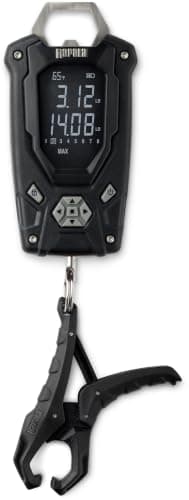
| 1 | Best fishing scale Rapala 50 lb High Contrast Digital Scale Published tare, 8 storage locations with memory back-up, an illuminated reverse-image LCD, and lb/oz, decimal lb or kg. | Anyone who wants to weigh a fish in a net and record it properly | $47.95 · Check price on Amazon #ad how this is funded · price as of October 15, 2026 |
| 2 | 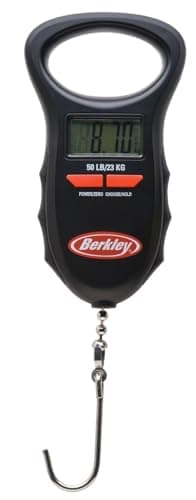 Best if you will get it wet Berkley Digital Fish Scale (50 lb) Published water-resistant construction, stores and averages up to 10 weights with auto-save, reads in lbs/oz or kg. | Kayak and bank anglers, and anyone who wants one button and a number | $34.22 · Check price on Amazon #ad how this is funded · price as of October 15, 2026 |
The method matters more than the scale
Our catch and release page argues that you do not need a weigh net or a lip-grip scale unless you genuinely want the weight. This page is for the reader who does — a personal best, a club record, a kid who wants to know — and the point is that wanting the number does not have to cost the fish anything.
Weigh the fish in the net. Hook the scale to the net handle or the hoop, with the fish lying in the mesh as it already is. The net supports the fish along its whole length, which is how a fish is built to be supported.
Tare the net out. Weigh the wet empty net first, zero the scale against it, then weigh fish and net together. The reading is the fish. This is the single reason tare appears at the top of the criteria below.
Never hang a fish vertically by the jaw. A fish’s internal organs are supported by water, not by connective tissue. Hanging it by the lower jaw puts the whole body weight on the jaw joint and lets the organs settle against the body wall. Our catch and release page makes this point about grippers in general; it applies with more force when there is a scale on the end adding leverage.
Have the scale zeroed and ready before the fish is out of the water. The clock starts when the fish comes out, and fumbling with a menu is the expensive part.
Measure length as well. Length is the figure that is comparable year to year and between anglers, it takes two seconds, and it does not require lifting the fish at all. If you only record one number, record length.
The four criteria, in order
1. Tare. Without it the weigh-in-the-net method is a two-step subtraction while a fish waits. With it, one reading. This is the feature to buy on.
2. A display you can read in sun and dark. You weigh fish at dawn, at dusk, and in flat midday glare. A backlit or reverse-image screen is the difference between reading the number and squinting at it.
3. Water resistance. The scale lives in the same wet pocket as everything else. Neither maker publishes an IP rating, so look for a stated water-resistant construction at minimum.
4. Memory, if you care about records. Storage locations or averaging. Useful, and the last thing to choose on.
Capacity is not on the list, because 50 lb covers every freshwater fish this site discusses, with room to spare. A 50 lb scale will weigh any bass, walleye, pike or channel cat you are likely to land.
The two scales, as published
| Figure | Rapala RHCDS50 | Berkley BTDFS50-1 |
|---|---|---|
| Capacity | 50 lb | 50 lb |
| Tare | Yes | Not published |
| Display | Illuminated reverse-image LCD | Not described beyond the units |
| Units | lb/oz, decimal lb, kg | lbs/oz or kg |
| Memory | 8 storage locations, memory back-up | Stores and averages up to 10 weights, auto-save |
| Totals | Min and max bin weight, total weight | Averaging only |
| Water resistance | Not published | Water-resistant construction |
| Batteries | Two AAA, not included | Not published |
| Accuracy | Not published | Not published |
| Dimensions and weight | Not published | Not published |
Four of those ten rows read “not published” on one side or the other, and both makers decline to publish an accuracy figure. For a measuring instrument that is a remarkable omission, and it is the honest headline of this comparison: you are buying a number-producing device from two companies that will not tell you how close the number is.
Why we are not recommending a gripper-scale combo
Both brands sell a combined lip gripper and scale, and they are popular. We are not featuring one, for the reason set out at the top of this page: the combo exists to let you clamp a fish’s jaw and hang its whole weight from it.
That is the specific thing not to do. The tool is not the problem in itself — a gripper used to control a toothy fish beside the boat, with the fish still supported, is fine — but a gripper with a scale on the end is a tool designed around hanging the fish vertically, and that is how it gets used.
Buy a plain scale and weigh in the net. It costs less, it works better with tare, and nothing about it encourages the bad version.
What we would skip
Lower-capacity versions of the same scale. Berkley lists a 35 lb model alongside the 50. There is no reason to prefer it: 50 lb already covers every freshwater fish on this site, and buying less capacity for the same job only narrows what the tool can do.
Spring scales with a dial. They are cheap and they have no tare, no backlight and no memory, which means all four criteria above fail at once.
Luggage scales. They work, and plenty of anglers use one. The honest note is that they are not built for a wet pocket and none of them publish a water rating either.
What a scale does not tell you
Two things worth being straight about.
Neither of these publishes an accuracy figure, so a reading is a reading rather than a measurement. If you are weighing for a club record, the club will have its own certified scale, and that is the number that counts.
A fish in a net on a spring scale bounces. Any handheld scale is reading a moving load through your arm. Take three readings and use the middle one, or use the Berkley’s published averaging, and treat the result as close rather than exact.
The rest of the weighing kit
A net is not optional for this method, and it is the other half of the purchase. Frabill publishes its teardrop trout net at 13 × 18 in with a floating hoop and rubberized mesh — rubber mesh matters because it does less damage to slime coat and it does not tangle hooks, which our catch and release page covers in full.
You will also want pliers in the other hand and, if any of this is happening at either end of the day, a headlamp so both hands stay free. Weighing a fish well is a two-handed job done quickly, and every second of fumbling is a second the fish is out of the water.
What we are not telling you
We have not tested either scale against a known weight, and neither manufacturer publishes an accuracy specification we could check one against. Every figure on this page is read off the two manufacturer product pages linked below, and where a page leaves something out — Rapala’s empty specifications section, Berkley’s missing tare and battery type — this page says so rather than filling the gap from retailer copy or customer reviews.
The weighing method above is standard fish-handling practice rather than something we measured. It follows from how a fish is supported in water, and it is the same argument our catch and release page makes about time out of the water and vertical loads.
So what do I actually buy?
Buy the Rapala if you will use tare and weigh in the net, which is the method this page recommends. Buy the Berkley if you want one button, averaging and a published water-resistant body. Buy a net either way.
Rapala 50 lb High Contrast Digital Scale
$47.95Published tare, 8 storage bins and an illuminated reverse-image display. Tare is the feature.
#ad how this is funded · price as of October 15, 2026
Berkley Digital Fish Scale (50 lb)
$34.22Published water-resistant construction and averaging over 10 weights. Simpler, and no published tare.
#ad how this is funded · price as of October 15, 2026
Frabill Teardrop Floating Trout Net (13 in x 18 in)
$44.99Published 13 x 18 in with a floating hoop. Weigh the fish in this, not by the jaw.
#ad how this is funded · price as of October 15, 2026
Rapala Fisherman's Pliers
$11.97The other hand's job. Weighing well is quick and two-handed.
#ad how this is funded · price as of October 15, 2026
The picks, in full
Every card below lists the specs we could read off a published page, the URL they came from, and one honest reason you might not want it.
1. Best fishing scale
Rapala 50 lb High Contrast Digital Scale
Rapala
Published tare, 8 storage locations with memory back-up, an illuminated reverse-image LCD, and lb/oz, decimal lb or kg.
The tare function is why this one wins, and it is not a convenience feature here — it is the whole method. Weigh the empty net, tare it to zero, then weigh the fish in the net. You get the fish’s weight without ever lifting it by the jaw or the gill plate. Rapala publishes tare; Berkley does not publish it on the equivalent model.
The display is the second reason. Rapala publishes a reverse-image illuminated LCD — light text on a dark background — which is the right way round for the two conditions you actually weigh fish in: bright sun on open water, and the dark. A conventional dark-on-light LCD washes out in sunlight, which is exactly when you are standing there with a fish out of the water waiting for a number.
Eight storage locations with memory back-up, plus quick reference for minimum and maximum bin weight and total weight, is published. That is a tournament feature and most readers will never use it — but the memory back-up means the figures survive a battery change, which matters if you keep a personal-best record.
Three units are published: pounds and ounces, decimal pounds, and kilograms. Decimal pounds is the one to set it to if you are recording anything, because lb-and-oz arithmetic is how weights get mis-transcribed.
The drawback
Rapala publishes no accuracy figure, no dimensions, no weight and no water resistance rating — the specifications section on its own product page is empty, which on a tool you use over water is a conspicuous blank. The two AAA batteries are not included, so it arrives dead. It is also the more complicated of the two: a directional pad and eight storage bins is more interface than someone who just wants a number needs, and the menu is one more thing to work out in the cold.
Published specs
- Item number
- RHCDS50
- Capacity
- 50 lb
- Display
- Reverse image LCD, illuminated: light text on a dark background
- Units
- Pounds and ounces, decimal pounds, or kilograms
- Storage
- 8 storage locations, with memory back-up
- Totals
- Quick reference for minimum and maximum bin weight and total weight
- Tare
- Yes
- Controls
- Directional pad for menu navigation
- Batteries
- Two AAA, not included
- Accuracy
- Rapala does not publish a figure
- Water resistance
- Rapala does not publish a rating
- Dimensions and weight
- Not published; the specifications section is empty
Specs read from Rapala - 50 lb. High Contrast Digital Scale.
#ad how this is funded · price as of October 15, 2026
2. Best if you will get it wet
Berkley Digital Fish Scale (50 lb)
Berkley
Published water-resistant construction, stores and averages up to 10 weights with auto-save, reads in lbs/oz or kg.
Berkley publishes the one thing Rapala does not: water-resistant construction. On a kayak, in a boat, or standing in a river, that is the specification that decides whether the scale is working next season. Neither maker publishes an IP rating you could check, but a stated water-resistant construction is more than a blank.
The memory works differently and is arguably better for ordinary use: it stores and averages up to ten weights with an auto-save function. Averaging matters more than it sounds, because a fish in a net on a spring scale bounces — take three readings and average them and you get a figure you can trust rather than whichever number you happened to read.
The ergonomic body is published too, and on a 50 lb-capacity scale that is a real consideration. If you ever actually load one near capacity you are holding the whole weight on one hand.
Simpler is a feature. Two units, one memory system, and nothing else to navigate.
The drawback
Berkley does not publish a tare function, and tare is what makes the weigh-in-the-net method work — without it you are weighing the net separately and doing the subtraction yourself, which is workable but fiddly with a fish waiting. Berkley also publishes no battery type, no indication whether batteries are included, no accuracy figure and no dimensions or weight. Customer reviews on the product page mention coin cells, but that is not a published specification and we are not treating it as one.
Published specs
- Model
- BTDFS50-1
- Capacity
- 50 lb
- Display
- Reads in lbs/oz or kg
- Memory
- Stores and averages up to 10 weights, with auto-save
- Construction
- Water-resistant, with an ergonomic body
- Tare
- Not published by Berkley
- Batteries
- Not published by Berkley
- Accuracy
- Berkley does not publish a figure
- Dimensions and weight
- Not published by Berkley
Specs read from Berkley - Digital Fish Scale 50 LB.
#ad how this is funded · price as of October 15, 2026
Questions people actually ask
What is the best fishing scale?
The Rapala 50 lb High Contrast, because it publishes a tare function. Tare is what lets you weigh a fish inside your landing net and subtract the net, which is the handling method that does not injure the fish. The Berkley 50 lb is the alternative and publishes water-resistant construction instead.
How do you weigh a fish without hurting it?
Weigh it in the net. Hook the scale to the net, zero the scale against the wet empty net first using tare, then weigh fish and net together. Never hang a fish vertically by its jaw — its organs are supported by water, not connective tissue, and the jaw joint takes the whole load.
Should you use a lip gripper with a scale?
We do not recommend the combined gripper-scale tools. A gripper used to control a toothy fish while it is still supported is fine; a gripper with a scale on the end is built around hanging the fish vertically from its jaw, which is the specific thing to avoid.
What capacity fishing scale do I need?
50 lb covers every freshwater fish this site discusses, with room to spare. There is no reason to buy a lower-capacity version of the same scale — it narrows what the tool can do for no benefit.
How accurate are digital fish scales?
Neither Rapala nor Berkley publishes an accuracy figure for these models, so a reading is a reading rather than a measurement. A fish in a net also bounces on a handheld scale, so take three readings and use the middle one, or use averaging if the scale has it.
Should I measure length instead of weight?
If you only record one number, record length. It is comparable between anglers and across seasons, it takes two seconds, and it does not require lifting the fish out of the net at all.
Do fishing scales need to be waterproof?
They need to survive a wet pocket. Neither of these publishes an IP rating you could check, so the best available signal is Berkley's stated water-resistant construction — Rapala's product page publishes no rating at all.
Read next
Sources
Prices on this page come from the retailer at request time and change without notice. If we cannot get a live one we say “check price” rather than show you a number that has gone stale. How we pick.