Tackle
Inline spinners: the simplest lure that still out-fishes complicated ones
A blade on a wire. No bill, no rattle, no technique to learn, and it still catches more trout than most fly boxes.
By Sawyer V. · Last updated · How we pick
The short answer
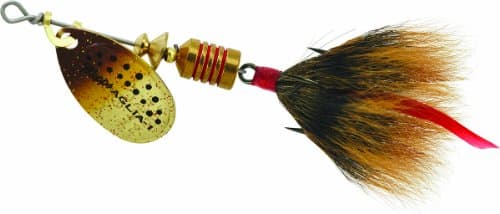
An inline spinner is the easiest lure in fishing to use correctly: cast it, reel it, catch fish. The Mepps Dressed Aglia is published in 1/8, 1/4 and 1/2 oz. Use 1/8 oz for trout and panfish in small water, 1/4 oz as a general default, and 1/2 oz in current or wind.
Reel & Rig earns a commission from qualifying purchases made through links on this page, at no extra cost to you. It does not change which gear we pick or what we say about it. Full disclosure.
Quick picks
| # | Product | Best for | Price |
|---|---|---|---|
| 1 | Best inline spinner Mepps Dressed Aglia Inline Spinner Three published weights, a tarnish-resistant French blade on machined brass spacers and a stainless wire form. | Trout in streams, panfish in ponds, smallmouth in rivers | $11.57 · Check price on Amazon #ad how this is funded · price as of October 12, 2026 |
Why something this simple works
An inline spinner is a metal blade mounted on a wire shaft so it rotates around it, with a weighted body and a hook behind. There is no bill, no rattle chamber and no internal weight-transfer system.
It produces two signals at once. The rotating blade throws flash in every direction, and it pushes a continuous pressure wave that a fish detects through its lateral line. Both happen the entire time the lure is moving, which is what makes it so forgiving — there is no cadence to get wrong.
That combination is unusually effective on trout and panfish specifically. Both are visual predators in relatively clear water, and both respond to something small and flashy moving steadily past.
Picking a size
| Weight | Use it for | Rod |
|---|---|---|
| 1/8 oz | Small streams, stocked trout, bluegill and perch | Ultra light to light |
| 1/4 oz | The general default. Ponds, rivers, smallmouth | Light to medium |
| 1/2 oz | Strong current, wind, or deeper water | Medium |
Weight here is doing two jobs at once: it sets casting distance and it sets how deep the spinner tracks at a given speed. In a fast river the heavier spinner is not about distance at all — it is the only way to keep the lure down where the fish are.
The line-twist problem, and how to fix it
This is the one real drawback of the category and it is worth stating plainly. A spinning blade transmits rotation down the line, and after twenty minutes you have a spool of coiled line that casts badly and forms wind knots.
The fix is a small barrel swivel about 18 inches above the lure. That is the whole solution, it costs almost nothing, and skipping it is the most common mistake in spinner fishing.
A ball-bearing swivel is better than a cheap barrel swivel if you are fishing them all day. On a light line, tie the swivel with the same care you would give any other connection — our knots page covers the two that matter.
Fishing one in current
In a river, do not cast upstream and reel back. Cast across and slightly down, and let the current do the work while you reel just fast enough to keep the blade turning.
The lure swings across the flow on a tight line, and the swing itself is the presentation. Trout and smallmouth sit behind rocks and current breaks facing upstream, and a spinner swinging past their window is arriving exactly the way real food does.
Slow water changes the instruction: there you have to supply all the speed yourself, and the risk is fishing too fast. Reel at the slowest speed that keeps the blade spinning, and you will feel through the rod exactly when it stops.
Where a spinner beats a spoon or a small crankbait
A spinner starts working at a lower speed than either, because a blade on a clevis needs very little water flow to begin rotating. In cold, slow water that is a genuine advantage.
It is also far less snag-prone than a crankbait in a rocky stream, because it rides higher and carries one treble rather than two.
For a first lure for a child or a complete beginner, an inline spinner is close to the ideal choice: it works with a plain steady retrieve and it catches a wide range of species. Our kids combo page pairs one with the right rod.
So what do I actually buy?
Buy 1/8 and 1/4 oz, plus a packet of small barrel swivels. The swivels are not optional — without them the line twist will ruin a spool inside an afternoon.
Mepps Dressed Aglia Inline Spinner
$11.57Published in 1/8, 1/4 and 1/2 oz. The 1/4 oz is the general-purpose size.
#ad how this is funded · price as of October 12, 2026
Ugly Stik GX2 Spinning Rod (5 ft Ultra Light, 2-piece)
$55.32A 5 ft ultra light rated 1/32-1/4 oz casts the 1/8 oz spinner properly. A medium rod will not.
#ad how this is funded · price as of October 12, 2026
Berkley Trilene XL Monofilament Line
$8.97Light mono is the right line here, and it forgives the treble hook on a hard strike.
#ad how this is funded · price as of October 12, 2026
The picks, in full
Every card below lists the specs we could read off a published page, the URL they came from, and one honest reason you might not want it.
1. Best inline spinner
Mepps Dressed Aglia Inline Spinner
Mepps
Three published weights, a tarnish-resistant French blade on machined brass spacers and a stainless wire form.
Published in 1/8, 1/4 and 1/2 oz. Those three weights genuinely cover most freshwater spinner fishing — small streams, ponds and rivers respectively.
The published construction detail worth caring about is the machined brass spacers. The blade rotates around the wire on a clevis, and what determines whether it spins reliably at slow speeds is how little friction there is at that joint. Brass spacers are the reason a good spinner starts turning almost the moment it moves.
The blade is published as tarnish-resistant. On a lure whose entire function is flash, a blade that dulls is a lure that stops working, so this is a functional spec rather than a cosmetic one.
The dressed version adds bucktail and a turkey quill strike attractor over the treble. Practically, the dressing slows the lure’s sink rate slightly and gives the fish a fuller profile to aim at.
The drawback
Inline spinners twist line badly — the blade rotating in one direction imparts that rotation to everything behind it, and without a swivel you will end up with a coiled mess. Mepps also does not publish the hook size on this page, and the treble is a poor choice if you intend to release fish.
Published specs
- Weights
- 1/8, 1/4, 1/2 oz
- Blade
- Tarnish-resistant French blade
- Spacers
- Machined brass
- Wire form
- Stainless steel
- Dressing
- Premium bucktail with a turkey quill strike attractor
- Hook size
- Mepps does not publish it on this page
Specs read from Tackle Warehouse - Mepps Dressed Aglia Inline Spinner.
#ad how this is funded · price as of October 12, 2026
Questions people actually ask
What size inline spinner is best for trout?
1/8 oz for small streams and stocked trout, 1/4 oz as a general default. In fast current a 1/2 oz spinner is not about casting distance — it is the only way to keep the lure down where the fish are.
Why does my line twist when using inline spinners?
Because the rotating blade transmits that rotation down the line. Fit a small barrel swivel about 18 inches above the lure. It is a complete fix and skipping it is the most common mistake in spinner fishing.
How do you fish an inline spinner in a river?
Cast across and slightly downstream, then reel just fast enough to keep the blade turning while the current swings the lure across the flow. The swing is the presentation — fish face upstream and it arrives the way real food does.
Are inline spinners good for beginners?
They are among the best. There is no cadence to learn and no depth to manage: a plain steady retrieve fishes them correctly, and they catch trout, panfish and smallmouth on the same lure.
Read next
Sources
Prices on this page come from the retailer at request time and change without notice. If we cannot get a live one we say “check price” rather than show you a number that has gone stale. How we pick.