Tackle
Seaguar InvizX vs Red Label: which fluorocarbon to buy
Same maker, two lines, and the published diameters show a consistent gap that decides most of the choice.
By Sawyer V. · Last updated · How we pick
The short answer
InvizX is thinner at most tests and published as softer and more supple; Red Label is published as specifically designed for baitcasting reels. At 12 lb, InvizX measures 0.011 in against Red Label’s 0.012. For spinning gear and leaders, InvizX. For a baitcaster main line on a budget, Red Label.
Reel & Rig earns a commission from qualifying purchases made through links on this page, at no extra cost to you. It does not change which gear we pick or what we say about it. Full disclosure.
Quick picks
| # | Product | Best for | Price |
|---|---|---|---|
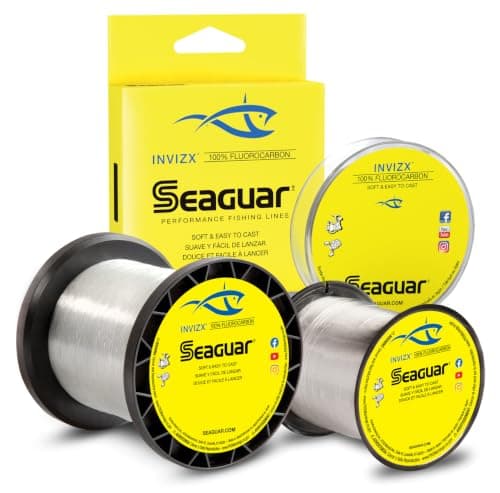
| 1 | Best for spinning and leaders Seaguar InvizX Fluorocarbon Line Thinner at most tests and published as soft and supple, which is the property fluorocarbon usually lacks. | Finesse work, and any leader knot | $23.26 · Check price on Amazon #ad how this is funded · price as of October 19, 2026 |
| 2 | 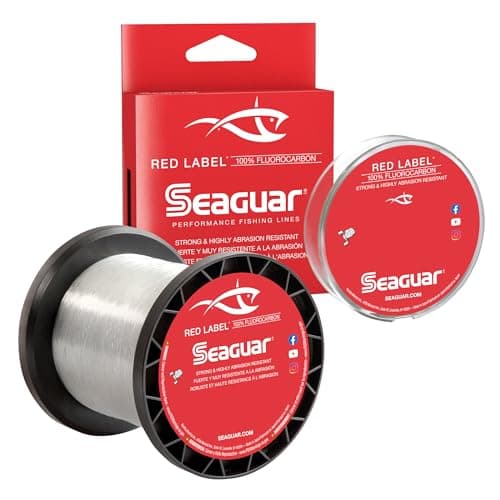 Best value for a full spool Seaguar Red Label Fluorocarbon Line Published as designed for baitcasting reels, with abrasion resistance and high knot strength. | Baitcaster main line | $15.48 · Check price on Amazon #ad how this is funded · price as of October 19, 2026 |
The charts, side by side
| Test | InvizX | Red Label | Difference |
|---|---|---|---|
| 6 lb | 0.008 | 0.008 | None |
| 8 lb | 0.009 | 0.009 | None |
| 10 lb | 0.010 | 0.010 | None |
| 12 lb | 0.011 | 0.012 | 0.001 |
| 15 lb | 0.013 | 0.013 | None |
| 17 lb | 0.015 | 0.015 | None |
| 20 lb | 0.016 | 0.016 | None |
An honest reading: they are the same diameter at six of seven published tests. The only gap is at 12 lb, where InvizX is a thousandth thinner.
That is a smaller difference than the marketing around premium versus value fluorocarbon implies, and it is worth knowing before paying more for one on the assumption it is thinner.
The difference that is not in the chart
Since diameter barely separates them, the published material claims are what remain.
| InvizX | Red Label | |
|---|---|---|
| Material | 100% fluorocarbon, Japan | 100% fluorocarbon, Japan |
| Handling | Published as soft and supple | Not published as soft |
| Stated intent | Easier casting, low stretch, fast sink | Designed for baitcasting reels |
| Stated strengths | Low visibility, low stretch | Abrasion resistance, knot and tensile strength |
| Spool sizes | 200, 600, 1000, 3000 yd | 175, 200, 1000, 3000 yd |
The softness claim is the meaningful one, and it maps cleanly onto the reel type each is aimed at. A spinning spool coils the line on every cast, so suppleness matters; a baitcaster spool does not, so it matters less.
Which to buy
As a leader, on any reel: InvizX. You are buying two to four feet at a time, so the price difference is trivial, and the suppleness makes the line-to-line knot easier to seat. At 12 lb it also matches 30 lb braid’s 0.011 in exactly, which is the ideal condition for a double uni or FG knot.
As a spinning main line: InvizX, for the same suppleness reason. Stiff fluorocarbon on a spinning reel produces coils and wind knots, and that is the most common reason people give up on fluorocarbon entirely.
As a baitcaster main line: Red Label. You are filling a spool with 150 to 200 yards, the price difference is real at that volume, and the baitcaster spool does not punish the extra stiffness.
For crankbaits: either, and fluorocarbon generally beats braid here. Its moderate stretch suits treble hooks, and its sink rate makes a crankbait run slightly deeper.
What neither chart tells you
Both makers publish diameters and material claims. Neither publishes measured knot strength, actual break strength against the rating, or how the line behaves after a season of UV and use.
We have not fished either. What this page can honestly compare is what they measure and what the maker states they are for — and on diameter, the answer is that they are far closer than the price gap suggests.
The picks, in full
Every card below lists the specs we could read off a published page, the URL they came from, and one honest reason you might not want it.
1. Best for spinning and leaders
Seaguar InvizX Fluorocarbon Line
Seaguar
Thinner at most tests and published as soft and supple, which is the property fluorocarbon usually lacks.
Fluorocarbon’s standard complaint is stiffness — it comes off the spool in coils and knots badly. Seaguar publishes InvizX as soft and supple for easier casting, which directly addresses that.
On a spinning reel that matters a great deal. A spinning spool imparts a coil to the line on every cast, and a stiff fluorocarbon fights it, producing loops and wind knots. Softer line behaves.
The published diameters run 4 lb at 0.007 in through 25 lb at 0.017, with 12 lb at 0.011 — which happens to match 30 lb braid exactly, and that is why it is our standard leader recommendation.
Spools in 200, 600, 1000 and 3000 yards. A 200 yard spool is several seasons of leader material.
The drawback
It is the more expensive of the two per yard. If you are filling a baitcaster with 200 yards of fluorocarbon main line rather than tying two-foot leaders, that difference adds up quickly.
Published specs
- 8 lb diameter
- 0.009 in / 0.23 mm
- 10 lb diameter
- 0.010 in / 0.26 mm
- 12 lb diameter
- 0.011 in / 0.28 mm
- 15 lb diameter
- 0.013 in / 0.33 mm
- 20 lb diameter
- 0.016 in / 0.40 mm
- Spool sizes
- 200, 600, 1000, 3000 yd
- Material
- 100% fluorocarbon, made in Japan
Specs read from Tackle Warehouse — Seaguar InvizX Fluorocarbon Line.
#ad how this is funded · price as of October 19, 2026
2. Best value for a full spool
Seaguar Red Label Fluorocarbon Line
Seaguar
Published as designed for baitcasting reels, with abrasion resistance and high knot strength.
Seaguar publishes this one as specifically designed for use on baitcasting reels, which is an unusually direct statement of intent and it lines up with the rest of the spec.
A baitcaster spool does not impart the same coil that a spinning spool does, so the stiffness that hurts InvizX’s cheaper sibling on spinning gear matters far less here. Meanwhile the published abrasion resistance is doing useful work on the heavier line a baitcaster typically carries.
Diameters run 6 lb at 0.008 in through 20 lb at 0.016. Spools in 175, 200, 1000 and 3000 yards.
It is also 100% fluorocarbon made in Japan, same as the InvizX — this is not a different material, it is a different formulation.
The drawback
It is consistently a thousandth of an inch or so thicker than InvizX at the same test, and it is not published as soft or supple. On a spinning reel that combination produces more memory and more coiling off the spool.
Published specs
- 6 lb diameter
- 0.008 in / 0.185 mm
- 8 lb diameter
- 0.009 in / 0.235 mm
- 10 lb diameter
- 0.010 in / 0.260 mm
- 12 lb diameter
- 0.012 in / 0.310 mm
- 15 lb diameter
- 0.013 in / 0.330 mm
- 20 lb diameter
- 0.016 in / 0.405 mm
- Material
- 100% fluorocarbon, made in Japan
- Spool sizes
- 200, 1000, 3000 yd
Specs read from Tackle Warehouse — Seaguar Red Label Fluorocarbon Line.
#ad how this is funded · price as of October 19, 2026
Questions people actually ask
Is InvizX thinner than Red Label?
Only at 12 lb, where it measures 0.011 in against 0.012. At six of the seven published tests — 6, 8, 10, 15, 17 and 20 lb — the two are identical in diameter.
What is the difference between Seaguar InvizX and Red Label?
Handling rather than diameter. Both are 100% fluorocarbon made in Japan, but InvizX is published as soft and supple for easier casting, while Red Label is published as designed specifically for baitcasting reels.
Which fluorocarbon is best for spinning reels?
InvizX, on the published softness. A spinning spool imparts a coil to the line on every cast and stiff fluorocarbon fights it, producing loops and wind knots — which is the most common reason people abandon fluorocarbon.
Which fluorocarbon should I use as a leader?
InvizX at 12 lb, which measures 0.011 in and therefore matches 30 lb braid exactly. Joining two lines of identical diameter is the ideal condition for a double uni or FG knot, and you only buy a few feet at a time.
Read next
Sources
Prices on this page come from the retailer at request time and change without notice. If we cannot get a live one we say “check price” rather than show you a number that has gone stale. How we pick.