Tackle
Fluorocarbon line: when it is worth the money
The most expensive line and the most oversold. Its real advantages are narrower than the marketing and genuinely useful where they apply.
By Sawyer V. · Last updated · How we pick
The short answer
Fluorocarbon’s real advantages are low visibility and a fast sink rate. It is not meaningfully thinner than monofilament. Published charts put 12 lb InvizX at 0.011 in and 12 lb Trilene XL mono at 0.013 in. For most anglers the right use is a leader, not a full spool.
Reel & Rig earns a commission from qualifying purchases made through links on this page, at no extra cost to you. It does not change which gear we pick or what we say about it. Full disclosure.
Quick picks
| # | Product | Best for | Price |
|---|---|---|---|
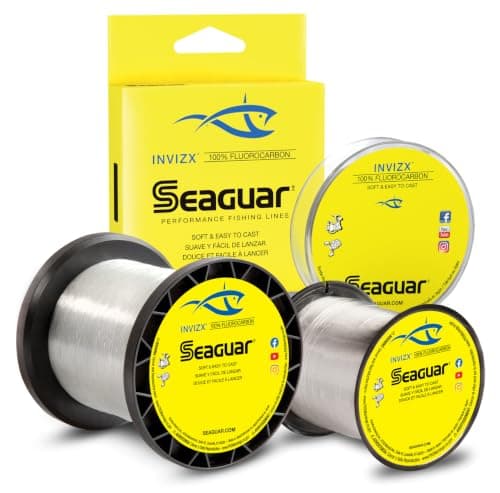
| 1 | Best fluorocarbon Seaguar InvizX Fluorocarbon Line 100% fluorocarbon with a published diameter chart from 4 lb at 0.007 in to 25 lb at 0.017 in. | Leaders, and clear-water finesse fishing | $23.26 · Check price on Amazon #ad how this is funded · price as of October 19, 2026 |
| 2 | 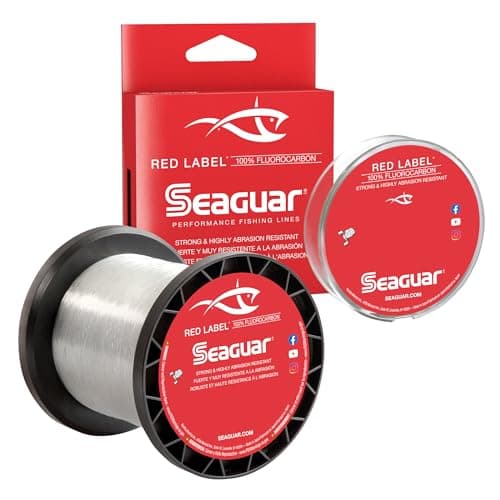 Best value for a full spool Seaguar Red Label Fluorocarbon Line Published as designed for baitcasting reels, at 0.012 in for 12 lb and 0.016 in for 20 lb. | Filling a baitcaster rather than tying leaders | $15.48 · Check price on Amazon #ad how this is funded · price as of October 19, 2026 |
The diameter myth, settled
The most repeated claim about fluorocarbon is that it is thinner than mono at the same strength. The published charts do not support it.
| Test | Seaguar InvizX | Trilene XL mono | Difference |
|---|---|---|---|
| 6 lb | 0.008 in | 0.009 in | 0.001 in |
| 8 lb | 0.009 in | 0.010 in | 0.001 in |
| 10 lb | 0.010 in | 0.011 in | 0.001 in |
| 12 lb | 0.011 in | 0.013 in | 0.002 in |
| 17 lb | 0.015 in | 0.015 in | None |
| 20 lb | 0.016 in | 0.016 in | None |
A thousandth of an inch at the light end, nothing at all at 17 and 20 lb. Whatever you are paying the premium for, it is not thinness.
What you are actually paying for
Refractive index. Fluorocarbon bends light at close to the same angle water does, so it is genuinely harder for a fish to see. This is a real physical property, not a marketing claim, and it is the main reason to use it.
Sink rate. Fluorocarbon is denser than water and sinks; mono floats. That matters more than most people credit. A floating line puts a belly of slack between rod tip and lure, which delays your hookset and mutes what you feel. A sinking line keeps a straighter connection.
Low stretch. Less than mono, more than braid. Better bite detection and hooksets than mono, without braid’s complete lack of cushioning.
Abrasion resistance. Genuinely good, and the reason it is standard as a leader over braid when there is rock or wood involved.
Leader or full spool?
For most freshwater anglers, leader. Here is the reasoning.
Fluorocarbon’s advantages all act at the business end — near the lure, where the fish is looking and where the line contacts structure. Its disadvantages — cost, memory, stiff knots — act along the whole spool.
Two to four feet of fluorocarbon joined to a braid main line gets you every advantage at about two percent of the material cost, and the memory problem disappears because a four-foot section cannot coil.
When a full spool is right: clear-water finesse fishing where you are making long casts to spooky fish and want the whole line invisible; and crankbait fishing, where fluorocarbon’s sink rate makes a bait run slightly deeper and its moderate stretch suits treble hooks better than braid.
Knotting it properly, because this is where it fails
Fluorocarbon is less forgiving than mono in knots, and a badly tied one breaks at a fraction of the rated strength. Three rules:
- Wet it. Not optional. Friction from a dry knot cinching down generates enough heat to damage the line, and fluorocarbon is more sensitive to it than mono.
- Tighten slowly and steadily. A fast jerk creates heat in one spot.
- Use enough wraps. Fluorocarbon is slick. Five to seven wraps on a clinch, not the three or four you might get away with on mono.
If a knot fails at the knot rather than mid-line, it was one of these three, essentially every time.
Is it worth it?
As a leader: yes, unambiguously. A 200 yd spool is several seasons of leader material and it makes braid usable in clear water.
As a main line for a beginner: no. It is stiff, it costs the most, it knots least forgivingly, and the invisibility advantage matters most in exactly the finesse situations a beginner is not yet fishing.
Buy mono first, braid second, and fluorocarbon as a leader alongside the braid.
The picks, in full
Every card below lists the specs we could read off a published page, the URL they came from, and one honest reason you might not want it.
1. Best fluorocarbon
Seaguar InvizX Fluorocarbon Line
Seaguar
100% fluorocarbon with a published diameter chart from 4 lb at 0.007 in to 25 lb at 0.017 in.
Seaguar publishes this as 100% fluorocarbon made in Japan, with low stretch, a fast sink rate, and what the maker describes as being soft and supple for easier casting than typical fluorocarbon.
That softness matters more than it sounds. Fluorocarbon’s standard complaint is stiffness — it comes off the spool in coils and knots badly. A softer formulation is genuinely easier to fish, particularly on a spinning reel.
The published diameters run 4 lb at 0.007 in, 8 lb at 0.009, 10 lb at 0.010, 12 lb at 0.011, 15 lb at 0.013, 20 lb at 0.016 and 25 lb at 0.017.
Spools in 200, 600, 1000 and 3000 yd. If you are using it as a leader, a 200 yd spool is several seasons of material.
The drawback
It is the most expensive of the three materials per yard and the least forgiving to knot — a fluorocarbon knot that is not properly seated and wetted fails at a fraction of its rated strength. On a spinning reel it also has more memory than mono, so it can spring into coils on the first cast of the day.
Published specs
- 8 lb diameter
- 0.009 in / 0.23 mm
- 10 lb diameter
- 0.010 in / 0.26 mm
- 12 lb diameter
- 0.011 in / 0.28 mm
- 15 lb diameter
- 0.013 in / 0.33 mm
- 20 lb diameter
- 0.016 in / 0.40 mm
- Spool sizes
- 200, 600, 1000, 3000 yd
- Material
- 100% fluorocarbon, made in Japan
Specs read from Tackle Warehouse — Seaguar InvizX Fluorocarbon Line.
#ad how this is funded · price as of October 19, 2026
2. Best value for a full spool
Seaguar Red Label Fluorocarbon Line
Seaguar
Published as designed for baitcasting reels, at 0.012 in for 12 lb and 0.016 in for 20 lb.
Same material as the InvizX — Seaguar publishes both as 100% fluorocarbon made in Japan — but a different formulation with a different stated purpose: this one is published as designed specifically for baitcasting reels.
That matters because a baitcaster spool does not impart the coil that a spinning spool does, so the stiffness which makes cheaper fluorocarbon awkward on spinning gear is far less of a problem here.
The published diameters are within a thousandth of an inch of the InvizX at six of seven tests, which is a much smaller gap than the price difference implies. Spools in 175, 200, 1000 and 3000 yd.
The drawback
It is not published as soft or supple, and on a spinning reel that shows up as more memory and more coiling off the spool. Use it on a baitcaster, or accept the handling penalty.
Published specs
- 6 lb diameter
- 0.008 in / 0.185 mm
- 8 lb diameter
- 0.009 in / 0.235 mm
- 10 lb diameter
- 0.010 in / 0.260 mm
- 12 lb diameter
- 0.012 in / 0.310 mm
- 15 lb diameter
- 0.013 in / 0.330 mm
- 20 lb diameter
- 0.016 in / 0.405 mm
- Material
- 100% fluorocarbon, made in Japan
- Spool sizes
- 200, 1000, 3000 yd
Specs read from Tackle Warehouse — Seaguar Red Label Fluorocarbon Line.
#ad how this is funded · price as of October 19, 2026
Questions people actually ask
Is fluorocarbon worth it for fishing line?
As a leader, yes. Its advantages — low visibility and a fast sink rate — all act near the lure, while its costs act along the whole spool. Two to four feet joined to a braid main line gets every benefit at a small fraction of the material cost.
Is fluorocarbon thinner than mono?
Barely, and not at all at heavier tests. Published charts put 10 lb InvizX at 0.010 in against 10 lb Trilene XL at 0.011, and both at 0.016 in for 20 lb. Whatever the premium buys, it is not thinness.
Why does fluorocarbon sink?
It is denser than water, unlike nylon monofilament which floats. That matters practically: a floating line puts a belly of slack between rod tip and lure, which delays hooksets and mutes what you feel.
Why does my fluorocarbon keep breaking at the knot?
Almost always one of three things: the knot was not wetted before tightening, it was cinched too fast, or it had too few wraps. Fluorocarbon is slicker and more heat-sensitive than mono — use five to seven wraps and tighten slowly on a wet knot.
Should a beginner use fluorocarbon line?
Not as a main line. It is the most expensive of the three materials, the stiffest, and the least forgiving to knot, and its invisibility advantage matters most in finesse situations a beginner is not fishing yet. Start with mono.
Read next
Sources
Prices on this page come from the retailer at request time and change without notice. If we cannot get a live one we say “check price” rather than show you a number that has gone stale. How we pick.