Electronics
The best fish finders under $300
Under three hundred dollars is where GPS becomes affordable, and GPS is the feature that changes how you fish.
By Sawyer V. · Last updated · How we pick
The short answer
Under $300 the feature worth prioritizing is GPS, not screen size or imaging. Marking a productive spot and returning to it is what turns a screen into a fishing tool. A bigger screen without GPS tells you what is under you now and nothing about where it was last week.
Reel & Rig earns a commission from qualifying purchases made through links on this page, at no extra cost to you. It does not change which gear we pick or what we say about it. Full disclosure.
Quick picks
| # | Product | Best for | Price |
|---|---|---|---|
| 1 | Best overall under $300 Humminbird HELIX 5 CHIRP GPS G3 5-inch 800x480, published 20/42/60-degree cones, 500 W RMS, GPS with 2,750 waypoints and AutoChart Live. | Everything a first unit should do | $341.56 · Check price on Amazon #ad how this is funded · price as of October 19, 2026 |
| 2 | 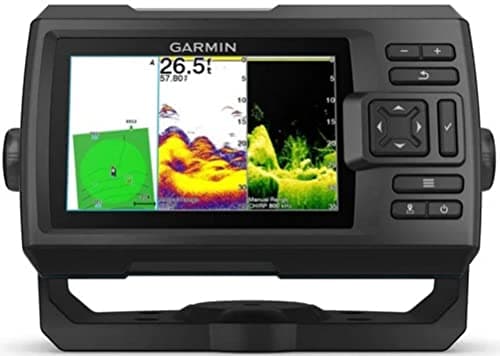 Best for unmapped water Garmin STRIKER Vivid 5cv ClearVu plus Quickdraw Contours at 1-ft resolution — the mapping is the reason, not the sonar. | A local lake with no chart | $334.99 · Check price on Amazon #ad how this is funded · price as of October 19, 2026 |
| 3 | 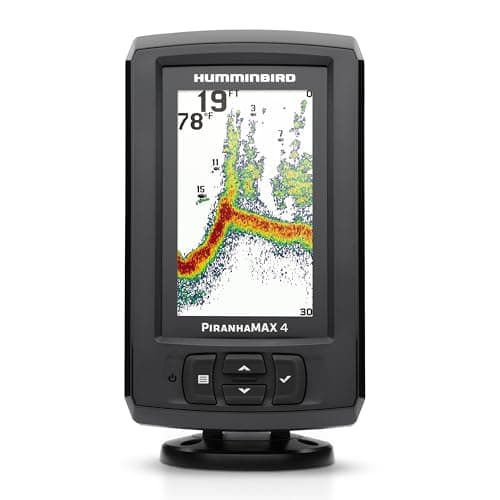 Cheapest worth buying Humminbird PiranhaMAX 4 Depth, bottom and fish on 4.3 inches for a fraction of the budget. No GPS, stated plainly. | A boat used a handful of times a year | $135.02 · Check price on Amazon #ad how this is funded · price as of October 19, 2026 |
What under $300 buys
More than people expect. In this band you can get all four of the things a fish finder should do: depth, bottom composition, fish marks, and the ability to save a spot and come back to it.
You can also get CHIRP, which meaningfully improves target separation, and on some units a down-looking imaging channel.
What it does not buy
- Side imaging. Effectively absent below this price. It is a water-covering tool for large open water and its absence is not a hardship on a small lake.
- A large screen. Five inches is the practical ceiling here, which rules out useful three-panel split views.
- Extensive pre-loaded charts. The generous C-MAP and Basemap sets sit above this band. Draw-your-own mapping is the substitute, and on one lake it is arguably better.
- Published brightness. None of the units here states a nit figure, so sun readability is genuinely unknown to us.
Prioritize GPS over everything else
If the budget forces a single choice, choose the unit with GPS.
The reason is that fishing knowledge compounds. You find a rock pile in eleven feet on the north end. Without GPS, that is a good afternoon. With GPS, that is a waypoint, and next spring you drive straight to it and check whether the fish are back.
Do that for a season and you have a personal map of the lake nobody can sell you. A larger screen does not compound.
Budget for what is not in the box
Two things people forget.
A battery, if the boat has no electrical system. A 12 V 7 Ah sealed pack runs a 615 mA unit for roughly eleven hours. Budget $30–60 including a charger.
A transducer mount that suits your hull. The included transom bracket suits a transom. Kayaks need a scupper or arm mount; some boats need an inside-hull install. That is $20–60 depending on the approach.
What to skip in this band
Anything advertising side imaging under $300. The claim is usually a narrow, low-resolution approximation that produces an image you cannot interpret, and it takes budget away from the GPS and beam width that would have helped.
The picks, in full
Every card below lists the specs we could read off a published page, the URL they came from, and one honest reason you might not want it.
1. Best overall under $300
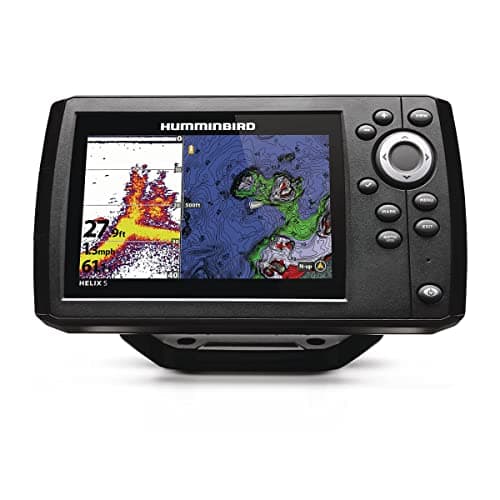
Humminbird HELIX 5 CHIRP GPS G3
Humminbird
5-inch 800x480, published 20/42/60-degree cones, 500 W RMS, GPS with 2,750 waypoints and AutoChart Live.
The specification that justifies the price is the published 60-degree wide cone. In fifteen feet of water that covers roughly a 17-foot circle; a 28-degree cone covers about 7.5. On shallow inland water that is most of the difference between a screen you use and one you ignore.
GPS with Basemap and 2,750 waypoints, plus AutoChart Live with eight hours of recording so you can map water the Basemap does not detail. 4,000 W peak-to-peak, 500 W RMS, 1,200 ft, 615 mA draw.
The drawback
No down imaging and no side imaging at this price, so structure stays an interpretation. Humminbird also does not publish a weight or a screen brightness figure for this unit.
Published specs
- Display
- 5 in, 800H x 480V color TFT
- Transducer
- XNT 9 HW T
- Sonar
- Dual Spectrum CHIRP: narrow 180-240, wide 140-200, full 150-220 kHz
- Coverage
- 20, 42 and 60 deg @ -10 dB
- Max depth
- 1,200 ft standard (3,000 ft with optional 50 kHz)
- Power output
- 4,000 W peak-to-peak / 500 W RMS
- Mapping
- Humminbird Basemap, AutoChart Live (8 h)
- Waypoints
- 2,750 waypoints / 45 routes / 50 tracks
- Dimensions
- 7.55 W x 4.64 H x 3.3 D in (gimbal)
- Power draw
- 615 mA
Specs read from Rogers Sporting Goods — Humminbird HELIX 5 CHIRP GPS G3.
#ad how this is funded · price as of October 19, 2026
2. Best for unmapped water
Garmin STRIKER Vivid 5cv
Garmin
ClearVu plus Quickdraw Contours at 1-ft resolution — the mapping is the reason, not the sonar.
This is the sub-$300 unit that gives you down-looking imaging as well as 2D: CHIRP ClearVu at a published 455/800 kHz and 500 W, reading to 750 ft, alongside traditional 77/200 kHz reading to 1,900 ft.
Quickdraw Contours at one-foot resolution is the other half. If your home water is a small lake nobody surveyed, this builds a better map of it than any chart set contains.
Twenty-foot transducer cable with a built-in temperature sensor, transom and trolling-motor mounts in the box.
The drawback
The retailer spec page we cite omits display resolution, weight, waypoint capacity and power draw. For a unit at this price those are basic figures and we would rather have them than not.
Published specs
- Display
- 5 in color
- Transducer
- GT20-TM, 20 ft cable with temperature sensor
- Traditional sonar
- 77/200 kHz, 500 W
- ClearVu sonar
- CHIRP 455/800 kHz, 500 W
- Max depth
- 1,900 ft traditional / 750 ft ClearVu
- Mapping
- Quickdraw Contours, 1-ft contours
- Mounts
- Transom and trolling motor
Specs read from Fish307 — Garmin STRIKER Vivid 5cv with GT20-TM Transducer.
#ad how this is funded · price as of October 19, 2026
3. Cheapest worth buying
Humminbird PiranhaMAX 4
Humminbird
Depth, bottom and fish on 4.3 inches for a fraction of the budget. No GPS, stated plainly.
Published: 4.3-inch 272 × 480 in 256 colors, dual beam 200/455 kHz with 28 and 16-degree cones, 600 ft and 320 ft, 2,400 W peak-to-peak and 300 W RMS, XNT 9 28 T transducer, tilt-and-swivel mount.
This is a genuinely honest product: it does three of the four jobs a fish finder should do and it does not pretend otherwise.
The drawback
No GPS is a bigger loss than the price gap suggests, and the 28-degree cone sees roughly 7.5 ft in 15 ft of water against about 17 ft for a 60-degree beam. In shallow water that is genuinely limiting.
Published specs
- Display
- 4.3 in, 272H x 480V, 256-color TFT
- Transducer
- XNT 9 28 T, transom mount
- Sonar
- Dual Beam, 200/455 kHz
- Coverage
- 28 deg and 16 deg @ -10 dB
- Max depth
- 600 ft @ 200 kHz / 320 ft @ 455 kHz
- Power output
- 2,400 W peak-to-peak / 300 W RMS
- Dimensions
- 3.91 W x 7.34 H x 3.62 D in (gimbal)
- Input
- 10.8-20 VDC
Specs read from L&M Fleet Supply — Humminbird PiranhaMAX 4.
#ad how this is funded · price as of October 19, 2026
Questions people actually ask
What is the best fish finder under $300?
A 5-inch CHIRP unit with built-in GPS and a wide beam option. The published 60-degree wide cone on a HELIX 5 covers roughly a 17-foot circle in 15 feet of water, against about 7.5 feet for a 28-degree beam — that difference matters more than screen size.
Can you get a fish finder with GPS under $300?
Yes, comfortably. GPS with mapping is available well within this band, and it is the feature worth prioritizing because marking a spot and returning to it is what turns a screen into a fishing tool.
Is a $300 fish finder good enough for a small lake?
More than good enough. What you give up is side imaging, a large screen and extensive pre-loaded charts — all of which matter most on big water. On a small inland lake, a 5-inch CHIRP unit with GPS does everything you need.
What else do I need to budget for with a fish finder?
A 12 V battery if your boat has no electrical system, at roughly $30 to $60 with a charger, and a transducer mount if your hull is not a standard transom — $20 to $60 for a kayak scupper mount or an in-hull install.
Read next
Sources
Prices on this page come from the retailer at request time and change without notice. If we cannot get a live one we say “check price” rather than show you a number that has gone stale. How we pick.