Reels
The best spinning reels for walleye
Deeper water and lighter line than bass fishing, which pushes the answer toward capacity.
By Sawyer V. · Last updated · How we pick
The short answer
Walleye are usually fished deeper than bass, so you need more line out and more capacity in reserve. A 2500 to 3000-size reel with a genuinely smooth drag is the target. The Daiwa BG3000 and the Pflueger President 30X both publish the capacity figures that let you check them against your rod.
Reel & Rig earns a commission from qualifying purchases made through links on this page, at no extra cost to you. It does not change which gear we pick or what we say about it. Full disclosure.
Quick picks
| # | Product | Best for | Price |
|---|---|---|---|
| 1 | No photo Best walleye reel Daiwa BG Spinning Reel (BG3000) The 3000-size step up in capacity, on a metal body with a published retrieve rate. | Deep jigging, rigging and big water | |
| 2 | 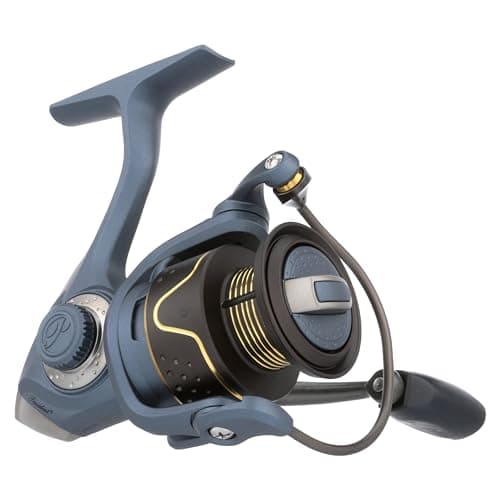 Best for feel and light line Pflueger President Spinning Reel (30X) 145 yd of 6 lb, 25.3 in per turn, at 8.8 oz — the lighter option. | Lighter jigs, shallower water, and long days holding the rod | $62.45 · Check price on Amazon #ad how this is funded · price as of October 12, 2026 |
Why depth changes the requirement
Bass fishing happens mostly in under fifteen feet. Walleye fishing routinely happens in twenty to forty.
That has a direct consequence for the reel: before a fish has done anything, you already have thirty feet of line out vertically. Every yard a fish then takes comes out of a smaller remaining spool, and a smaller remaining spool means the drag behaves differently as its effective diameter drops.
So capacity is not about long runs here. It is about having enough line on the spool that the last thirty yards behave the same as the first.
The drag requirement is specific
Walleye have bony mouths and are hooked on a single jig hook, often at depth on light line. Three things that all argue for the same property.
Start-up smoothness is what stops a light hook tearing free on the first surge, and it is the property least often published. Our drag page covers setting it properly.
Consistency as the spool empties matters more in deep water for the reason above.
Do not reel against a slipping drag. This is the third cause of line twist on our line twist page, and deep-water walleye on light line is exactly the situation that produces it. Pump the rod instead.
Sizing, using published figures
| Technique | Size | Why |
|---|---|---|
| River jigging, shallow | 2500 | Little line out; weight matters more |
| Lake jigging, 20-40 ft | 3000 | Capacity in reserve below the line already out |
| Live-bait rigging | 2500-3000 | Line has to leave the spool freely on a take |
| Casting cranks | 2500 | Retrieve comfort over capacity |
As always, check the published capacity rather than the size number — our reel size page shows how far apart two reels with similar labels can be.
Line: braid to a leader, usually
Walleye jigging is the strongest freshwater case for braid, and the reason is the bite.
A walleye take is frequently just weight, as our walleye rods page describes. Monofilament stretches enough over thirty feet to absorb exactly that signal. Braid has effectively no stretch, so it arrives at your hand.
The fluorocarbon leader is there because the water is clear and often rocky. It is hard to see and it resists abrasion, which our fluorocarbon page covers.
Remember that braid needs backing on a bare spool or it slips, which our spooling page explains.
What not to spend on
Very high gear ratios. Walleye jigging is a slow, deliberate technique. A fast retrieve is not an advantage and costs torque.
Bearing count. The bearing that matters is the line roller, and count is the most oversold number on a reel box — a point our beginner reel page makes with published figures.
Sealed saltwater bodies. Genuinely useful in salt, unnecessary on a freshwater walleye lake, and it costs both money and weight.
So what do I actually buy?
Take the 3000 for deep lake jigging and the lighter reel for rivers and long days holding the rod.
Daiwa BG Spinning Reel (BG3000)
Check priceThe 3000-size capacity step, on a metal body. Deep-water pick.
Pflueger President Spinning Reel (30X)
$62.458.8 oz and 145 yd of 6 lb — lighter, for rivers and all-day jigging.
#ad how this is funded · price as of October 12, 2026
Power Pro Spectra Braided Line
$44.25Braid delivers the weight-only walleye take that mono absorbs.
#ad how this is funded · price as of October 12, 2026
Seaguar InvizX Fluorocarbon Line
$25.99Fluorocarbon leader for clear, rocky walleye water.
#ad how this is funded · price as of October 12, 2026
The picks, in full
Every card below lists the specs we could read off a published page, the URL they came from, and one honest reason you might not want it.
1. Best walleye reel
Daiwa BG Spinning Reel (BG3000)
Daiwa
The 3000-size step up in capacity, on a metal body with a published retrieve rate.
The 3000 is the size that suits walleye specifically, and the reason is depth. Jigging in twenty-five to forty feet means a lot of line off the spool before you have hooked anything, and capacity in reserve is what a fish that runs uses.
A metal body matters more here than on bass gear, because walleye fishing frequently means holding a rod with a jig at depth for hours and then loading the reel hard against a fish. Body flex under sustained load is what puts gears out of mesh.
Daiwa publishes capacity, ratio and retrieve rate on the BG family, which is what lets you match it to the rod rating on our walleye rods page rather than guessing from the size label.
The drawback
It is heavier than a comparable Pflueger, and walleye jigging is a hold-the-rod-all-day technique where that accumulates. The 3000 is also more reel than you need for shallow river walleye, where the extra capacity is dead weight.
Published specs
- Gear ratio
- 5.6:1
- Bearings
- 6 ball + 1 roller
- Weight
- 10.8 oz
- Line capacity
- 8 lb / 240 yd, 10 lb / 200 yd
- Retrieve per turn
- 37.4 in
- Body
- Hard Bodyz body and side cover, Air Rotor
Specs read from Tackle Warehouse — Daiwa BG Spinning Reels.
2. Best for feel and light line
Pflueger President Spinning Reel (30X)
Pflueger
145 yd of 6 lb, 25.3 in per turn, at 8.8 oz — the lighter option.
At 8.8 oz this is a noticeably lighter reel, and on a technique where the rod is in your hand continuously that is a real advantage rather than a specification detail.
145 yd of 6 lb is ample for river walleye and shallower lake work. Walleye do not make long runs; capacity matters for the line you already have out, not for a hundred-yard sprint.
Light line is also the point. Walleye water is often clear, and 6 to 8 lb fluorocarbon or braid with a leader is standard — which this reel holds plenty of.
The drawback
Pflueger does not publish a maximum drag figure, and on deep-water walleye where a good fish loads the reel hard that omission matters more than it does on bass gear. Capacity is also genuinely lower than the Daiwa, which shortens your margin when jigging deep.
Published specs
- Gear ratio
- 5.2:1
- Bearings
- 10 stainless + 1 roller
- Weight
- 8.8 oz
- Line capacity
- 6 lb / 145 yd, 8 lb / 130 yd
- Retrieve per turn
- 25.3 in
- Body
- Graphite body and rotor
- Spool
- Aluminum, braid ready
Specs read from Tackle Warehouse — Pflueger President Spinning Reels.
#ad how this is funded · price as of October 12, 2026
Questions people actually ask
What size reel for walleye?
A 2500 for shallow rivers and casting, a 3000 for lake jigging in twenty to forty feet. Depth is the reason — you already have thirty feet of line out vertically before a fish does anything.
Why does capacity matter for walleye if they don't run far?
Because of the line already out. Jigging deep means a large share of the spool is deployed before the fight starts, and a nearly empty spool changes how the drag behaves as its effective diameter drops.
Should you use braid for walleye?
Braid to a fluorocarbon leader, usually. A walleye take is often just weight, and mono stretches enough over thirty feet to absorb that signal entirely. The leader handles clear, rocky water.
Do you need a high gear ratio for walleye?
No. Jigging is slow and deliberate, so a fast retrieve is not an advantage and it costs torque. Bearing count and sealed saltwater bodies are two more things not worth paying for here.
Prices on this page come from the retailer at request time and change without notice. If we cannot get a live one we say “check price” rather than show you a number that has gone stale. How we pick.