Tackle
Braided line: what the diameter chart tells you
Two braids, one diameter chart, and the honest account of what braid costs you in exchange for what it gives.
By Sawyer V. · Last updated · How we pick
The short answer
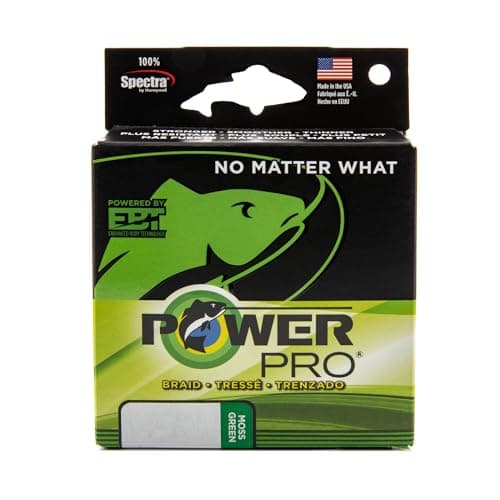
Braid’s single advantage is strength per diameter, and Power Pro publishes the comparison itself. 30 lb braid measures 0.011 in and behaves like 8 lb mono for thickness. On a freshwater reel, 20–30 lb with a 10–15 lb fluorocarbon leader is the standard setup.
Reel & Rig earns a commission from qualifying purchases made through links on this page, at no extra cost to you. It does not change which gear we pick or what we say about it. Full disclosure.
Quick picks
| # | Product | Best for | Price |
|---|---|---|---|
| 1 | Best braid Power Pro Spectra Braided Line Published diameters with the maker's own mono equivalents: 30 lb at 0.011 in, behaving like 8 lb mono. | Sensitivity and capacity on a freshwater reel | $44.25 · Check price on Amazon #ad how this is funded · price as of October 19, 2026 |
| 2 | 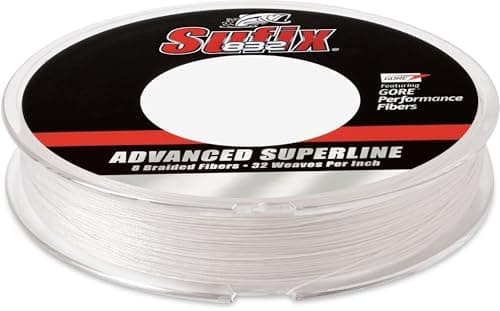 Best for abrasive cover Sufix 832 Advanced Superline Braid 8 fibers including one GORE Performance Fiber at 32 weaves per inch, with 30 lb at 0.011 in. | Rock, timber and anywhere line gets rubbed | $17.99 · Check price on Amazon #ad how this is funded · price as of October 19, 2026 |
The chart, in full
| Test | Inches | mm | Mono equivalent |
|---|---|---|---|
| 8 lb | 0.005 | 0.13 | 1 lb |
| 10 lb | 0.006 | 0.15 | 2 lb |
| 15 lb | 0.007 | 0.18 | 4 lb |
| 20 lb | 0.009 | 0.23 | 6 lb |
| 30 lb | 0.011 | 0.28 | 8 lb |
| 40 lb | 0.013 | 0.33 | 10 lb |
| 50 lb | 0.014 | 0.36 | 12 lb |
| 65 lb | 0.016 | 0.41 | 16 lb |
| 80 lb | 0.017 | 0.43 | 17 lb |
What test to buy for freshwater
Almost everyone over-buys, because braid is cheap in strength terms and 50 lb sounds reassuring.
The constraint is your rod’s line rating, not the braid. On a rod rated 6–14 lb, 15–20 lb braid keeps the line as the weak point in the system, which is what protects the blank. On a medium-heavy rod rated 8–20 lb, 30 lb is defensible.
The other reason not to over-buy: heavier braid is thicker, and thickness is the only thing you were buying braid for. 50 lb at 0.014 in is thicker than 12 lb mono. At that point you have paid a premium to end up back where you started.
Braid needs a leader, and that means a knot
Braid is opaque and highly visible. In clear water fish see it. The standard fix is two to four feet of fluorocarbon between the braid and the lure.
That requires a line-to-line knot. Two are worth knowing:
The double uni. Easier, adequate, and it takes ten minutes to learn. Tie a uni knot in each line around the other, then pull them together. It leaves a small bump that occasionally clicks through the guides.
The FG knot. Stronger and much slimmer — it passes through guides almost unnoticed. It is genuinely fiddly to learn and worth the evening.
Match diameters where you can. 30 lb braid at 0.011 in joined to 12 lb fluorocarbon at 0.011 in is a knot between two lines of identical thickness, which is the condition under which line-to-line knots behave best.
Spooling braid: two things that go wrong
Spool slip. Braid is slick. Without a braid-ready spool, the entire spool of line can rotate on the arbor when you hook something, and you reel forever while nothing happens. Fifty yards of monofilament backing fixes it permanently. Reels like the Pflueger President and the Abu Garcia Max SX publish braid-ready aluminum spools and do not need it.
Loose winding. Braid has no memory and no stiffness, so it will happily wind on loose and then bury itself under tension on the first hard fight. Keep firm pressure between two fingers while spooling — more than you would with mono.
What braid is genuinely worse at
Being fair about this, since the diameter chart makes braid look strictly superior.
- Treble-hook baits. Zero stretch transmits every surge straight to small hooks in soft tissue. Use mono for crankbaits.
- Abrasion over sharp edges. Braid is many fine fibers; cut some and the rest fail. Mono is a single strand that scuffs.
- Cheap guides. A cracked ceramic insert saws braid apart. This is a real argument for one-piece stainless guides on a budget rod.
- Wind knots. Limp line plus slack equals tangles that mono would not form.
- Cost. Several times mono per yard, though it lasts several seasons.
The picks, in full
Every card below lists the specs we could read off a published page, the URL they came from, and one honest reason you might not want it.
1. Best braid
Power Pro Spectra Braided Line
Power Pro
Published diameters with the maker's own mono equivalents: 30 lb at 0.011 in, behaving like 8 lb mono.
Power Pro publishes something most line makers do not: its own mono-equivalent diameter alongside the actual measurement. 8 lb braid at 0.005 in is stated as behaving like 1 lb mono; 30 lb at 0.011 in like 8 lb; 50 lb at 0.014 in like 12 lb.
That transparency is worth something on its own, because it lets you size a spool correctly. A reel rated for 130 yards of 8 lb mono takes considerably more than 130 yards of 30 lb braid.
The construction is braided Spectra fiber with a smooth finish, which Power Pro describes as reducing friction through the guides for casting distance and knot performance.
Spools in 150, 300, 500 and 1500 yd. For freshwater, 150 yd over a mono backing is the sensible purchase — you are never using the bottom of the spool.
The drawback
It is highly visible in clear water, so it needs a fluorocarbon leader and therefore a line-to-line knot. It has zero stretch, which pulls treble hooks free on the surge. And it will saw straight through a cracked guide insert, which mono would survive.
Published specs
- 10 lb diameter
- 0.006 in / 0.15 mm (2 lb mono equivalent)
- 15 lb diameter
- 0.007 in / 0.18 mm (4 lb mono equivalent)
- 20 lb diameter
- 0.009 in / 0.23 mm (6 lb mono equivalent)
- 30 lb diameter
- 0.011 in / 0.28 mm (8 lb mono equivalent)
- 50 lb diameter
- 0.014 in / 0.36 mm (12 lb mono equivalent)
- Spool sizes
- 150, 300, 500, 1500 yd
- Material
- Braided Spectra fiber
Specs read from Tackle Warehouse — Power Pro Spectra Braided Line.
#ad how this is funded · price as of October 19, 2026
2. Best for abrasive cover
Sufix 832 Advanced Superline Braid
Sufix
8 fibers including one GORE Performance Fiber at 32 weaves per inch, with 30 lb at 0.011 in.
The published construction is what separates this from the Power Pro: eight fibers, of which seven are Dyneema and one is a GORE Performance Fiber, braided at 32 weaves per inch. Sufix states the GORE fiber is there for abrasion resistance and to reduce vibration.
That is a specific, checkable claim about what the eighth fiber does, which is more than most braid marketing offers. If you fish rock, timber or anywhere line gets rubbed, it is the property worth paying for.
Diameters run 8 lb at 0.007 in through 80 lb at 0.018, with 30 lb at 0.011 — identical to the Power Pro at that test and at every test above 20 lb. Spools in 150, 300, 600 and 1200 yd.
The drawback
It is generally the more expensive of the two per yard, and it is measurably thicker than Power Pro below 20 lb — 0.007 in against 0.005 at 8 lb. If you fish light braid on finesse spinning gear, that gap runs the wrong way.
Published specs
- 8 lb diameter
- 0.007 in / 0.18 mm (3 lb mono equivalent)
- 10 lb diameter
- 0.008 in / 0.20 mm (4 lb mono equivalent)
- 15 lb diameter
- 0.0085 in / 0.22 mm (5 lb mono equivalent)
- 20 lb diameter
- 0.009 in / 0.23 mm (6 lb mono equivalent)
- 30 lb diameter
- 0.011 in / 0.29 mm (8 lb mono equivalent)
- 50 lb diameter
- 0.014 in / 0.34 mm (12 lb mono equivalent)
- Construction
- 8 fibers: 7 Dyneema + 1 GORE Performance Fiber
- Weave density
- 32 weaves per inch, R8 Precision Braiding
- Spool sizes
- 150, 300, 600, 1200 yd
Specs read from Tackle Warehouse — Sufix 832 Braided Line.
#ad how this is funded · price as of October 19, 2026
Questions people actually ask
What pound braid should I use for bass fishing?
Fifteen to twenty pound on a rod rated 6-14 lb, or thirty pound on a medium-heavy rated 8-20 lb. Stay near the rod's rating so the line remains the weak point that breaks before the blank does.
Is 30 lb braid too heavy for freshwater?
Not in strength terms — it measures 0.011 in, the same as 12 lb mono. The question is your rod's rating. On a rod rated to 14 lb, 30 lb braid removes the line's role as the fuse in the system.
Do I need mono backing under braid?
Only if your spool is not braid-ready. Braid is slick enough that the whole spool can rotate on the arbor under load. Fifty yards of monofilament backing fixes it, and reels with braid-ready aluminum spools do not need it.
What knot should I use to join braid to fluorocarbon?
The double uni is easier and adequate; the FG knot is stronger and much slimmer through the guides. Match diameters where you can — 30 lb braid and 12 lb fluorocarbon are both 0.011 in, which is ideal for a line-to-line knot.
Why does braid cut through my rod guides?
It does not cut through good guides — it saws through a guide whose ceramic insert has already cracked. That is the practical argument for one-piece stainless guides on a budget rod, which have no insert to crack.
Read next
Sources
Prices on this page come from the retailer at request time and change without notice. If we cannot get a live one we say “check price” rather than show you a number that has gone stale. How we pick.