Tackle
Bladed jigs: what a ChatterBait does that a spinnerbait cannot
The lure that sits between a spinnerbait and a crankbait, and beats both in stained water with grass in it.
By Sawyer V. · Last updated · How we pick
The short answer
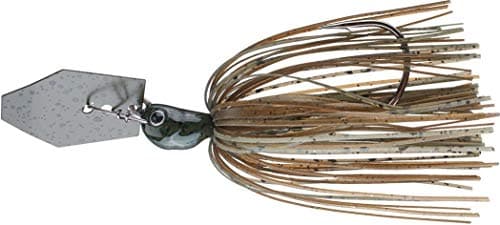
A bladed jig hangs a hex-shaped blade directly off the jig head, so the whole lure shakes rather than just a blade spinning behind it. The Jack Hammer is published in 3/8, 1/2, 3/4 and 1 1/4 oz. Start with 3/8 oz. It vibrates harder than a spinnerbait and comes through grass better than a crankbait.
Reel & Rig earns a commission from qualifying purchases made through links on this page, at no extra cost to you. It does not change which gear we pick or what we say about it. Full disclosure.
Quick picks
| # | Product | Best for | Price |
|---|---|---|---|
| 1 | Best bladed jig Z-Man Evergreen ChatterBait Jack Hammer Four published weights, a flat-bottom low center-of-gravity head, and a Gamakatsu heavy wire hook. | Stained water with grass, and anywhere a crankbait would foul | $19.79 · Check price on Amazon #ad how this is funded · price as of October 12, 2026 |
What the blade actually does here
On a spinnerbait, the blade spins on a wire arm above and behind the lure body. The blade moves; the body largely does not.
On a bladed jig, the blade is attached directly to the front of the jig head. It cannot spin freely, so instead it deflects sharply from side to side, and it drags the entire lure with it. The head, skirt and trailer all shake.
That is a fundamentally different signal in the water. A spinnerbait produces flash plus a modest pressure wave; a bladed jig produces a hard, tight vibration you can feel in your hands from thirty yards away.
Where it sits between the other two
| Lure | Main signal | Through grass? | Best water |
|---|---|---|---|
| Spinnerbait | Flash and a pressure wave | Yes, very good | Stained, around wood and brush |
| Bladed jig | Hard, tight vibration | Yes, good | Stained, in and over grass |
| Crankbait | Wobble and deflection | No, trebles foul | Clear to stained, hard cover |
The gap a bladed jig fills is grass. A crankbait’s trebles collect every strand of vegetation they touch; a bladed jig has a single upward-facing hook and comes through it. A spinnerbait handles wood better, but a bladed jig has far more vibration.
Retrieves worth knowing
Straight and steady. The default. Cast, count it down to the depth you want, and reel at a constant speed. Keep it just fast enough that the blade is thumping.
Ripping through grass. Fish it deliberately into the top of a grass bed until it loads up, then snap the rod tip to tear it free. The sudden acceleration out of the grass is what triggers the bite, and this is where most of the good fish come from.
Yo-yo. Reel a few turns, let it fall on a semi-slack line, reel again. In colder water this outfishes a steady retrieve, for the same reason a jerkbait pause does.
The trailer is not optional
A bladed jig fished bare is an incomplete lure. Adding a soft plastic trailer changes three things at once: it enlarges the profile, it adds a second action, and it slows the fall.
A paddle-tail swimbait is the standard choice and the one to start with — the tail thump and the blade vibration reinforce each other. A straight-tail plastic is the alternative when you want a tighter, less busy presentation in clear water.
Match the trailer size to the head. A 4 in trailer on a 3/8 oz head is balanced; a 6 in trailer on the same head will kill the vibration entirely.
Gear that suits it
Medium-heavy power, moderate-fast action, and either heavy fluorocarbon or braid. This is a single-hook lure, so the treble-hook argument for stretch does not apply — you want enough backbone to drive a heavy wire hook and to pull a fish clear of grass.
The rod that throws a spinnerbait throws this too, which is a convenient overlap if you are building one setup rather than five. Our rod power and action page explains why those two ratings are separate decisions.
So what do I actually buy?
One 3/8 oz bladed jig and a bag of paddle-tail trailers. That combination covers stained water and grass, which is where most freshwater bass actually live.
Z-Man Evergreen ChatterBait Jack Hammer
$19.79Published in 3/8, 1/2, 3/4 and 1 1/4 oz. Start at 3/8 oz — it fits a medium rod's window.
#ad how this is funded · price as of October 12, 2026
Keitech Swing Impact FAT Swimbait
$10.84The trailer. A 3.8 or 4.8 in paddle tail adds profile and a second vibration source.
#ad how this is funded · price as of October 12, 2026
Strike King Burner Spinnerbait
$9.23The spinnerbait alternative, for wood and brush where a bladed jig is the second choice.
#ad how this is funded · price as of October 12, 2026
The picks, in full
Every card below lists the specs we could read off a published page, the URL they came from, and one honest reason you might not want it.
1. Best bladed jig
Z-Man Evergreen ChatterBait Jack Hammer
Z-Man
Four published weights, a flat-bottom low center-of-gravity head, and a Gamakatsu heavy wire hook.
The published weights are 3/8, 1/2, 3/4 and 1 1/4 oz. For most freshwater fishing the first two cover everything, and 3/8 oz sits inside a medium rod’s casting window.
Z-Man publishes a flat-bottom head described as a low center-of-gravity design. That is a specific geometric claim, and it does a specific thing: a low, flat head resists rolling, so the lure tracks upright at speed instead of blowing out and spinning on its side.
The blade is published as thin stainless steel. Thin matters here — a lighter blade starts vibrating at a lower retrieve speed, which is what lets you fish this bait slowly in cold water.
A hand-tied silicone skirt and a Gamakatsu heavy wire hook are both published. Heavy wire is the right call on a lure you fish in grass, because you will be pulling fish out of vegetation rather than playing them in open water.
The drawback
It is one of the more expensive single lures in freshwater fishing, and grass fishing loses lures. Z-Man also does not publish an overall length or the hook size — only the hook brand and wire gauge — so two figures we would normally state are simply unavailable.
Published specs
- Weights
- 3/8, 1/2, 3/4, 1 1/4 oz
- Head
- Flat-bottom, published as a low center-of-gravity design
- Blade
- Thin stainless steel
- Skirt
- Hand-tied silicone rubber
- Hook
- Gamakatsu heavy wire
- Length
- Z-Man does not publish an overall length
Specs read from Tackle Warehouse - Z-Man Evergreen Chatterbait Jack Hammer.
#ad how this is funded · price as of October 12, 2026
Questions people actually ask
What is a ChatterBait?
A bladed jig — a jig head with a flat blade attached directly to the front, so the blade deflects side to side and shakes the entire lure rather than spinning behind it like a spinnerbait blade.
What weight bladed jig should you start with?
3/8 oz. It sits inside the 1/4 to 5/8 oz casting window printed on a medium rod, and it covers most freshwater depths. Heavier weights exist for wind, current and deeper water.
Do you need a trailer on a bladed jig?
Yes, in practice. A trailer enlarges the profile, adds a second action and slows the fall. A paddle-tail swimbait is the standard choice, and its tail thump reinforces the blade's vibration.
Is a bladed jig better than a spinnerbait?
Not better, different. A bladed jig vibrates much harder and fishes grass well; a spinnerbait gives flash plus vibration and comes through wood and brush better. In muddy water the bladed jig's stronger signal usually wins.
Read next
Sources
Prices on this page come from the retailer at request time and change without notice. If we cannot get a live one we say “check price” rather than show you a number that has gone stale. How we pick.