Tackle
The best lipless crankbaits, and how to fish a bait with no bill
No bill means no fixed depth. The weight you pick is the depth you fish.
By Sawyer V. · Last updated · How we pick
The short answer
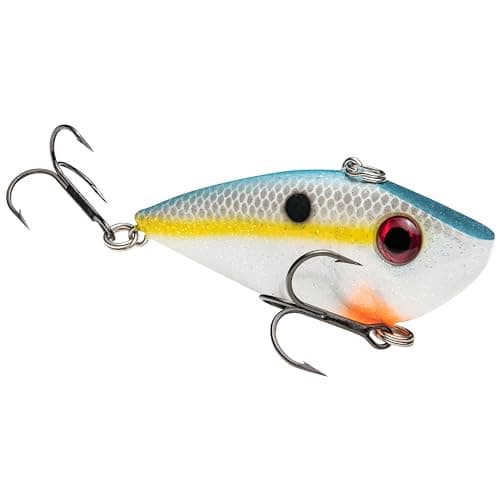
The Strike King Red Eye Shad publishes four sinking sizes: 1/4 oz at 2 in, 3/8 oz at 2.25 in, 1/2 oz at 2.5 in and 3/4 oz at 3 in. There is no published running depth because there is no bill — you set the depth by counting the bait down before you start reeling.
Reel & Rig earns a commission from qualifying purchases made through links on this page, at no extra cost to you. It does not change which gear we pick or what we say about it. Full disclosure.
Quick picks
| # | Product | Best for | Price |
|---|---|---|---|
| 1 | Best lipless crankbait Strike King Red Eye Shad Lipless Crankbait Four published sinking sizes from 1/4 oz at 2 in to 3/4 oz at 3 in, with no set running depth. | Covering water fast in spring and fall, and fishing over grass | $7.53 · Check price on Amazon #ad how this is funded · price as of October 12, 2026 |
Why there is no depth rating
Every bill-equipped crankbait publishes a running depth, because the bill is a fixed wing that drives the bait down a predictable amount at a given speed. Our crankbaits page uses those figures as the main selection tool.
A lipless bait has no bill. The line tie sits on top of the back, and the whole body is the wing. It has a rate of fall and a rate of rise, and no fixed depth at all.
So the published figure to select on is weight, because weight is fall rate. Everything else about how deep you fish is decided by you, on the water, in the ten seconds after the bait lands.
The countdown, which is the whole technique
Cast, and count while the bait sinks with a slack line. Start reeling on the count you chose. That is it.
If the count is too high the bait finds the bottom and you feel it stop, so drop two and cast again. If you never touch anything, add two. Within four casts you know how deep the bottom is at that distance and you can fish just above it deliberately.
| Weight | Length | Best water |
|---|---|---|
| 1/4 oz | 2 in | Shallow grass flats, cold clear water, pressured fish |
| 3/8 oz | 2.25 in | General shallow to mid depth |
| 1/2 oz | 2.5 in | The default — distance, fall rate and profile all in the useful range |
| 3/4 oz | 3 in | Deep flats, wind, and holding depth in current |
Ripping grass, which is the reason this bait exists
Fish a lipless bait over the top of submerged grass and it will catch the tops. Let it. When it loads up, snap the rod tip hard and tear it free.
That rip is the strike trigger. The bait comes out of the grass sideways and accelerating, which is exactly what a fleeing baitfish does, and bass eat it on the way out far more often than on the steady retrieve.
It is also why a lipless bait beats a spinnerbait in grass despite the exposed trebles: the spinnerbait comes through clean and never triggers that reaction.
The gear that suits it
A moderate-action rod, not a fast one. Two treble hooks in a hard-fighting fish pull free when the rod is too stiff to give, and a moderate blank absorbs the head shakes that unhook them. Our power and action page works this through.
Line matters more here than on most lures. Braid straight through has no stretch, and no stretch on trebles pulls hooks. Either fish fluorocarbon straight through, or braid with a fluorocarbon leader.
A moderate-retrieve reel helps too, for the same reason it does on lipped cranks — it makes fishing the bait too fast harder to do by accident.
When to throw it, and when not to
Throw it in spring before the fish move up to spawn, and again in fall when bait balls up. Both are shad-eating periods, and this is a shad-shaped bait fished fast.
Throw it anywhere you need to cover a big flat quickly and find out where the fish are.
Do not throw it around laydowns, dock pilings or brush. Two exposed trebles on a sinking bait is the most efficient snag in fishing. Fish a bladed jig or a jig there instead.
So what do I actually buy?
Start with one 1/2 oz in a shad pattern. Add a 1/4 oz if you fish shallow grass and a 3/4 oz if you fish deep flats or wind.
Strike King Red Eye Shad Lipless Crankbait
$7.53Four published sinking sizes. The 1/2 oz at 2.5 in is the one that covers the most water.
#ad how this is funded · price as of October 12, 2026
Strike King Pro Model 5XD Crankbait
$7.53The lipped alternative when you need a guaranteed depth rather than a countdown.
#ad how this is funded · price as of October 12, 2026
Seaguar InvizX Fluorocarbon Line
$25.99Fluorocarbon has enough give to keep trebles in, unlike braid straight through.
#ad how this is funded · price as of October 12, 2026
The picks, in full
Every card below lists the specs we could read off a published page, the URL they came from, and one honest reason you might not want it.
1. Best lipless crankbait
Strike King Red Eye Shad Lipless Crankbait
Strike King
Four published sinking sizes from 1/4 oz at 2 in to 3/4 oz at 3 in, with no set running depth.
Strike King publishes this as sinking across all four sizes, and that is the defining property. A bill-equipped crankbait floats at rest and dives to a rated depth; a lipless bait does the opposite — it sinks at rest and rises as you reel.
That inverts how you fish it. Depth is set before the retrieve, by counting the bait down after the cast, and held by retrieve speed. Reel faster and it rides higher; slow down and it drops.
The four published weights are a depth ladder rather than a size ladder. The 1/4 oz falls slowly enough to fish over shallow grass without burying in it; the 3/4 oz gets down to fish holding on a deep flat and stays there in wind.
The 1/2 oz at 2.5 in is the one to buy first. It casts a long way on a medium rod, it falls at a speed that suits most water, and it matches the size of the shad that bass are actually eating in spring and fall.
The drawback
Strike King does not publish the hook size, so you cannot check the trebles against your rod and line before buying. Lipless baits also snag more than almost anything else in the box — two exposed trebles, no bill to deflect off cover, and a sinking bait means every pause is a chance to find the bottom. They are a poor choice around wood, and a genuinely expensive lure to lose.
Published specs
- 1/4 oz
- 2 in, sinking
- 3/8 oz
- 2.25 in, sinking
- 1/2 oz
- 2.5 in, sinking
- 3/4 oz
- 3 in, sinking
- Class
- Sinking - it has no bill and no set running depth
- Hook size
- Strike King does not publish it
Specs read from Tackle Warehouse - Strike King Red Eye Shad.
#ad how this is funded · price as of October 12, 2026
Questions people actually ask
How deep does a lipless crankbait run?
There is no published running depth, because there is no bill. It sinks at rest and rises as you reel, so you set the depth by counting it down after the cast and holding it there with retrieve speed.
What size lipless crankbait should I buy first?
The 1/2 oz, 2.5 in size. It casts well on a medium rod, falls at a rate that suits most water, and matches the shad that bass feed on in spring and fall.
Why do I keep losing fish on a lipless crankbait?
Two treble hooks and no stretch. Fish it on a moderate-action rod and on fluorocarbon, or braid with a fluorocarbon leader — braid straight through on a stiff rod pulls trebles out on head shakes.
Can you fish a lipless crankbait in grass?
Yes, and it is the technique the bait is built for. Let it tick the grass tops, then snap the rod hard to rip it free. The acceleration out of the grass is what triggers the bite.
Read next
Sources
Prices on this page come from the retailer at request time and change without notice. If we cannot get a live one we say “check price” rather than show you a number that has gone stale. How we pick.