Tackle
Spoons: a curved piece of metal that has outfished newer ideas for a century
No bill, no rattle, no skirt, no plastic. It still catches trout, pike, bass and panfish.
By Sawyer V. · Last updated · How we pick
The short answer
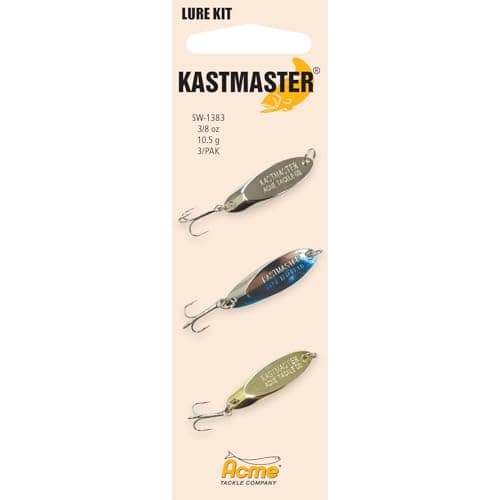
A spoon wobbles because it is curved and unevenly weighted. The Kastmaster runs 1/8 oz at 2 in to 1 oz at 3 5/8 in; the Little Cleo runs 1/4 oz at 1 5/8 in to 3/4 oz at 2 1/2 in. The Kastmaster is the long-casting one; the Little Cleo has the wider, slower wobble.
Reel & Rig earns a commission from qualifying purchases made through links on this page, at no extra cost to you. It does not change which gear we pick or what we say about it. Full disclosure.
Quick picks
| # | Product | Best for | Price |
|---|---|---|---|
| 1 | Best casting spoon Acme Kastmaster Spoon Six published sizes from 1/8 oz at 2 in to 1 oz at 3 5/8 in, machined from solid brass. | Distance, wind, and covering water fast | $18.84 · Check price on Amazon #ad how this is funded · price as of October 12, 2026 |
| 2 | 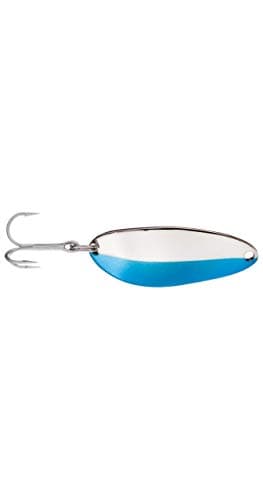 Best wobbling spoon Acme Little Cleo Spoon Five published sizes from 1/4 oz at 1 5/8 in to 3/4 oz at 2 1/2 in, in gold or nickel. | Slow retrieves, cold water, and trout in current | $5.90 · Check price on Amazon #ad how this is funded · price as of October 12, 2026 |
Why a curved piece of metal works
A spoon has no moving parts. Its action comes entirely from geometry: it is curved on one side and its weight is distributed unevenly along its length.
Pulled through water, that asymmetry means water pressure is higher on one face than the other. The lure tips, which changes which face is loaded, so it tips back. The result is a continuous side-to-side roll.
That roll produces two signals at once: a flash as the polished surface catches light from alternating angles, and a pressure wave a fish detects through its lateral line. It is the same two-signal combination our inline spinner page describes, produced by a different mechanism.
The practical consequence is that a spoon has one correct speed range. Too slow and it does not tip at all; too fast and it stops rolling and starts spinning on its axis, which looks like nothing alive and twists your line badly.
Shape decides the action
| Kastmaster | Little Cleo | |
|---|---|---|
| Body | Compact and thick | Wide and thin for its weight |
| Action | Tight, fast wobble | Wide, slow roll |
| Casting | Long - dense and low drag | Shorter - catches air |
| Best speed | Medium to fast | Slow to medium |
| Best in | Wind, distance, warm water | Current, cold water, close range |
The comparison between 1/2 oz in each is instructive. Both weigh the same; the Kastmaster is a compact block and the Cleo is a broad blade. Same mass, entirely different behavior in the water.
Three ways to fish one
Cast and retrieve. The default. Cast, let it sink to a count, retrieve at the slowest speed that keeps it wobbling. You can feel the wobble through the rod, which is how you know the speed is right.
Swing it in current. Cast across and slightly downstream and let the flow swing it, exactly as our inline spinner page describes. The current supplies the speed and the spoon does the rest.
Vertical jigging. Drop it straight down, lift the rod a foot or two, and let it flutter back on a semi-slack line. The fall is where the bite comes, because a spoon falling on slack line flutters and flashes in a way it never does on a retrieve. This is also why spoons work through the ice — see our ice jigs page.
Line twist, and the fix
Spoons twist line. A spoon that occasionally spins rather than wobbles transmits that rotation straight up the line, and after an hour you have a coiled spool.
The fix is the same as for spinners: a small barrel swivel eighteen inches above the lure. Our line twist page covers the four causes and this is one of them.
If you are fishing spoons all day, a ball-bearing swivel is worth the small extra cost over a plain barrel.
Finish: gold, nickel, or painted
Acme publishes the Little Cleo in gold and nickel, which is the standard pairing and the only color decision worth making at the start.
Nickel or silver reflects a bright white flash. Best in clear water and bright light, imitating a silvery baitfish.
Gold or brass gives a warmer, duller flash that carries better in stained water and low light.
The rule of thumb that holds up: bright day, bright water, silver. Dull day, colored water, gold. Our lure color page works through why this is one of the few color rules with a physical basis.
What to pair them with
Spoons at 1/8 to 1/4 oz need a light or ultralight rod to cast properly. At 1/2 oz and up a medium rod handles them.
Monofilament is the sensible line. A spoon carries a treble hook, so the same argument as our crankbait page applies — some stretch keeps small hooks in.
So what do I actually buy?
Buy one of each in 1/4 or 1/2 oz, plus swivels. The two designs genuinely do different jobs and together they cover most spoon fishing.
Acme Kastmaster Spoon
$18.84Six sizes from 1/8 oz at 2 in to 1 oz at 3 5/8 in. The distance and wind option.
#ad how this is funded · price as of October 12, 2026
Acme Little Cleo Spoon
$5.90Five sizes from 1/4 oz to 3/4 oz, gold or nickel. The slow, wide-wobble option.
#ad how this is funded · price as of October 12, 2026
Berkley Trilene XL Monofilament Line
$8.97Mono's stretch keeps a treble hook in on the strike, which braid does not.
#ad how this is funded · price as of October 12, 2026
The picks, in full
Every card below lists the specs we could read off a published page, the URL they came from, and one honest reason you might not want it.
1. Best casting spoon
Acme Kastmaster Spoon
Acme Tackle
Six published sizes from 1/8 oz at 2 in to 1 oz at 3 5/8 in, machined from solid brass.
The published size ladder is unusually complete: 1/8 oz at 2 in, 1/4 oz at 2 3/8, 3/8 oz at 2 5/8, 1/2 oz at 3, 3/4 oz at 3 3/8 and 1 oz at 3 5/8.
Notice how little the length changes across an eightfold weight increase — from 2 in to 3 5/8 in. That is the whole design: this spoon gets heavier by getting thicker, not longer. Dense and compact is what makes it cast a long way into wind.
Acme publishes it as machined from solid brass. Machined rather than stamped means the geometry is consistent between individual lures, which on a bait whose action comes entirely from its shape is the difference between one that wobbles and one that spins.
1/4 oz is the size to start with for trout and panfish; 1/2 oz for bass and pike or for fishing deeper water.
The drawback
The compact shape that makes it cast well also gives it a tight, fast wobble that is less attractive to fish at slow speeds — in cold water a wider-bodied spoon is usually better. Acme does not publish the hook size, and the stock treble is the part most anglers replace first.
Published specs
- 1/8 oz
- 2 in
- 1/4 oz
- 2 3/8 in
- 3/8 oz
- 2 5/8 in
- 1/2 oz
- 3 in
- 3/4 oz
- 3 3/8 in
- 1 oz
- 3 5/8 in
- Body
- Machined from solid brass
- Hook
- Treble; Acme does not publish the hook size
Specs read from Tackle Warehouse - Acme Tackle Kastmasters.
#ad how this is funded · price as of October 12, 2026
2. Best wobbling spoon
Acme Little Cleo Spoon
Acme Tackle
Five published sizes from 1/4 oz at 1 5/8 in to 3/4 oz at 2 1/2 in, in gold or nickel.
Published at 1/4 oz / 1 5/8 in, 1/3 oz / 2 in, 2/5 oz and 2/3 oz both at 2 1/4 in, and 3/4 oz / 2 1/2 in.
The interesting entry is the pair at 2 1/4 in: 2/5 oz and 2/3 oz at the same length. Same profile, very different density — the heavier one sinks faster and holds depth in current, the lighter one flutters. That is a genuinely useful choice to have within one length.
Compared to the Kastmaster this is a wider, shorter body for its weight, and it produces a broader, slower side-to-side roll. That action works at retrieve speeds where a compact spoon has stopped doing anything interesting.
Published with split rings and a treble hook, in gold and nickel finishes. Gold for stained water and low light, nickel for clear water and bright days.
The drawback
The wide body catches air and casts noticeably shorter than a Kastmaster of the same weight, which matters from a bank. It also has a stronger tendency to spin rather than wobble if you retrieve it too fast, and Acme does not publish the hook size here either.
Published specs
- 1/4 oz
- 1 5/8 in
- 1/3 oz
- 2 in
- 2/5 oz
- 2 1/4 in
- 2/3 oz
- 2 1/4 in
- 3/4 oz
- 2 1/2 in
- Hardware
- Split rings and a treble hook
- Finishes
- Gold and nickel
Specs read from Tackle Warehouse - Acme Tackle Little Cleo Spoon.
#ad how this is funded · price as of October 12, 2026
Questions people actually ask
How does a fishing spoon work?
Geometry alone. It is curved on one side and unevenly weighted, so water pressure loads one face more than the other and the lure tips back and forth. That roll produces both flash and a pressure wave.
What size spoon should you use?
1/4 oz for trout and panfish, 1/2 oz for bass, pike or deeper water. The Kastmaster gets heavier by getting thicker rather than longer, so weight and profile are largely separate decisions.
Gold or silver spoon?
Silver or nickel in clear water and bright light, gold in stained water and low light. It is one of the few lure color rules with a physical basis, because it is about how much flash carries through the water.
Why does my line twist when fishing spoons?
Because a spoon retrieved too fast stops wobbling and starts spinning on its axis, transmitting that rotation up the line. Fit a small barrel swivel about eighteen inches above the lure.
Read next
Sources
Prices on this page come from the retailer at request time and change without notice. If we cannot get a live one we say “check price” rather than show you a number that has gone stale. How we pick.